Showing posts with label vintage paperback. Show all posts

Sunday, April 23, 2017

VINTAGE PAPERBACK OF THE WEEK: Elmer Kelton, BARBED WIRE (1957)

When he died in 2009, Elmer Kelton was widely hailed as the best western writer of his time, by which presumably was meant, in the face of whatever claim might be made for Larry McMurtry, that Kelton was top hand among genre specialists. Kelton belonged to the last generation who learned their trade in the western pulps, a peer of Elmore Leonard and John Jakes. Most of his pulp stuff appeared in Ranch Romances, understandably given that magazine's longevity and frequency. He was still placing stories in the Thrilling Group's remaining pulps when Ballantine published Barbed Wire, their third Kelton novel, in 1957. It resembles a Ranch Romance less than it does, at least thematically, the T. T. Flynn novel and Anthony Mann film The Man From Laramie. It's more Mann than Flynn, I think, because the protagonist reminds me of Jimmy Stewart's flawed, driven heroes. Doug Monahan is an ex-rancher who's gotten into the barbed wire business; he and his former ranch hands bring the wire and string it up when ranchers or farmers want to enclose their land. When he tries that in Kiowa County he runs afoul of Captain Andrew Rinehart, the local patriarch who took the land from the Indians and wants to keep it an open range for his cattle. When Rinehart's men break up Monahan's wire-stringing camp and kill his beloved Mexican cook, while Doug's employer scurries away like a coward, he provokes a slow-burning feud. Monahan isn't out to kill anyone, but he refuses to be driven out and strives relentlessly to interest the locals in barbed wire. He finds a customer in Noah Wheeler, an old war buddy of the Captain's who's been given freer rein to run a farm when others wouldn't get away with it. Wheeler's grudge isn't with the Captain but with a smaller "range hog" rancher whose scrub bulls get in the way of Noah's ambitious stock breeding plans. But Rinehart, egged on by foreman Archer Spann, sees any fencing as an insult to himself and his legacy. Along with his men, he's got the tenuous backing of his hand-picked sheriff Luke McKelvie, torn between loyalty to his patron and a growing appreciation of the rule of law. Taking his informal title of "peace officer" seriously, he tries to discourage Monahan and Rinehart from provoking each other, but there are too many forces in play, as well as the two antagonists' irreconcilable wills, for the well-meaning lawman to control.


Two things stand out in this first Kelton novel I've read. The first is his eye for the details of hard work, acquired from the ranch background touted on the back cover. The opening pages will give you as thorough a description of digging post holes as you'll probably ever want. I appreciate that sort of immersive detail, which explains why I find myself preferring ranch stories to generic gunfighter tales. The second standout is his consideration for both sides in the barbed-wire debate, though he clearly sympathizes with those characters who see the fencing off of land as a necessary and progressive step. He also allows readers to understand, if not agree with, the attitude of opponents like Rinehart, who becomes a figure of some pathos as he grows more conscious of his failing powers and more concerned over his wife's delicate health. Barbed Wire is almost a tale without a villain, but Kelton's approach to his villain is still unusual. He emphasizes that Archer Spann is a superior foreman, legitimately skilled in all the aspects of that job, as well as a clean liver who never touches alcohol. His fatal flaw is his "littleness," his inability to be "big," by which Kelton means a defensive, spiteful selfishness that leads him to rob a discharged cowhand of the $300 he'd allowed the ranch to withhold as a savings account. Spann is unable to transcend the bitterness of his upbringing and always looks for someone on whom to take out his undying resentment. Loyal to Rinehart in the hope of inheriting the R Cross Ranch from the childless rancher, Spann constantly urges the old man to escalate the campaign against Monahan and Wheeler, finally betraying his irredeemable mean streak when he gun-butchers Wheeler's prize cattle and tramples Wheeler's daughter in the novel's most brutal scene. It's the most brutal scene not simply because it's violence against a woman but also because, after the murder that starts the feud, Kelton goes out of his way not to kill major characters.

I got the sense that Kelton was consciously defying genre expectations, creating situations and relationships that make the reader almost certain that this or that character will die, only to deny the cheap catharsis of death without seeming to contrive his way out. It's not just about denying violence: Rinehart's wife is introduced as frail and at least momentarily bedridden, and once you tag Rinehart as a tragic antagonist you expect him to lose the thing he loves the most, but she simply gets better instead. Kelton finally teases her leaving Rinehart instead of dying on him. Likewise, you think that Wheeler's son Vern, the Rinehart cowhand robbed by Spann, is surely doomed to be killed by the foreman or one of his minions, especially once he hooks up with a childhood friend turned rustler, but for all that Barbed Wire is a metaphor for generational conflict as a metaphor for the nation's progress, Kelton's ultimately more interested in reconciliation than revenge. His main characters -- even Spann has a guilty conscience, though it never stops him -- are intelligent and empathetic enough to see when they've gone too far. Monahan is willing to quit the barbed-wire business after Noah Wheeler gets beat up, and has to be talked out of blaming himself for the collateral damage from his war of wills with Rinehart, whose stubbornness takes longer to break down but does so nonetheless. Not even Spann is killed, and the end of Barbed Wire feels no less cathartic for that. Having read this early Kelton, and knowing that he had a half-century of writing to go, I suspect that there probably was some reason for all the acclaim he received at the end of his trail.

Monday, April 17, 2017

VINTAGE PAPERBACK OF THE WEEK: Richard S. Prather, JOKER IN THE DECK (1964)


Richard S. Prather didn't publish in the pulps. Instead, after establishing himself as a novelist and the creator of Sheldon "Shell" Scott, he landed stories in the hard-boiled crime digests of the 1950s and 1960s, including a short-lived Shell Scott Mystery Magazine. Prather maintained a blistering pace through those two decades -- Joker in the Deck is one of three 1964 novels -- but slowed down afterward, partly due to disputes with publishers. Shell Scott became a logo as well as a character, his cotton-topped head adorning every new paperback original. He's a ladies' man but not quite the swaggering stud one might expect from hard-boiled detective stories from his heyday. Joker sometimes exposes an anxiety bordering on the naive in the face of aggressive or deviant sexuality, as if Prather's audience were slightly younger than the average. Shell is also a political conservative who probably voted for Barry Goldwater in the year Joker was published. His commiseration here with a possible bad guy lamenting the huge, socialistic tax burden the government imposes on him may be the closest Shell Scott comes to empathizing with criminals. Usually he gets a bit sanctimonious about crime, particularly the drug trade, when he isn't in his more typical happy-go-lucky horndog mode. You might be able to divide detective and crime fiction into two categories: those stories that try to humanize criminals, whether they're the protagonists or not, and those that make comic-book heavies of them. In the few Shell Scotts I've read Prather falls into the latter category.


In Joker Shell gets involved in real estate intrigue on a coastal California island. He's getting deep into a game of strip poker with his buddy Jim Paradise and two dames they met at a promotional event when Jim gets the news that his business partner, who proves to be his brother under an alias, has been murdered. In short order someone shows up to murder him, but Shell saves the day. In the aftermath, however, Shell fails to notice someone dragging the would-be killer's body away. Brea Island is shared by Jim's development project and a baby-food factory that appears to be improbably mobbed up. The mob guys, led by an ex-con who learned organic gardening in stir, run the Da Da plant for its owner, who arranged with Jim's brother to shuffle ownership of the island so the baby-food magnate as part of an elaborate tax dodge. Shell may hate high taxes as much as any red-blooded American -- and in those days they were sky-high compared to now -- but he also knows lawbreaking when he sees it. He also suspects that there's more going on on the island than meets the eye. Are the mob guys using the baby-food plant as a front for drug smuggling? Has oil been discovered on Brea Island? Either could explain the book's lethal attempts to consolidate ownership of the island.

As he pieces the story together Shell maintains an interest in the two women who played strip poker with him. Laurie is the good girl of the two while Eve (introduced on the opening page as "a long-legged, voluptuous looking, slinky, busty hippy bomb, an Adam bomb") is too aggressive for Shell's taste, tempting though her body is. For all his presumed experience, Shell seems to have an adolescent's sense of discovery every time he meets a beautiful woman, as well as a detective novelist's impulse to attempt original descriptions of female pulchritude. It's with a "galvanizing shock" that the big he-man discovers that Eve isn't wearing a brassiere in one scene, and "when Eve leaned forward and -- not aware of what she was doing, I presume -- sort of wiggled her shoulders joyously from side to wild side, there was almost as much commotion under that blouse as two people kicking each other under a blanket."  There's a different sense of discovery, even as he remembers a past experience, when Shell enters a suspicious niteclub. Presumably his memory of San Francisco prepares the reader for what follows. The tone is set by a weird woman with "a face to be presented only to steel mirrors, the face on the bride of Death." Shell shudders as he watches this apparition chat with Eve, and his evening grows only more shuddery.

I moved across the room to the bar, a bit nervously, because for some reason I didn't want to be seen, not by anybody who knew me. I didn't know why for sure; I just knew I didn't want to be seen. Tension built up in me gradually, rose along my spine and gathered in a knot at the base of my skull....I looked around. At men and women, sitting at tables, drinking, talking. There seemed nothing unusual. But then the scene seemed to shift. It was the same -- yet different. I had looked right at it, it was there in front of my eyes, but it hadn't impressed me until now. Men and women were sitting at tables, true; but at no table was a man sitting with a woman.

Really, Shell? This is your 24th novel, and you've had more adventures than that, and it takes you that long to notice you're in a gay bar? Richard Prather is a far better writer than John B. West, yet on this point I prefer Rocky Steele's hard-boiled contempt for and familiarity with the gay scene to Prather's horror-movie buildup to his awesome realization. The issue isn't whether one is more or less homophobic than the other, but that a hard-boiled guy like Shell really ought to take such things for granted, if not in stride, at this point in his storied career. Maybe more devoted readers can tell me if this is typical of Shell Scott -- this overall feeling I had on reading Joker in the Deck that Prather's hero is kind of a big kid at heart. That point aside, I liked Joker quite a bit. Prather seems to write authoritatively on the legalistic shenanigans involving the transfers of title to the island, and on other subjects he wears his research lightly. In a story like this expertise (or the convincing simulation of it) help hold the reader's interest because he feels he's learning something about Shell Scott's world as well as this particular mystery plot. I may not agree with Shell's politics but I accept them as an artifact of his time -- by which I don't mean that they're obsolete -- and Prather has as much right to incorporate them into his fiction as anyone to his left. I have another Shell Scott on my shelf -- to give things away a bit, it's actually half a Shell story -- and on the strength of Joker I'll probably be getting to that one sooner rather than later.

Thursday, April 6, 2017

VINTAGE PAPERBACK OF THE WEEK: Georges Surdez, THE DEMON CARAVAN (1927)

Surdez wrote many long stories for Adventure that could have passed for novels but published in long form only rarely. As far as I can tell, Demon Caravan (the title refers to a type of desert storm) was written for publication as a novel instead of appearing in the pulps first. It reads as if written for a different market, which isn't necessarily to Surdez' advantage. It's more old fashioned in its construction than his contemporary pulp stories, in that it takes quite a while for the actual story to begin. Novelistic conventions require an elaborate establishment of the protagonist, Captain Paul Lartal, in his new environment, an Algerian colonial outpost, and the introduction of several nearly interchangeable supporting characters who'll be left behind when Lartal goes on the novel's true mission. There's a good desert battle scene in the middle of this, but nearly half the 214 page novel (that's the page count for the 1951 Dell paperback) is buildup for Lartal's expedition into a hidden oasis.

Some collectors are fond of Dell's back cover maps, but give me more hard-boiled copy any time.


We're somewhere between Lost Horizon (yet to be written) and L'Atlantide (which Surdez may have read in the original French or in its English translation in Adventure) when Lartal, accompanied by his faithful Arab sidekick Tlemsani reach this desert utopia. What we have here is a progressive Muslim community founded by people tired of war, led by a charismatic chieftain and his French son-in-law, a fugitive from his own army for killing a fellow officer. When Lartal arrives the son-in-law, who converted to Islam and took the name Si Khalil, is the leader who consults with a representative assembly of guild elders and the like. Just as Si Khalil in his youth fell for the chieftain's daughter and married her, so Lartal is smitten with Si Khalil's daughter Morjana, for whom her father has been seeking a suitable mate. There is, however, a rival suitor who threatens to disrupt Si Khalil's utopia. Omar ben Azziz is a type the world has come to know all too well in the 21st century. Surdez calls him a Senussi, but we'd call him an Islamist. "While all are Mohammedans here, tolerance has prevailed," Si Khalil explains, "The young wish to change that.

Of late there has come about a renewal of religious fervor. There are more ways than one to interpret the Koran. The military spirit has spread among the schoolboys in some way. Under their tuition, the boys are growing up to hate strangers, men not of their faith, although they have never seen them. Instead of warriors for protection, they maintain we should send them out for conquest.

Omar is the sort who has a quote from the Koran as the self-serving answer to every question. He uses the arrival of Lartal to stir up dissent against Si Khalil, arguing that the granddaughter of the great founder, though half-French herself, should not be married off to an infidel outsider. With a pessimism that probably appears prophetic now, Surdez shows Si Khalil's position crumbling until he decides that he, Morjana and Lartal should escape and seek shelter with the French. Omar's ascendancy has split the ruling family as Yusuf, Si Khalil's son by another mother, takes the side of the supposed holy man. Over the second half of the novel Surdez has been ratcheting up the tension, and in the final chapters he lets rip as the good guys make their break, though not without casualties or without a timely and brutal act of filial piety by the conflicted Yusuf. The second half of Demon Caravan makes the whole worth reading, so long as you understand that it's more romantic adventure than pulp fiction. It's still unmistakably Surdez, and it makes you sadly confident that he would have handled himself well in the era of paperback originals had he made it there instead of dying shortly before at the age of 49.

Tuesday, March 14, 2017

VINTAGE PAPERBACK OF THE WEEK: C. N. Heckelmann, LAWLESS RANGE (1945-8)


The publishers of this 1948 paperback desperately want you not to think of it as mere pulp fiction. Let's go right to the back cover to see the case they make.


Lawless Range, then, is in the great tradition of Cimarron and The Ox-Bow Incident, or so Signet claims. It is literature of a new kind, as the first-page blurb reiterates: "Lawless Range is typical of the new brand of Western fiction -- literate and yet suspenseful, adult and action-packed." I'll give them "action-packed," but the rest is a load of bull. If this isn't pulp, then I don't know what Signet's copywriter thought pulp was. Is it not pulp if the author doesn't use the embarrassing yuhs and tuhs? Is it literate when two potential lovers debate their attraction thusly?

"In my own life I have known few women," he told her, "Perhaps that has been to my disadvantage. In any event it has always been in my mind that when a man kisses a woman, he does so because his intentions are serious, because he regards her as his woman and she accepts him as her man."
Diana's cheeks whitened and that pallor deepened, by contrast, the rich, red line of her mouth. She stepped nearer, suddenly enjoying the uneasy storm behind his slate-gray eyes.
"You're a strange man, Jim," she said, and now her eyes were mocking and inviting him, "Your belief leaves no room for the man and woman who are attracted to each other at first sight and must answer the call of their own nearness because they recognize it as a force bigger than themselves and not to be ignored." She stopped and put her hands on his chest. "Oh, Jim, why are we here talking when --?"

These two had kissed impulsively only a page before. Their almost academic exchange is a typically stilted romantic scene from the novel, though Jim, the hero, will end up with another woman, Sally the virtuous, tough-minded schoolteacher. Their courtship is complicated by the fact that Jim, a federal marshal operating undercover, killed Sally's brother just before the story started. His mission is to discover who's behind a rustling ring, and his refusal to reveal himself makes nearly every male character suspect, since all suspect him of being an outlaw and are hostile to him. It's a standard whodunit with a bunch of red herrings to blur Jim's trail, rather like a Texas Rangers novel with love scenes. The novel is not a paperback original but was first published in the Canadian Sunday-supplement magazine Star Weekly in 1945, and then in hardcover by Arcadia House, a company that specialized in genre fiction for five-and-dime "commuter libraries." I don't think I've read anything by Heckelmann before but I'll be reluctant to try more after this one. Whether Lawless Range is bad pulp or bad literature, merely inept or hopelessly pretentious, it's bad. There are more tin-eared sentences in this 163 page novel than I've seen collected between two covers in some time. Heckelmann writes drama badly and action badly.

Esmond's talk whipped at Sally, flat and disturbing.

Hockett cursed and his wide, stocky frame bowed in a crouch. Rashness was pinching his muscles, turning him wild and desperate.

She had hardened herself against him and the solid thrust of her contempt was an unscalable barrier between them.

Reed's gun canted upward in his fist. He felt it buck solidly against his wrist, saw the red froth crawl from the bore.

[and on the very same page...]

Red death was crawling from Braley's gun.

Nothing says "fast-action western" like stuff crawling out of guns. I might charitably assume that Heckelmann wrote this in a hurry and for a quick payday, but that's not the sort of western novel Signet was trying to sell with its ambitious blurbs. I might not be so hard on Heckelmann if his paperback publisher hadn't told me to expect something better -- not only something better written but something more mature, more researched, more authentically colorful. The sort of western novels Signet describes actually did exist at this time, but Lawless Range just isn't one of them.

Sunday, March 5, 2017

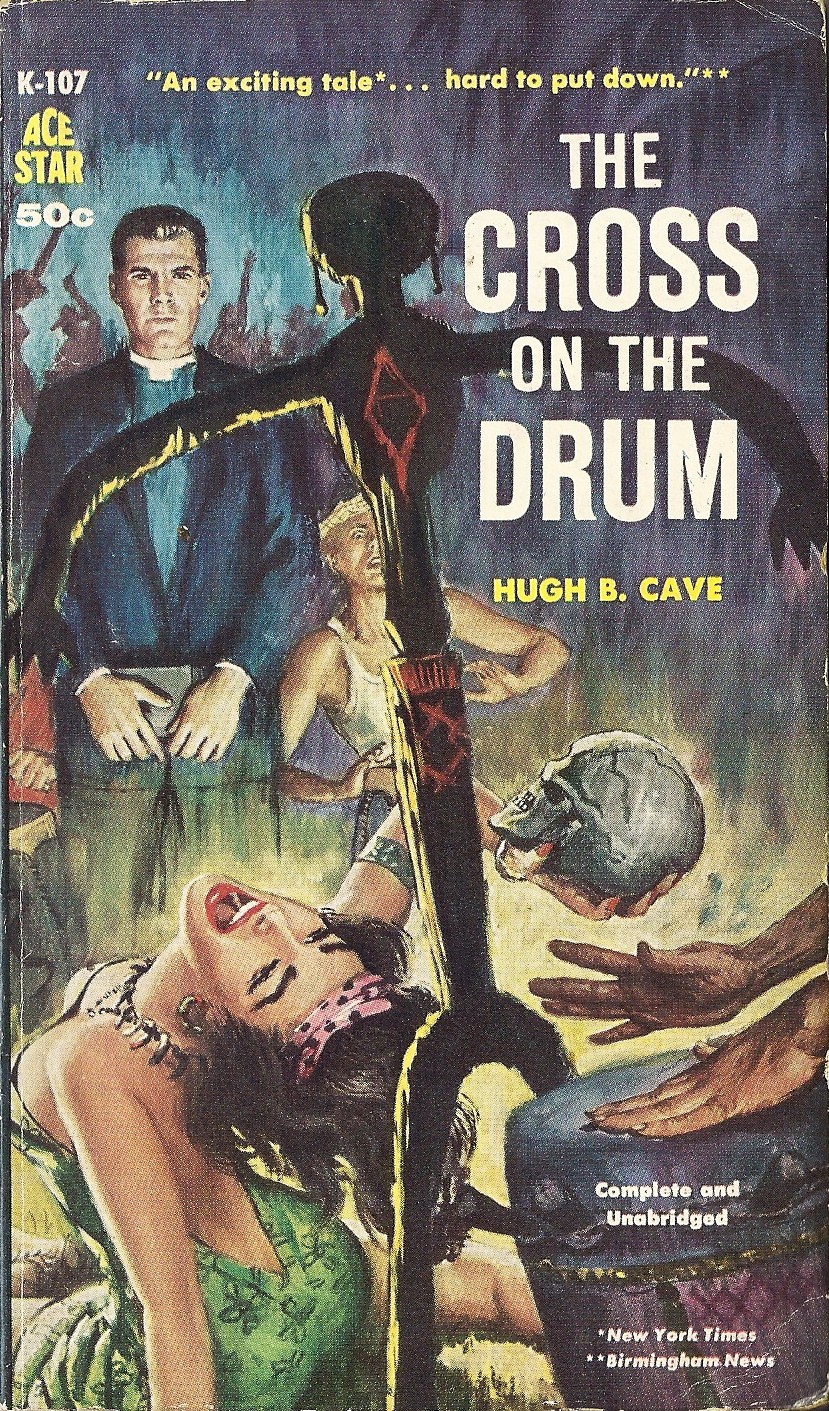
VINTAGE PAPERBACK OF THE WEEK: Hugh B. Cave, THE CROSS ON THE DRUM (1959)

Cave's publishing career lasted nine decades, his first stories appearing when he was 19, in 1929, his last appearing in the 21st century. By the 1950s, with the pulps dying around him, he graduated smoothly to the slicks, only to be re-embraced by pulp fans in his old age, long after his main slick markets had vanished. For a time he was a mainstream author, known both for a nonfiction study of Haiti and for The Cross on the Drum, reportedly a best-seller and presumably based on his personal experience of Caribbean life. This is a mainstream novel, first published in hardcover, and in certain respects a conscious repudiation of pulp tropes. It addresses one of the classic pulp subjects, the clash of cultures, but takes an un-pulp approach to it.


Cave himself probably wrote pulp stories treating voodoo as a horror, and if he didn't many others writers did. Many more have used the generic "witch doctor" as the villain of stories in many settings, representing the unreasoning, reactionary superstition of primitive people.  Fanatic or fraud, this type is usually shown selfishly if not cynically exploiting his people's credulity for his own benefit. In The Cross Cave departs from that formula by stressing the similarities between his houngan, Catus Laroche, and his Christian missionary, Barry Clinton. For both men, religion is less a matter of dogma than service. Each persists in his beliefs and practices in spite of growing doubts because both want to help the people of Isle du Vent. Each is painfully aware of how limited his ability is to materially help the desperately poor people of the island. Each is also guardedly critical of the other's faith while withholding judgment on each other as individuals. Catus zeros in on the apparent absurdities of the Gospel while Barry finds a weak spot in the apparent indifference of the loa to the material or spiritual well-being of the people they possess and take sacrifice from. It's a measure of Barry's own doubt, however, that he can't simply dismiss all the behaviors of possessed people as mere shamming. In any event, it's not really a high priority for Barry to denounce vodun (Cave's usage) or the loa. Recognizing how vodun had incorporated Catholic saint worship, he'd be satisfied to have Catus's people add Jesus to their pantheon in order to learn Jesus's moral lessons. In turn, Catus wants to learn more about Christianity, if only to understand his antagonists better, but he really appreciates what Barry is able to accomplish simply as a glorified medic. While most of the novel is told from Barry's point of view, Cave lets us into Catus's head often enough for us to understand that these holy men are basically two of a kind.

Barry and Catus probably would work out a modus vivendi if not for the rest of the plot. An ambitious native, Pradon Beliard, tries to play the two off each other to advance his own interests. The island's white plantation boss, Lemke, backs Beliard's efforts to subvert Barry's mission, growing increasingly hostile as he suspects his estranged wife Alma of being attracted to him. Catus's sister Micheline has had an affair with Lemke and has the hots for Barry, despite Catus' hot hostility to the idea of her sleeping with white men. When Barry definitively spurns Micheline -- he actually has fallen for Alma -- she joins forces with Beliard with some explosive gossip. She'd been privy to a confidential conversation between Barry and Catus after the death of a village girl, when Barry had explained that the girl could have survived had Catus brought the girl to him for modern medicine. Barry promised to keep this secret in order not to undermine Catus's position in his community, but Micheline now blabs this to Beliard, so he can say that Barry's been telling the story all over. Worse, she tells Beliard that the child she's carrying is Barry's, when it's actually Lemke's. Once Catus appears convinced of this double betrayal, both Barry's mission and his life are in jeopardy....

When I said that Cross on the Drum was in some ways a conscious repudiation of pulp, I had in mind at least two scenes when Barry compares his situation to pop culture cliches. Micheline's disheveled seduction attempt, following their survival of a boat wreck, reminds him of scenes from numerous "South Sea" movies. Later, after days of menacing drumming abruptly stop, and one of Barry's few remaining friends fears the worst, the missionary reflects that this "isn't one of those movies in which the beleaguered  explorers crouch in the jungle, surrounded by howling savages." Cave underscores this point by having Barry and Catus eventually settle things like reasonable men, but before that can happen the story depends on two classic coups de pulp. First, Barry's faithful housekeeper poisons her nephew Pradon Beliard -- non-lethally, natch -- in order to terrify him into confessing his culpability in all the novel's conspiracies. Second, after the housekeeper has saved Barry from eating a poisoned chicken, the missionary decides to play on the islanders' superstition and awe them into halting any attack. He has the word spread that he actually did die by poisoning, so that his appearance outside his church as the islanders converge upon it can look miraculous. He makes a point, however, of promising Catus after the fact that he'll tell the people the truth at his next service. His ultimate victory, Cave tells us, comes when Catus calls him mon frere rather than mon Pere. The novel closes on a note of peaceful coexistence, with the spiritual development of both divines to be continued. Despite the melodramatic climax, The Cross on the Drum often succeeds in what I take to be Cave's goal of transcending pulp formulae and the conventions of popular fiction in general while presenting a remarkably non-judgmental comparison of Christianity and vodun. I wouldn't say it really rises to the level of literature, but it's an earnestly entertaining, briskly plotted story that held my interest for all its almost 300 paperback pages. It may not so much transcend pulp as illustrate how pulp fiction could evolve as a pulp author learned more about the world and its people.

Sunday, February 26, 2017

VINTAGE PAPERBACK OF THE WEEK: Jay Scotland, STRIKE THE BLACK FLAG (1961)


John Jakes, who turns 85 this year, is one of the last-surviving writers to appear in an actual pulp magazine, if not the last living western pulp writer. He broke in while still a teenager and was successful enough to have his name mentioned on some magazine covers. Yet when he remade himself into a historical novelist at the end of the pulp era, he was told that his name was to bland for the genre. Little did that editor know that John Jakes would become one of the most successful brand names in historical fiction during the 1970s. In the 1960s, we got "Jay Scotland." One of his subjects was the last days of piracy in Jamaica in the early 18th century. This happens to be the subject matter of one of my favorite current TV shows, the Starz series Black Sails, now in the middle of its final season. The gimmick of Black Sails is that the historical pirates of Nassau interact with characters invented by Robert Louis Stevenson, making he pirate saga a prequel to his beloved novel Treasure Island. It takes creative license with the historical characters on the premise that their careers would be altered by the interventions of both the Stevenson characters and entirely original characters invented for the show. For instance, Edward "Blackbeard" Teach has just made his exit, but instead of going down fighting, as is understood to have been the actual case, he is captured, along with fellow historical figures Jack Rackham and Anne Bonny, and is put to death by keel-hauling on the direct order of real-life pirate nemesis Woodes Rogers. Jakes/Scotland takes similar license with history by introducing his own hero, Gideon Clark, and making him quartermaster for historical pirate Charles Vane, his exploits and those of others eventually changing Vane's fate. When I started watching Black Sails, I noticed that the Nassau pirates hadn't been used much in movies, though Anne Bonny provided a vague template for numerous female pirates. The Starz show has succeeded so well at making them tremendous antiheroes that I've been left wondering even more. Unfortunately, that makes it hard not to judge Strike the Black Flag's versions of these characters by what's been done on television, and to find the "Scottish" pirates somewhat wanting.


Jakes' Charles Vane is a dissolute brute with none of the thuggish charisma or redeeming heroism that Zach McGowan gave the character before his third-season exit. The historic Vane was hanged rather ignominiously, but the Black Sails Vane becomes a martyr embodying resistance to Redcoat tyranny. In Strike the Black Flag Vane is murdered offstage (apparently) by Clive Steed, the novel's main villain and a fictionalized version of Stede Bonnet, the dilettante pirate who consorted with Teach and Vane. As quartermaster of Vane's ship, Gideon Clark is a target for the ambitious Jack Rackam (to use Jakes' spelling), who again has none of the redeeming qualities of the TV Rackham. Historically Rackham and Anne Bonny were a pair, and Black Sails treats them that way -- sometimes with an extra woman thrown in as, apparently, in real life. Strike the Black Flag gets there eventually, but the immediate problem Bonny poses for Gideon Clark is as the likely avenger of her husband James Bonny, a member of Vane's crew whom Clark had to kill in self-defense. It's pretty universally acknowledged that Clark is in a world of trouble once Anne finds out what's happened. As a female pirate, and one who reportedly showed more courage and ferocity than Calico Jack Rackham, Anne Bonny has fascinated people for the last 300 years. Unsurprisingly in our time, Black Sails presents her as something of a superwoman, just about unstoppable in hand-to-hand combat. Just in last week's episode, forced to fight a burly, sledgehammer-wielding British marine with no weapons of her own, Anne manages to spark the liberation of her fellow pirate-captives with a couple of bits of broken glass, despite taking a terrible beating. Jakes' Anne is not quite this sort of female fury, but Gideon Clark would "sooner swim in a hurricane than face her....A woman who learns to live among men like us must have twice the craft and savagery of the male." Yet one someone finally attacks him, he's surprised to find that it's Anne, she of the "impudent breasts" and the "stormy grey beauty of her eyes." She's vicious with a dagger but vulnerable to a forearm to the jaw. The eventual alliance of Anne and Jack creates a problem for Gideon Clark's future, which Jakes leaves open-ended with a sequel in mind. I'd rather have that sequel than the actual book, since Clive Steed never manages to fascinate like the historical pirates.  Stike the Black Flag wraps up with Clark rescuing the novel's good girl Clarissa Harlow -- erudite Jakes named her after Samuel Richardson's epistolary heroine -- from Rackam and Clive Steed's clutches, while Blackbeard goes to his fate, only for a lookalike to scare off the Spanish fleet at a convenient moment. Black Flag strikes me as a novel written mainly for the money, but conscientiously so, as his Author's Note explaining the mix of fact and fiction testifies. I didn't find it very memorable, but it was doomed to an unfair comparison once I saw Black Sails first.

Wednesday, February 15, 2017

VINTAGE PAPERBACK OF THE WEEK: John B. West, AN EYE FOR AN EYE (1959)


Here's how Signet introduced readers to their new author:

JOHN B. WEST was born in Washington D.C. and educated at Howard University and Harvard University. He holds five academic degrees. Dr. West is a specialist in the prevention and treatment of tropical diseases, and he has a general practice in Liberia, Africa. He also owns and operates the Liberian Broadcasting Company, is President of the National Manufacturing Company and President of the Liberian Hotel and Restaurant Corporation. An Eye for an Eye is his first book.

How many paperback readers were sufficiently culturally literate to recognize what "Howard University" and "Liberia" signified? Did they realize they were reading a hard-boiled detective novel by a black man? It probably didn't matter, because West manages the feat of writing an utterly generic crime story in a presumably lily-white milieu, with no reflection whatsoever of his own experiences as a relatively privileged black man. A doctor's son, he first went to Africa in the early 1930s, where he became a special public health advisor to Emperor Haile Selassie. After returning to the U.S. and earning an M.P.H. from Harvard, he became the first black man to be appointed a district health officer in New York City. He went to Liberia during World War II as a major in the Army Medical Corps and stayed on after the war as an important figure in that country's public and private sector. The nearest thing I could find in his biography to a detail relevant to his detective novel career was that he recommended a family friend, Kansas City policeman Leon Jordan, to take over the police force in Monrovia, the Liberian capital. But if West paid special attention to police work it doesn't show in An Eye for an Eye. In this first of five novels produced before his 1960 death in a traffic accident, he gives us the generic tough but fair cop willing to give his detective the benefit of the doubt sometimes, as well as the hothead who hates the shamus's guts for some reason and longs to have him put away. You've seen them hundreds of times if you've read books like these.


The shamus himself is Rocky Steele, ex-prizefighter and more recently the winner of the Congressional Medal of Honor for valor in the Pacific theater of World War II. He remains a sort of celebrity whom people often recognize from his fight days, but he struggles, as do all of his kind, to keep his office afloat and his pretty secretary paid. A big payday is promised when he's hired to protect Norma Carteret, a sexy heiress, from a kidnap threat issued to her father by extortionists. Rocky takes the job despite a phone warning from a rough voiced man, hereafter "Rough Voice." His first night on the job he bangs Norma. The next day she's dead. Naturally Rocky's a suspect, but naturally Rocky's a better detective than the police, though it takes some roughing up by gangsters to clue him in that he should be looking for the bullet that killed Norma. After roughing up some gangsters they clue him on some names that put him on the vengeance trail, for he has sworn to avenge Norma blood for blood.

An Eye for an Eye is a bloodbath in the Mickey Spillane style. Rocky Steele is fond of gut-shooting people for maximum suffering when they deserve to die, and of course as a private dick he takes frequent beatings himself. Steele's detective method usually consists of learning things from stoolies or beating them out of goons. Those in the latter category that he doesn't kill are soon dispatched by their unforgiving employers. These violent encounters are punctuated with comic-book level tough-guy dialogue as the mystery unravels with blunt monotony. Occasionally, however, West will come up with a scene that at least has some camp value. One such moment comes when Rocky, with secretary Vicky in tow, visits the gay bar ("Fairyland," a cabbie calls it) run by one of his informants, Benny the Dyp. Benny (the "Dyp" is for "dypsomania") will tell Rocky that the man he's after killed Benny's brother back in Chicago, and he will urge Rocky (who needs little urging on this subject) to kill the man, but also to make sure that the man knows before he died that Benny ratted him out. It's in his desire for revenge for his brother that Benny seems to Rocky (he narrates, natch) to almost be a man. Meanwhile, Vicky receives some unwanted attention from the sapphic contingent.

Vicky was taking it in stride now. She could see from the exaggerated masculine swaggering of the half-females and the overdone switching of the half-males that were were in a joint for the third sex. And the fourth. All the men in the place were drooling as they watched me with my arm around Benny, and all the women were giving Vicky the once over....

Vicky was getting the works, too. A wrestler in pants, with two bumps on her chest big enough to hide behind, had slipped up on Vicky's blind side and was giving her the once over with a pair of hands that knew what they were looking for. I could almost see the shivers running up and down Vicky's back. This was gonna be a new experience for her. And I had a hunch it was gonna be a new experience for the wrestler, too. Vicky was frozen stiff, and that was an incentive for her newfound playmate, who sensed virgin territory to be conquered. But she didn't know Vicky. Under that sleek, clinging dress that made her look as soft as the two peaches that stood out on her chest, there lurked a familiarity with judo and jujitsu that I'd taught her. and what she didn't want to give, nobody got. Benny saw it coming, too, and he tittered some more.

The wrestler cooed something in Vicky's ear, and got the best backhand slap in the kisser I'd ever seen Vicky dish out. The wrestler's eyes blazed and she made a grab for Vicky's shoulder, and then mild hell broke loose. Vicky caught her by the hand, and the first thing anybody knew the wrestler was flat on her flat backside, looking up at Vicky from under a table, with a knot rising on her head. I couldn't help laughing out loud. From that point on. Vicky figured to be safe in that joint. Poor Vicky was as red as a sunset in Moscow.

For the record, however, the only "fags" in the novel are Rocky's cigarettes. There's something that'll always be funny about that scene, but at least West meant it that way that time. The scene I found funniest of all is almost certainly unintentionally hilarious. A sub-boss, Tanner, has the drop on Rocky and is busy taunting him when a "well-stacked" woman sneaks into the room. Rocky recognizes her as someone who had given him some info a short time earlier, and he suspects now that she sold him out to Tanner. When she first catches his eye Tanner thinks Rocky is trying to distract him with a variation on the "Look! Behind you!" gag, but he's not going to fall for it. He thus remains arrogantly oblivious as a mortal drama plays out behind him. I'll spare you the full length of it and start in the middle. The broad, clearly hurt bad, approaches Tanner but faints twice in the first paragraph. Here's the second.

She moved again. Slowly -- so slowly -- she pulled herself up once more to stand beside the chair. I could see her better now -- it was like cold clay, and there were blue welts under both eyes. Her hand was pressed against her left breast. She held onto the chair and took a deep breath like it hurt, then she leaned against the chair and slid to the floor again. My pulse was hammering in my ears. I couldn't see why Tanner didn't hear it. She couldn't keep coming like that. She was making it on sheer will power, and it couldn't hold up -- not long enough for her to make that last ten feet. Only ten feet now between me and death. She sat on the floor beside the chair for a minute or two, like a woman in a daze, then she started to pull herself up again, and every muscle in my body was pulling with her. She couldn't make it any more. She slid back down again, exhausted, and my hopes slid with her, but she didn't know how to quit. She came toward us on her hands and knees, every movement spreading pain across her face.Four feet from Tanner's stool she washed out again, flat on the floor, her pale face buried in the warmth of the rug. It was all I could do to keep from trying to make it over the goon with the gun to help her, but I waited, working overtime to keep staring at Tanner so my eyes wouldn't give her away. Every nerve and muscle in my body was tense as a violin string. It was a full five minutes this time before she moved again, pushing to her knees and crawling on toward Mike Tanner's back. Three feet. Two. She stopped. One foot!...

The poor woman needs to make it all the way because she has no gun, and must press her lipstick against Tanner's back to make him think she's packing. I dunno: maybe you found this genuinely suspenseful, but I couldn't help visualizing the scene, imagining it all playing out in a single take and how melodramatically ridiculous the dame would look staggering and stumbling around while this idiot Tanner, enthralled by Rocky's hypnotic gaze, doesn't notice. Apparently he couldn't hear her falling over the roar of Rocky's pulse. There are many ways in which West proves himself a bad writer, from the questionable time management of his plot -- it always seems like a lot more time has passed than Rocky claims -- to his embarrassing renderings of Irish brogue and drunken slur (change every "s" to "sh" and you've got it), but this one takes the cake. Chester Himes he is not. And yet I suppose it was transgressive in some mild way for a black writer to imagine the adventures of a white man, or especially to imagine him making love to a white woman. Believe that or not, you might still believe that West's success as a mystery writer, however tragically short-lived, put him in the vanguard of racial progress just as the Civil Rights movement was gaining strength, for in Signet and its readers he had found an apparently undiscriminating audience.

Tuesday, February 7, 2017

VINTAGE PAPERBACK OF THE WEEK: George C. Appell, THREE TRAILS (1958)

As it happens, Appell's first published story appeared in Collier's in 1944, but apart from a couple of stories in Esquire he was a pulp writer from then on, working the western mags until almost the bitter end of the era. Like many pulpsters he moved into paperback originals (and the occasional hardcover) as the pulps lost favor. I liked most of the stories and novelettes of his that I've read, so I was eager to give one of his long-form works a try. Three Trails is a grim tale of a manhunt spiraling out of control. At the behest of a federal commissioner, a corrupt marshal assigns three deputies to capture Shad Kruger, a gunman who's worked on and off as an enforcer for the marshal. Naturally he assigns his three most expendable men to the task. Kendon Sheppard is a rival to the marshal, even though his father was a marshal who died under questionable circumstances with a cloud of corruption over him. Preacher Cole, a layman despite his name, simply hasn't proven useful to the marshal, failing to use his personal popularity to promote his boss's political career. Buford "Chink" Lee, is sort of like Kruger, acting as the marshal's muscle in shady dealings at the other end of the territory and probably knowing too much about those dealings for his own good. The novel gets its title from the deputies' plan to arrive in Cold Spring one at a time, by different routes, so that if Kruger gets wind of one of them coming, the other two have a chance to intercept him if he leaves town. Since that plan quickly falls apart, the title more accurately describes what we'd now call the character arcs of the three deputies.


The deputies aren't really equal as artistic creations. By far the most fascinating of the three is Chink Lee -- he's white but his eyes slant a bit -- who we learn once rode with the James Gang and, in this reality, betrayed them at Northfield. Lee is a tale-spinner who likes to talk of his father the war hero who knew General Grant, but he's pretty much trash. He's ruthless and mostly unrepentant about it, but his cunning sometimes runs ahead of his brains -- or would it be vice versa? His plan initially is to find some way to get all of the $20,000 reward promised to the deputies for himself. His first step is to convince Preacher Cole to travel with him instead of taking his own trail, the idea being that Cole will walk point and probably get shot while Lee swoops in to nab Kruger. That marks him as a bad guy in our eyes for a while, and he never fully evolves into a good guy, but what makes him fascinating is how Appell brilliantly describes Lee's erratic, contradictory personality. At different points he rivals Sheppard for a doctor's daughter and lusts after Cole's wife, but his heart ultimately belongs to Trixie (she prefers "Tricia" and "Buford") the sickly saloon girl. Lee's plans change on the fly over the course of the novel, and for the most part the changes seem plausible rather than contrived. Sheppard and Cole pale by comparison. Sheppard has a standard vengeance/redemption plot, with a long-term motive to clear his father's name, and he has little personality beyond that. Preacher Cole is described as looking like a worried Abraham Lincoln, inspiring me instantly to cast Royal Dano in my dream movie version. His role is basically that of an anxious family man who knows this will be his last job for the marshal one way or another, and that the reward for Kruger is his only hope of providing for his family and proving himself a man. He's not the sap Lee initially takes him for, since the commissioner secretly ordered him to spy on Chink, but his self-doubt defines him until he discovers what he's capable of under pressure. If Sheppard and Cole aren't as compelling creations as Chink Lee, the three deputies' interaction with each other at least keeps everyone in the same room.

One reason Chink Lee's plans keep changing, apart from the influence of the woman nearest him, is that the plan to capture Shad Kruger quickly goes to pieces as the deputies proceed from disaster to disaster. They're concerned from the start that Kruger will have men with him in Cold Spring, but it's not until they get there that they realize how horribly outnumbered they are. In short order they find themselves under siege in a hotel room. Their best option seems to be Lee's harebrained scheme to lure one of Kruger's men, a rival of Lee's for Trixie's affections, into getting captured by negotiating with him for Trixie's safe conduct out of the hotel. This actually works until Chink learns that while he and Trixie were negotiating more of Kruger's men got into the hotel room and disarmed Sheppard and Cole. This predicament climaxes in a horrific gunfight, with Lee using his hostage as a human shield and Trixie suffering collateral damage. Now our deputies are holed up in a hotel room full of dead men and the dying Trixie. In an absurdly macabre touch, the deputies find Trixie's handbag after she expires and apply her mascara to their faces in a desperate effort to disguise themselves -- inspired by Chink, in a fog of mourning, drawing cat whiskers on his face the way Trixie used to -- before they try to escape via a dumb waiter to the basement. They go through the remainder of the novel looking like bad stage actors, and that may have been Appell's way of commenting on the improbability of their escape and eventual victory (not for all three, however) over Kruger, which comes with the destruction of Cold Spring by fire and a tense chase through the wilderness before things are settled for good. Three Trails anticlimaxes a bit after the exit of a major character, but it's a dark, dramatic western well worth reading. Appell goes overboard a little early on spelling out every character's motivation, but once he has a handle on them he builds tension and momentum effectively. He slips up on detail every once in a while, most noticeably when he describes two exit wounds in Trixie's back but has Preacher contemplating probing for the bullets three pages later, but that's something an editor should have caught. In creating character, mood and suspense, Three Trails is a clear success that has me looking forward to reading another Appell in my collection later this year.

Sunday, January 29, 2017

VINTAGE PAPERBACK OF THE WEEK: L. Sprague de Camp, THE HAND OF ZEI (1950-63)

The Ace Double edition of The Hand of Zei is a "moderately abridged" version of the "expanded" second half of L. Sprague de Camp's 1950 Astounding Science Fiction serial of the same title. Publishing this as a separate book from the serial's first half, which took the name The Search for Zei, is like what Hollywood does nowadays with books at the end of a series, to squeeze one extra payday out of a tentpole franchise. I'm sure Avalon Books had a similarly mercenary motive for splitting the original into two books, but I wonder why Ace abridged the second half for its reunion volume. Unless Ace had a smaller page limit for its doubles in the 1960s than in the 1950s, there should have been room for something more substantial than the 108 page Hand of Zei we get here, following the 138 page Search. In this abridged form Hand reads nothing like a standalone novel. It's blatantly just a wrap-up of the story started in Search which, as you'll recall from last week, had Earthman Dirk Barnevelt infiltrating the planet Krishna, disguising himself as an uncomfortably prominent native, to retrieve his lost employer, a celebrity explorer who turns out to have become a mind-controlled pirate. Zei is the crown princess of the matriarchy of Qirib, where females maintain control with an aprhodisiac drug now being smuggled throughout the universe. Admirably uncomfortable with the tradition requiring the queen of Qirib to conclude each annual marriage by devouring her husband, Zei is kidnapped by pirates but rescued by Barnevelt.

In Hand the superstitious crew of Dirk's rescue ship abandons Dirk, Zei and one loyal crewman on an island inhabited by carnivorous man-beasts. These promptly kill the loyal crewman while the two survivors escape via a minimalist raft after Dirk distracts the savages by setting a forest fire, for which he is chided later by his human sidekick, the Polynesian-Australian xenologist George Tangaloa. After this episode the title character of both books recedes into the background until the very end while Dirk becomes commander-in-chief of an international naval expedition against the pirates. At this point de Camp formally introduces a much-mentioned character who had first appeared in an earlier Krishna story: Prince Ferrian, his world's great modernizer, who contributes an oar-propelled aircraft carrier, technology having advanced only sporadically under a wide embargo of Earth technology, to the anti-pirate armada. After a hard fight the pirates sue for peace, but Zei's mother the queen proves treacherous, while some of the pirates, many of whom are male refugees from Qirib, prove honorable despite early attempts to assassinate Dirk. Barnevelt, having reclaimed his employer, wraps up his work on Krishna by leading the pirates in a coup d'etat against the Qirib matriarchy, to the relief of Zei, who has inherited the throne and a responsibility to marry and kill a friend. While this uprising promises the replacement of matriarchy with gender equality, I'm sure some modern readers will find something politically incorrect in Dirk's intervention, especially since de Camp shows the defeated amazons happily fraternizing with the occupying pirates. Dirk's reunion with Zei might not have been so happy, since the author has emphasized the incompatibility of species -- Krishnans appear mammalian but lay eggs -- but in a finishing touch reminiscent of many a hoary old melodrama about whites falling in love in the darker regions, it turns out that Zei is not Krishnan but human, having worn fake antennae since infancy after the old queen secretly adopted her to conceal her own disqualifying barrenness. All things end happily, as I suppose they should in these planetary romances. They're meant as light entertainment and often as exercises in stylish erudition, wordplay illustrating the foreignness of distant cultures. Zei is a fine example of this subgenre, and while an Ace Double isn't the ideal way to present the story the format ultimately shouldn't be held against a fun read like this one.

Sunday, January 22, 2017

VINTAGE PAPERBACK OF THE WEEK: L. Sprague de Camp, THE SEARCH FOR ZEI (1950-62)

L. Sprague de Camp's The Hand of Zei, a novel in his Viagens Interplanetarias series, exists in at least three different forms. It first appeared as a four-part serial in Astounding Science Fiction (the present Analog) in 1950. The serial was published as two separate books, the second taking the original title, and each with new material by de Camp, in 1962. The following year, Ace published both, somewhat disingenuously, in one of their popular double novel editions, with Hand "moderately abridged" from the expanded version and Search complete and unabridged. The Viagens stories are set in a 22nd century in which Brazil is the dominant power on Earth and humans are exploring the stars. They feature a cosmopolitan cast of human characters and eccentric aliens. The hero of Zei is Dirk Barnevelt, a Dutch-American writer and publicist for Igor Shtein, a celebrity traveler and explorer. Barnevelt is a type common to postwar literature: a sort of corporate drone longing for adventure yet tied to Mom's apron strings until his employers assign him to hunt for the missing Shtein on the planet Krishna, where an aphrodisiac drug giving women dominance over men is becoming a dangerous export to Earth. Dirk's sidekick for the search is George Tangaloa, a Polynesian xenologist who oddly uses a lot of stock Australian slang ("shiela," "dinkum") in his speech. On Krishna they'll be limited to the planet's approximately 19th-century level technology due to a Viagens embargo, though they carry miniature cameras to shoot footage in secret, and while humans trade on the planet they will disguise themselves as natives, the better to roam more widely than humans might. Impractically, Dirk is given the alias of a famous Nyaman warrior, and his challenge will be to live up to the name's reputation as a swashbuckling strategist. Most of the action takes place in the matriarchy of Qirib, where the queen takes a new husband every year after executing and eating his predecessor. Zei is the heir presumptive of Qirib and happily takes a dim view of the custom, in light of Dirk's growing affection for her. The Search portion of the original novel climaxes with Dirk leading a rescue of Zei, who had been kidnapped by pirates who control the realm's supply of the crucial drug. What happens after, I'll find out next week.

This is the first de Camp novel I've read in decades. Growing up, I knew the author, who first appeared in pulp in 1937,  for his involvement in the paperback editions of Robert E. Howard's Conan stories. I read his time-travel story Lest Darkness Fall and some of his collaborations with Fletcher Pratt. None of these really prepared me for Zei. The blurb on the cover compares it to Edgar Rice Burroughs' Martian stories, but in retrospect the more obvious stylistic comparison is with the work of Jack Vance. Arguably, de Camp had Vance's style before Vance did. It's all there in Zei except for Vance's pseudo-erudite footnotes. The rococo speech patterns of alien characters are definitely there, and that sort of word jazz give Zei much of its entertainment value. De Camp writes action and description well enough, but once he gets his protagonists off his somewhat stodgy, gray-flannel-suit Earth, the novel becomes an exercise in style for its own sake that modern readers will have to take or leave. In this sample, Zei's mother the queen introduces her daughter to our hero.

And now, sirs, to your business. You shall deal, not with me, but with my daughter, the Princess Zei, whom you see sitting upon my left. For within a ten-night comes our yearly festival called kashyo, after which I'll abdicate in favor of my dutiful chick. 'Tis meet, therefore, that she should gain experience in bearing burdens such as sit upon our shoulders, before responsibility in very truth descends upon her. Speak.

And that's a mild sample, with conventional grammar and few archaic usages or neologisms. Try this one, the queen's response to Zei inviting our heroes to a Krishnan version of Chinese Checkers:

Ever a creature of whim. Such an invitation before even their bona fides have been confirmed! Oh, have 'em in, since not without dishonor may we withdraw an invitation once extended. But post a guard over the best royal plate. Perchance they'll prove more guestly than the locals, all of whom are either queer or dull, and oftimes both.

While you might question whether it conveys the truly alien or renders all the universe a vast Ruritania, some find it a pleasure to read, myself included. This much of Zei, at least, is an unapologetic romp to de Camp's tuneful, dancing prose. Come back soon to see how the rest goes.

Monday, January 16, 2017

VINTAGE PAPERBACK OF THE WEEK: Dan Cushman, THE FORBIDDEN LAND (1958)

Dan Cushman made his first sale to Fiction House in 1940, but it didn't see print until a 1943 issue of North-West Romances. The Fiction House pulps remained his most dependable market throughout the 1940s, though he broke into the slicks early with a 1945 Esquire story. If Cushman is known today it's for his westerns, including the modern-day Indian story Stay Away, Joe, which was his biggest success. That novel became a Book of the Month Club selection, a Broadway musical, and an Elvis Presley film reputed to be among his worst. Cushman lived to see it widely repudiated for its supposed patronizing attitude toward its subjects. While the western was his main genre, Cushman also became a mainstay of Fiction House's Jungle Stories, and Altus Press has collected his Armless O'Neil stories for that magazine. As the pulps died and paperback originals flourished Cushman continued to write exotic tales of Africa and the South Seas, including a 1958 Fawcett Gold Medal novel that barely merits a mention in Brent D. McCann's master's-thesis biography of the author. McCann -- and, presumably, Cushman himself, whom McCann interviewed extensively -- dismissed The Forbidden Land as "light" fiction, and that's probably being generous. I've read some good Cushman western stories, including one of his Pecos Kid tales for the short-lived Popular Publications pulp of that name, but he pretty much phoned in Forbidden Land.


Cushman wrote his exotics with little or no first-hand experience of their settings, and while the Mau Mau uprising in Kenya is mentioned, and a "Maji-Maji" menace dating back to early 20th century Tanzania is invoked on the back cover, Forbidden Land really isn't about Africa at all. Africa serves the purpose it did most of the time in Jungle Stories, as a lawless, amoral setting for black savagery or white depravity, depending on the author. Cushman opts for white depravity. At first Forbidden Land reads like something more conventional. Our protagonist, Ray Blades, deals in contraband ivory and guns for the Maji-Maji, but the novel quickly stops being about smuggling and native uprisings once Blades is mistaken for an old acquaintance, Fenton, who is involved in a bizarre conspiracy. Someone got the brilliant idea to turn part of Mozambique into South Israel, hoping to make money off Jewish settlers who found Palestine too crowded, violent, or morally troubling a place to make homes in. The plan quickly went south, with the original pioneers and investors held as hostages by "Lutgow, the most feared and hated man in all of Africa." Lutgow is German by birth but was raised by an English stepfather after World War I. He talks in a vaguely Germanic sentence structure but we're told that he only knows about 200 words of his native language. He runs a big plantation in Mozambique but his main profession seems to be mad scientist.

He captured this gorilla in the cold forest and the natives hauled him down in a cage on rollers. It took them two weeks. Then, in secret, behind a stockade, Lutgow tried to interest that beast in a native girl. But the beast struck her and killed her. It's hard to excuse a thing like that, except he did it for science. He had some theory about the Neanderthal man....Not to work his fields did he sacrifie this poor native girl. But to prove that a species could be evolved backward as well as forward, A super race, yes! A race with not only intelligence, but the bodies and physical strength to go with it.

Keep up, please: we achieve a super race by evolving man backward. Lutgow exemplifies this himself by building up his body to match his super genius, proving his strength by killing men with his bare hands. It looks like Cushman only interested himself in the story by cultivating a creepy homoerotic environment in Lutgow's compound. One of the villain's flunkies is Avalos "a large, smooth, handsome young man, a Turk perhaps, or a Turk-Levantine....He had a fine body, well-displayed by his sheer shirt and trousers, but he had a small, womanish mouth. In a way he reminded Blades of a picture he had seen in the Illustrated London News of the man who had just won the title of Mr. America." Inevitably Blades has to slug this perfumed fellow, and Lutgow recognizes him ultimately as a worthy adversary -- worthy of bare-handed combat to the death -- because only he had stood up to Avalos. "What a man you are!" the villain exclaims. The novel's climax is the inevitable single combat between Blades and Lutgow, but Cushman denies us the pulpy satisfaction of the hero breaking the villain with his hands. Instead, he has Blades prove his dominance by commanding one of Lutgow's servants to finish off his wounded master. Then he gets the girl, the daughter of one of the captive Jews whose husband was one of Lutgow's flunkies. It's 152 pages long and the first couple of chapters are total waste, as if Cushman started with one story in mind but got tired of it. The prose is mostly lifeless, the descriptions dull, and it has only the peculiar features I've mentioned to recommend it, if that's the word. I have a Cushman western on my reading list for later this year, and I feel certain it will be better than this. It would be hard not to be.

Thursday, January 5, 2017

VINTAGE PAPERBACK OF THE WEEK: Frank O'Rourke, THE BIG FIFTY (1955)

Frank O'Rourke started in the slicks, as far as we can tell, publishing his first story in Collier's in 1945. He became a regular there and in The Saturday Evening Post, and also appeared in Fifties post-pulp publications like Argosy and Bluebook. O'Rourke worked in a variety of his genres but his westerns are probably his most noteworthy writings. If Henry King's film The Bravados (1958) is faithful to O'Rourke's source novel then I want to read that book. Richard Brooks' The Professionals (1966) was also made from a O'Rourke novel.

The Big Fifty is an end-of-the-west story, though the year is only 1878. That's the end for the old buffalo hunters, who've seen the great herds hunted nearly to oblivion. Some hunters have resorted to hide-stealing, and that's where True Benton comes in. I hope that's True for "Truman," but O'Rourke never says so. Benton's been hired by Colonel DeLight (almost invariably "Old Colonel DeLight") to find evidence that the Colonel's son was killed by the arch hide-thief Jan Schmidt. In other words, Big Fifty is a tried-and-true infiltration story in which Benton must win Schmidt's confidence while setting him up for Old Colonel DeLight's vengeance. Fortunately it's more than that.


As you might expect from an end-of-the-west story, Big Fifty is more a mood piece than anything else. The tone grows more melancholy as we read along, as Benton comes to like if not admire Schmidt, a charismatic, somewhat honorable villain who is himself conscious of the imminent end of things. As we come to understand, Schmidt has really been playing out his string ever since the end of the Civil War; part of him has been dead for all that time, and he keeps that part buried in a set of sealed boxes he carries with him. Benton learns that Schmidt is not personally guilty of the murder of Old Colonel DeLight's son, but he's inescapably responsible, having given an order to rough up the young man that was carried out overzealously. Benton still feels it his duty to steer Schmidt toward a reckoning, but he doesn't feel good about it. No one really feels good in this story. The novel's romantic quadrangle -- I'm starting to notice this is a fairly common story structure -- does little to lighten to mood. Benton and Old Colonel DeLight's right-hand man Lance McGowan seem destined to be rivals for Celia DeLight, the colonel's daughter, but then we see Lance gradually fall for Schmidt's henchwoman (and lover?) Emma Lu Boudreau as Celia warms to True. Our female leads grow increasingly gloomy as Emma becomes more certain of Schmidt's doom and Celia fears for her father's rapidly declining health. Old Colonel's desire for revenge on Schmidt only seems to be hastening his end. and it becomes a question whether he'll live to see Schmidt caught in Benton's elaborate trap.

As it turns out, Schmidt gets to make a dramatic last stand, confronting the betrayer he thought a friend while keeping his back to an impatient McGowan, poised to act as Old Colonel DeLight's executioner. And Old Colonel lives long enough to hear the news, at least. And I suppose it's a happy ending because True and Lance look to get their girls, but under the circumstances it's one of the most gloriously miserable happy endings you'll ever read. I appreciate that, though, because it gives Big Fifty character. It's not the most action-packed western but O'Rourke's emphasis on character and mood keep you from missing that. I'm willing to read more O'Rourke after this, and fortunately there's plenty more to read.

Tuesday, December 27, 2016

VINTAGE PAPERBACK OF THE WEEK: Williams Forrest, THE GREAT DEBAUCH (1958)

Paperback originals from the 1950s were sometimes more ambitious than their genre reputation suggests. They probably were the last resort for writers who couldn't land a hardcover contract, for whatever reason. So long as a publisher saw something exploitable in the story, and you could at least write competently, you had a shot at softcover. Williams Forrest presumably had the competent part nailed down. He never published any pulp fiction, apparently, but went straight to the slicks. During the 1950s he appeared frequently in The Saturday Evening Post, the top slick weekly, and he'd published novels before. The Great Debauch isn't exactly Post material, as the exploitation cover suggests. This relatively hefty original (220 pages) belongs to a briefly popular genre set in Allied-occupied Europe (or Japan) after World War II. The subject matter of such stories can be summed up best as "fraternization." Debauch adds a fresh angle by making his protagonist, Lt. Mike Fathom, responsible for discouraging fraternization through propaganda broadcasts to American troops. That angle associates Debauch with another contemporary subgenre concerned with the power of advertising and the anxieties of advertising men.


Mike is, of course, a hypocrite, or else we'd have no story. Like many GIs, he takes full advantage of the awesome power he has over the helpless civilian population of a defeated country. Fathom's story takes him on an arc from contempt to compassion for Germans, though his love interest actually is a French woman, one of many who went or were sent to Germany during the war, all of whom are suspect on some level. For a while a threat looms over the story after we learn that the Americans are hunting a French woman who'd ratted out GIs to the Gestapo. Could it be Jeanine, Mike's girl? Apparently not, but we get a strong sense of the vulnerability of all women to occupiers and vengeful compatriots. Mike shares a building with Russian troops whom he has to discourage at gunpoint from raping a maid, until the night he loses interest. The Russians play a small role in the story, however, and Americans are quite menacing on their own. We meet a Major Dickey and see him kick a German prisoner to death during an interrogation, for instance, but neither he nor any of the variably disturbing characters we encounter really counts as a villain. The sudden shift in priorities from war to occupation seems just as traumatizing for the troops, on an emotional level at least, as any battle.

The cover goes just a little overboard in conveying the tone of the novel. While Forrest is restrained (or constrained) in his language, Debauch has the intimate frankness one probably expects in paperback originals. In its efforts at intimacy Debauch betrays its author's aim at something bigger than a paperback original. Forrest writes post-coital scenes in the stiltedly conscientious style you might identify with Ernest Hemingway's later work, in a manner meant to convey a certain gravitas to the lovers' emotional intimacy, if not also the dialogue of Americans with foreigners. Forrest also aspires to a sensuality of description, both earthy and abstract, more reminiscent of Norman Mailer and his contemporaries. As you might suspect, it's very hit-and-miss but you come to admire the earnestness of Forrest's effort to craft consciousness while flexing writer's muscles one rarely exercised writing for the Post. He also has a good eye for dramatic episodes, from one woman's violent attempt to resist repatriation to Mike's peculiar rescue of an old aristocratic couple from the humiliation of having to sweep the streets while bourgeois Germans (no less or more guilty in his eyes) look on mockingly. The strangest storyline involves Mike's obsession with the poor German family living across the street from his quarters and their struggle to maintain dignity in privation. He eventually decides to give the daughter of the family a maid's job, and the unstable Major Dickey takes her on as a lover even after Mike learns that she's not the daughter of the family but the last loyal whore of an old pimp and his wife. Dickey clobbers Mike when he impugns the girl's honor, only to learn that the girl, who had threatened to spit in Mike's mouth while he was down, has syphilitic chancre sores in her own mouth and has likely given Dickey the clap. That on top of his guilty feelings about killing a German leads to Dickey's suicide, moments after Mike had saved him from getting shot by an American sentry. That subplot puts us more firmly in paperback-original territory, but as a whole Great Debauch is most interesting for the ways it tries, not always successfully, to transcend its softcover bounds.

Monday, December 12, 2016

VINTAGE PAPERBACK OF THE WEEK: Edmond Hamilton, STARWOLF: THE WEAPON FROM BEYOND (1967)

Edmond Hamilton was one of the founding fathers of "space opera," spacefaring tales in which science took second place to the conventions of adventure stories. The nickname "World-Wrecker Hamilton" testifies to an apocalyptic tendency in his stories, while the term "space opera," used to describe his work, echoes the "horse opera" label for formulaic westerns. Hamilton started out in Weird Tales back in 1926 and kept busy through the 1960s. No doubt beloved by many old fans for his Captain Future series and other adventures, he's probably considered the inferior writer in the household he shared with his wife Leigh Brackett. The Starwolf series was a late effort in a more hardboiled style that lasted for only three books. The protagonist is not the Starwolf but a Starwolf, one of a piratical race that plagues the stars, albeit an exceptional one. Morgan Chane is part Tarzan, part Superman -- the latter a character Hamilton wrote during the Golden Age of Comics. He's the son of human mercenaries who settled on the pirate planet Varna, a high-gravity world of finely-furred strongmen who are unbeatable space pilots because "nobody could endure physically the shattering impact of inertial stress [they] endured, maneuvering their little ships at man-killing velocities." The gravity is too much for Morgan's parents, but the boy grows into a mighty man, possibly stronger than any human in the galaxy, and a Starwolf in his own right until he falls out with friends and has to fake his death to escape their vengeance.


In The Weapon From Beyond Chane is rescued by a ship of mercenaries from Earth, headed for planet Kharal. Hamilton tells us that Earth is a relatively poor planet because the other planets in its solar system are resource-poor, so its primary export is its resourceful, honorable fighting men. Initially contemptuous, Chane comes to respect the Earthmen, especially their captain John Dilullo. They've been hired by the arrogant Kharalis to investigate reports that their longtime enemies, the albino Vhollans, have acquired a superweapon. Since Chane is genetically human he can pass for a Merc, though displays of superhuman strength and speed threaten to reveal him as a Starwolf. Only Dilullo knows that that's exactly what he is, and while he intends initially to exploit that knowledge and hold it over Chane, he too warms to his new colleague. Together they infiltrate Vhol, offering to sell the natives weapons or their own services, in order to find the secret weapon. The big twist is that the secret weapon isn't a weapon at all. It's the wreck of a massive expeditionary vessel of an apparently benign species, the Krii -- this book appeared in the same year that Marvel Comics introduced the Kree space empire -- that only records specimens from across the universe and uses no weapons whatsoever. Their science is so advanced, however, that they can neutralize all the technology and weapons of Vhollans or humans. The arrival of a Krii rescue mission after who knows how many years would be an anticlimax if you're expecting a big battle, but it has its appeal on a sense-of-wonder.

Hamilton writes artlessly in a manner that only betrays its age when he indulges in goofy made-up techno-jargon like the Mercs' "ato-flash." He sometimes editorializes in oddly irrelevant fashion, as when he describes a Vhollan red-light district that "was a gusty, crowded place but was not sinful, for most of these people had never heard of the Judeo-Christian ethic and did not know they were sinning at all." He isn't big on character development and most of his world-building is of the throwaway sort. Weapon From Beyond is padded somewhat by episodes that have no plot value but are meant to provide a momentary thrill, as when Chane's outing on a Vhollan pleasure boat is interrupted by, or interrupts, the ritual feeding of sea monsters.  It's really pretty bad for its first half, but picks up considerably in the second. The action highlight is an attack on the Merc ship by Starwolves who may or may not be hunting Chane. Hamilton ratchets up the tension by reiterating how hopeless the fight must be before Dilullo takes Chane's advice that the best defense against Starwolves is a good or reckless offense. One we discover the Krii ship and meet the Vhollan scientist who's been exploring it and resisting his military's demands for exploitable technology, it feels like this is what Hamilton wanted to write about all along. The last half of this 154 pager redeems it enough to make Weapon From Beyond worth enduring its first half, but there's no denying that this was old-fashioned stuff already when it first appeared almost 50 years ago, a trifle even by genre standards. Still, I can't complain when I only paid a dollar for it. It's worth at least that much.

Sunday, December 4, 2016

VINTAGE PAPERBACK OF THE WEEK: Lionel White, THE MERRIWEATHER FILE (1959)

Lionel White is probably best known for his novel Clean Break, which is itself better known as The Killing, the title under which Stanley Kubrick and Jim Thompson filmed their late-noir classic in 1956. A number of White's stories were filmed, including this slight novel, which probably lost little in its conversion into an episode of Thriller, the early Sixties anthology series hosted by Boris Karloff. My edition is from September 1961 so Merriweather may have been reissued to benefit from interest created by the TV show.  At 121 pages it's one of the shortest paperback novels I've read and you can sense that White struggled to get it to novel length. The first-person narration gets repetitive at times as the narrator tends to recap things in a manner that made me wonder whether this had been a serial first -- apparently not, though. White is considered a master of the caper story -- another novel is called The Big Caper -- but Merriweather is more of a whodunit. The narrator, Howard Yates, is a straitlaced lawyer and recent widower who is drawn into a maelstrom engulfing his friends and neighbors, Charles and Ann Merriweather. They seem normal enough apart from having lost their only child in a freak driveway accident, but one day Ann confides to Howard her belief that someone tried to kill her by asphyxiation one night when Charles wasn't home. The Charles is taken in for questioning when a dead body turns up unexpectedly in the trunk of his car. He has an alibi, based on the estimated time of death, but isn't eager to publicize it. As Howard learns, Charles spent the night of the mystery man's death with another woman. Charles claims not to know the dead man, but Howard learns that Charles' mistress knew him. He grows increasingly convinced that Charles is keeping something from him, and as circumstantial evidence makes the case against Charles more solid -- we learn that the dead man was a gambler and bookie and that Charles had made some big withdrawals from his bank account recently -- Howard becomes convinced that the only way to save Charles' life, still presuming him innocent, is to tell a lie in which Charles did kill the man to rescue Ann from his attack. Ann is willing to perjure herself -- she'd explained earlier that she'd taken sleeping pills and was dead to the world on the crucial night -- on the condition, now that she knows of Charles' infidelity, that he agree to a legal separation. In the end, Charles insists on telling his version of the truth, however hopeless it looks....


Most people making their way through Merriweather will find themselves torn between two assumptions. They'll either presume that Ann Merriweather is the killer, having lied about taking the pills, or they'll assume that Howard did it and is playing an unreliable narrator, since he often seems too naive to be true. I won't spoil the story any more than it's been spoiled in the last 57 years, but I will warn you that there is more to Charles Merriweather's story than he lets on to his lawyer. Don't confuse my reluctance to spoil the story with a recommendation. It only means that anticipating the big reveal is really the only thrill this trifle can offer. I may call it a mystery but it hardly qualifies as a detective novel, since Howard Yates is one of the worst detectives you'll ever encounter and it's up to someone else to finally explain to us what actually happened, almost in deus ex machina fashion. It's all been buildup for the sort of twist ending you'd expect at the end of a half-hour radio or TV show. The best I can say for Merriweather is that it's very readable despite the narrator's rather stilted manner, and it's over quick. The best I can say for Lionel White is that I've read Clean Break and that book is a classic -- and I'd still be willing to read more of his work in that line.