Showing posts with label Georges Surdez. Show all posts

Friday, November 30, 2018

'I regret that one cannot speak freely in France these days unless one carries a bomb.'

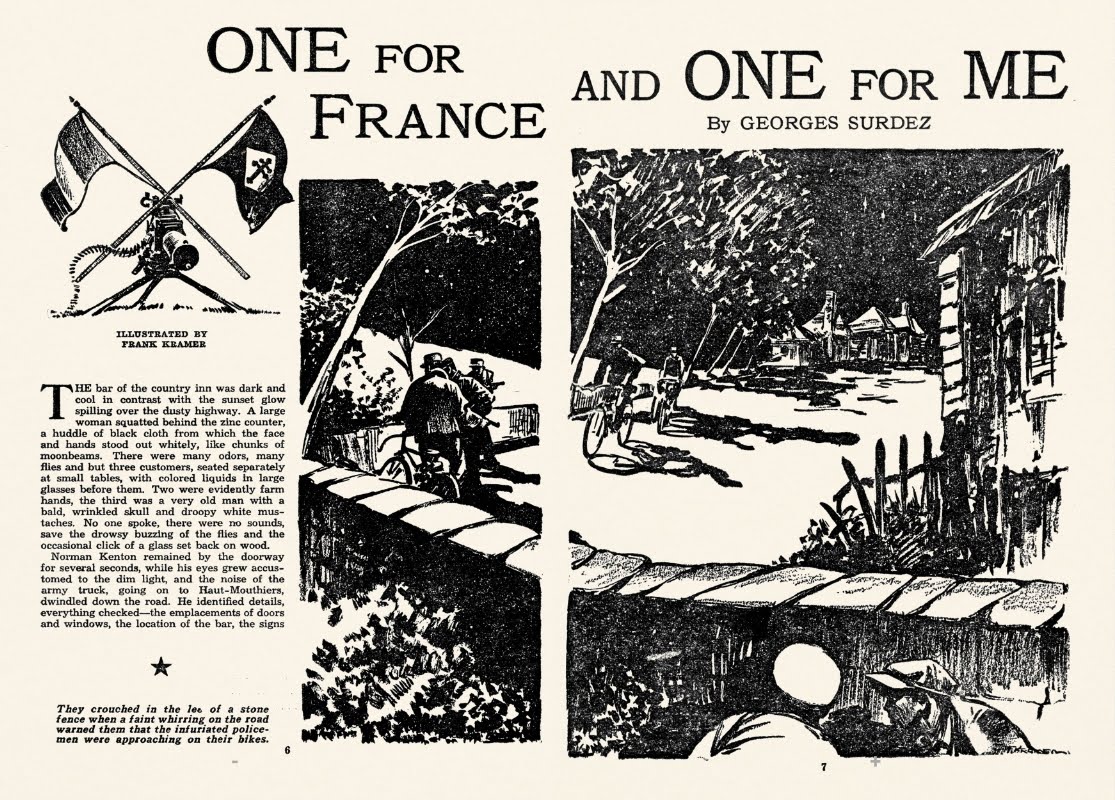
When World War II came, Georges Surdez, who had been the Foreign Legion writer par excellence in pulp, made the new war his subject, whether it was fought by the Legion or by others. With the end of the war came a new shift, or at least the hint of one. "One For France and One For Me" (Adventure, January 1946) sees Surdez moving in an almost noirish direction, with an abrupt cynicism about the French Resistance so soon after the war. Norman, an American point-of-view character returning to a town where he'd been harbored by resistance fighters during the war finds himself caught up in a manhunt that appears mostly to be a settling of scores. His old buddy in the resistance, Frederic, is still a fugitive, only now hunted by a sovereign French regime that sees him as no more than a bandit. The more Norman learns about the war within the more, the darker and murkier the picture grows. Ordinary Frenchmen took advantage of both the Resistance and the Nazis to get rid of personal enemies, and the same situation holds, more or less, now that the war is over.

Suppose you are an employee in some large firm, next in line for a good job. You make your choice between the Gestapo and the Resistance. In the first case, you write, 'So-and-so takes strolls near the railway station often - he notes the troops passing through.' That's enough to get him picked up. To the Resistance you write: 'You wonder who tipped off the Boches about the aviator? Ask so-and-so.' And you get your promotion while the other chap's in jail, or after he's killed. Or say you're a middle-aged man with a pretty wife younger than yourself. She has a cousin of whom she's very fond. There's nothing wrong as yet, but you think there may be soon. A couple of notes and he is arrested as hostage, or deported to Germany. It's the lettre de cachet within the reach of all.

Frederic has many scores to settle. He wants to publish lists of informants that the new government would rather see suppressed. He especially wants revenge on a pathetic informer who turned his own daughter, the resistance fighter's lover, over to the Gestapo, supposedly on the naive assumption that she would quickly confess under pressure. She proved tougher than anyone thought and ended up dying under torture without naming names, and her blood is on her father's hands. Over time, Frederic killed the Germans who'd tortured his love, but his vengeance is incomplete while the old man lives. He's a juror for the trial of Frederic's grandfather, a fascist and collaborator. Tricking Norman into acting as his escort, Frederic invades the courtroom carrying a bomb. He wants the opportunity to denounce several of the jurors as crooks or collaborators, but wants to act as judge, jury and executioner for the old man. Living up to the principle that gave Surdez his title, Frederic kills his grandfather ("One for France"), then delivers the coup de grace to his true enemy after the spectators virtually lynch him ("One for me."). As a bonus, Frederic finally shoots himself. Almost inevitably, Norman learns that Frederic's bomb was a fake. A fellow American laughs cynically, but Norman "had believed in the bomb. And then, when you thought of Emilie and the others ... you did not feel like laughing at all." For one of Surdez's first postwar stories, this is an extraordinary piece of work.

Sunday, September 16, 2018

'Dirty! He is strong man, that fellow.'


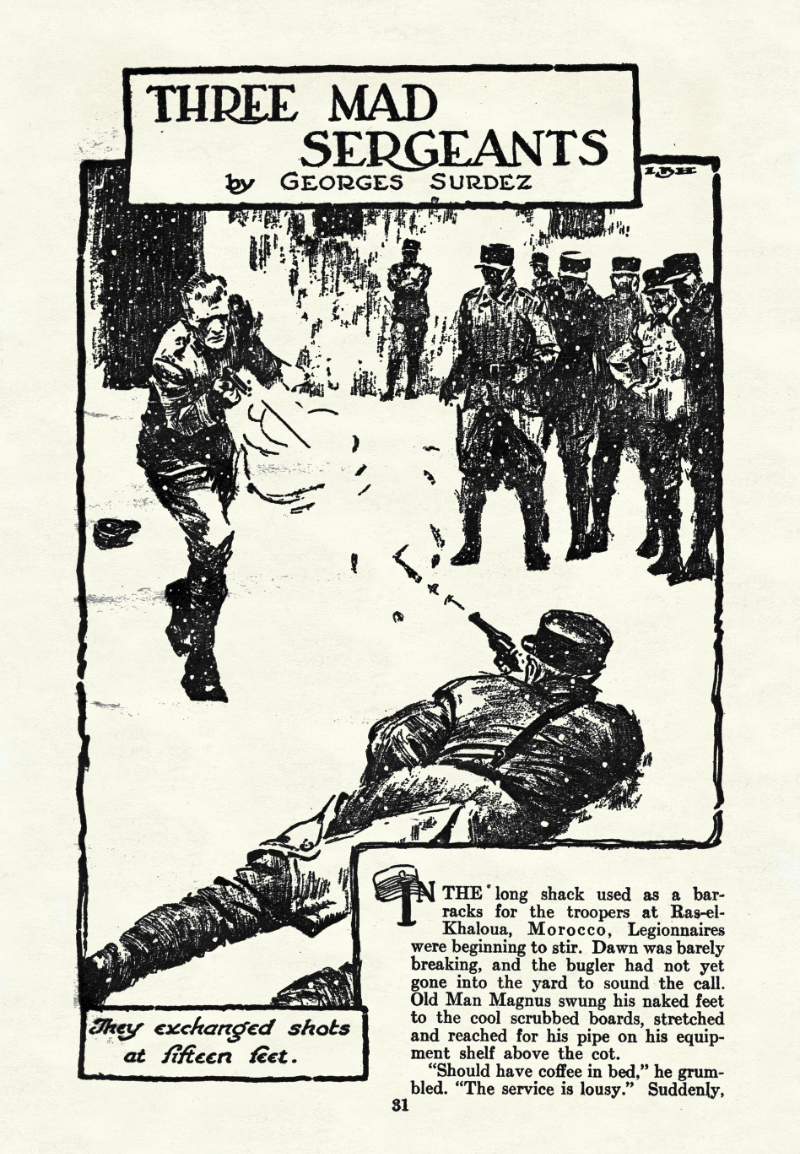
There's often a vicarious "can you take it?" quality to Foreign Legion stories. The readers is invited to imagine whether he, in the protagonist's boots, can take the discipline, the climate, the bullying by superior officers. Such stories are often tests of character, the final exam taking place under fire when some (usually) Muslim insurgents attack the post or the patrol. Going against that grain, Georges Surdez's "Three Mad Sergeants" (Adventure, February 1939) is one of the master's most nihilistic works in his genre. It concerns a unit on punishment detail in the Atlas mountains as winter hits. They're put in charge of the titular non-coms, the worst of whom, and thus the leader, being a sadistic, possibly syphilitic Pole named Larkorska. While he torments the men, the other two, rivals for a woman, goad each other toward mutual destruction, egged on by Lakorska, the enemy of all. The hero of this tale is Magnus, a former German officer who apparently joined the Legion to forget his killing of a best friend for cowardice on a world-war battlefield. Normally he's the drunk of the regiment -- or else it's the Bulgarian, Nikirov, obsessed with finding a hidden stash of booze -- but as he sobers up, deprived of liquor (apart from the daily wine ration) by the cruel Lakorska, he regains enough of his old pride to find his situation intolerable.


Not to worry, though, since after Lakorska finally gets one of the other sergeants to kill the other, the maddest of the sergeants takes out the survivor and goes completely berserk, holing up in his well-stocked, well-fortified quarters to take potshots at anyone that moves. With his newfound clarity, Magnus realizes that the men have to take Lakorska alive in order not to be accused of fragging all three sergeants. He also comes up with a plan to smoke him out of his lair so he can be dogpiled, but doesn't anticipate the madman bursting out into the open stark naked, his apparently pasty pallor making excellent camouflage in the snow. It falls to Bulgarian brute Nikirov finally to subdue Lakorska, overcoming the Pole's proverbial strength of a madman (see Nikirov's comment in the header) in a desperate grapple. In the end, Nikirov finally finds the legendary stash and all the survivors get wasted except Magnus, who holds out until the captain who originally assigned everyone to this wintry hell offers him a promotion for his leadership. That brings back unbearable memories of the war, along with a sergeant's stripes, both of which he hopes to "soak off" by throwing himself off the wagon at the end. Most of the time you can find some sort of a moral in a Surdez story, but this one is bracing, and arguably one of his best, in its complete absence of such a thing.

Monday, June 4, 2018

'No fool but yourself made you enlist, Waldemar.'

I like the way Georges Surdez backs his way into the actual meat of his Foreign Legion story, "By Special Request" (Adventure, January 1, 1932). Lieutenant Framyr volunteers to hold Bou-Mabrouk, a Moroccan post overrun and then abandoned by the Riffi rebels, because his best friend had commanded the Senegalese infantry who had been killed to the last man. Surdez lets us see Framyr through the eyes of Sergeant Kellburger, only to have Kellburger become the protagonist when Framyr is abruptly killed. The real story is the war of wills within the insurgent war between Kellburger and Private Waldemar. Of the latter, Surdez writes: "His chief fault was one rare in Germans, if common enough in Frenchmen and Belgians. He loved to argue with his superiors, to show off before a crowd -- in a word, to be different." This is significant in a unit that is disproportionately German. Waldemar fled Germany after getting "mixed up in a counterrevolution in Germany soon after the armistice." The changing political situation in Germany -- it's unclear when exactly this story is set -- encourages Waldemar to think of returning home to his family now that his term of service is almost up. In fact, it expires while the post is under siege by the Riffi, as the ranks of Legionnaires are steadily whittled down and the survivors are tempted to quit by Megandank, a deserter who promises safe passage and pretty much whatever men want, while threatening utter destruction, by air power if necessary, to those who hold out. Kellburger refuses to let Waldemar leave, fearing that others would follow him, and as his fellow sergeants and corporals fall one by one the ad hoc commander is forced to trust Waldemar with responsibility. There's some unseemly pride at stake, at least from our modern perspective. Kellburger is determined to hold out longer than the Sengalese, who after all "were unimaginative men who suffered only physically, from thirst, hunger and wounds." His men hold out one day longer, and then Kellburger is seriously wounded when Megendank, approaching under a truce flag, lures him into sniper's range. At last, if inevitably, Waldemar rises to the occasion, taking out Megandank and rallying the remaining defenders until relief arrives. Surdez doesn't go overboard and have Waldemar reenlist, but his experience clearly has changed the ertswhile malcontent for the better. Again, Surdez keeps his Legion material fresh by foregrounding a clash of  personalities. His characters aren't very sophisticated, to be honest, but Surdez has a knack for making the reader feel that he's encountering distinctive individuals with every new story. It's a rare one of his that I haven't enjoyed.

Wednesday, September 27, 2017

'From first to last, I punished Laurens justly.'

Many of Georges Surdez's Foreign Legion stories strike me as having split personalities. At heart, many of them are essentially character studies. But knowing his pulp audience, Surdez always finds a way to resolve his character conflicts through combat situations. "Clay in Khaki" (The Big Magazine, 1935) is a good example of this. The first half of it hardly has action in it, describing the fatal incompatibility of Verlinden, a veteran German sergeant, and Laurens, a popular recruit from a higher class background than was typical for Legionnaires. The story's told largely from the point of view of their new commander, Lieutenant Chamber, who sees Laurens as a decent kid unjustly goaded into desertion, and eventual death, by Verlinden. His attitude toward Verlinden is mild, however, compared to that of Laurens' buddies, who are ready to tear the sergeant apart when Laurens' body is returned to base. Still, Surdez lets Verlinden tell his side of the matter. The veteran found Laurens conceited; the younger man "thought himself my superior" and openly made fun of the sergeant, undermining his authority. That might just be an authoritarian talking, but this is the Foreign Legion, where discipline is everything. Seeing Verlinden's point, but also seeing that his position under his command is no longer tenable, Chamber arranges for his transfer to Indo-China, accepting the sergeant's suggestion that he, Verlinden, apply for the transfer himself in order to save face. But before the transfer can be finalized, Chamber's unit must go out in pursuit of a strong force of bandits. In the middle of battle mutiny breaks out as men refuse to take orders from Verlinden, and Chamber finally has to disarm him in order to have any hope of rallying his men. Then comes the ironic twist. Mocked by the men and believing his career ruined, Verlinden decides to commit suicide-by-Berber, charging the enemy position armed only with his automatic pistol.

He was a true Legionnaire, in love with the spectacular and, his life being sacrificed, he granted himself the luxury of exacting admiration from the very Legionnaires who had laughed. To die was nothing -- if it meant that he would be remembered.

Inevitably he goes down in a hail of gunfire, but when some Berbers venture from their position to plunder the body, them men who had scorned Verlinden moments before now go berserk in defense of his corpse. "Verlinden's personality had fled wherever the spirit travels after death, but there remained his clay and his uniform," Surdez writes, "His head, taken as a trophy through the market places of desert villages, would be a reproach to his Legionnaires." By sacrificing himself for purely selfish reasons, Verlinden inadvertently wins the day for the Legion. The question of whether Verlinden was justified in his treatment of Laurens has been forgotten, proof that the story was more about Verlinden all along. Surdez doesn't really imply that Verlinden's conduct vindicates him, and his reluctance to pass final judgment is a nice touch from an author I've only rarely disliked.

Thursday, April 6, 2017

VINTAGE PAPERBACK OF THE WEEK: Georges Surdez, THE DEMON CARAVAN (1927)

Surdez wrote many long stories for Adventure that could have passed for novels but published in long form only rarely. As far as I can tell, Demon Caravan (the title refers to a type of desert storm) was written for publication as a novel instead of appearing in the pulps first. It reads as if written for a different market, which isn't necessarily to Surdez' advantage. It's more old fashioned in its construction than his contemporary pulp stories, in that it takes quite a while for the actual story to begin. Novelistic conventions require an elaborate establishment of the protagonist, Captain Paul Lartal, in his new environment, an Algerian colonial outpost, and the introduction of several nearly interchangeable supporting characters who'll be left behind when Lartal goes on the novel's true mission. There's a good desert battle scene in the middle of this, but nearly half the 214 page novel (that's the page count for the 1951 Dell paperback) is buildup for Lartal's expedition into a hidden oasis.

Some collectors are fond of Dell's back cover maps, but give me more hard-boiled copy any time.


We're somewhere between Lost Horizon (yet to be written) and L'Atlantide (which Surdez may have read in the original French or in its English translation in Adventure) when Lartal, accompanied by his faithful Arab sidekick Tlemsani reach this desert utopia. What we have here is a progressive Muslim community founded by people tired of war, led by a charismatic chieftain and his French son-in-law, a fugitive from his own army for killing a fellow officer. When Lartal arrives the son-in-law, who converted to Islam and took the name Si Khalil, is the leader who consults with a representative assembly of guild elders and the like. Just as Si Khalil in his youth fell for the chieftain's daughter and married her, so Lartal is smitten with Si Khalil's daughter Morjana, for whom her father has been seeking a suitable mate. There is, however, a rival suitor who threatens to disrupt Si Khalil's utopia. Omar ben Azziz is a type the world has come to know all too well in the 21st century. Surdez calls him a Senussi, but we'd call him an Islamist. "While all are Mohammedans here, tolerance has prevailed," Si Khalil explains, "The young wish to change that.

Of late there has come about a renewal of religious fervor. There are more ways than one to interpret the Koran. The military spirit has spread among the schoolboys in some way. Under their tuition, the boys are growing up to hate strangers, men not of their faith, although they have never seen them. Instead of warriors for protection, they maintain we should send them out for conquest.

Omar is the sort who has a quote from the Koran as the self-serving answer to every question. He uses the arrival of Lartal to stir up dissent against Si Khalil, arguing that the granddaughter of the great founder, though half-French herself, should not be married off to an infidel outsider. With a pessimism that probably appears prophetic now, Surdez shows Si Khalil's position crumbling until he decides that he, Morjana and Lartal should escape and seek shelter with the French. Omar's ascendancy has split the ruling family as Yusuf, Si Khalil's son by another mother, takes the side of the supposed holy man. Over the second half of the novel Surdez has been ratcheting up the tension, and in the final chapters he lets rip as the good guys make their break, though not without casualties or without a timely and brutal act of filial piety by the conflicted Yusuf. The second half of Demon Caravan makes the whole worth reading, so long as you understand that it's more romantic adventure than pulp fiction. It's still unmistakably Surdez, and it makes you sadly confident that he would have handled himself well in the era of paperback originals had he made it there instead of dying shortly before at the age of 49.

Tuesday, February 14, 2017

They March From Yesterday

In the golden age of Adventure, when Arthur Sullivant Hoffman was the editor, star writers like Georges Surdez could publish something like a genuine novel of 60 or more dense two-column pages in a single issue. Later editors may not have liked to see one writer take up so much space, even in a 192 page magazine. That might explain Surdez's "They March From Yesterday," which totals 56 pages, being split between the March 1 and March 15, 1930 issues. Having read both parts, thanks to Foreign Legion fan Jack Wagner's Mon Legionnaire blog, I suspect that Surdez may have been asked to pad his story into a two-parter. The story in its basic form follows the American Peter Kempton, who joins the Legion under the name Edouard Maguil to escape the gangsters who killed his stepfather back in New York City. As one might expect in such a story, one of those gangsters has joined the Legion himself to escape the law. This gives Surdez an opportunity to refute the legend, exploited by other writers, of the Legion sheltering fugitives from justice. Contrary to "the most false among the false tales told of the Legion," if his superiors learned Legionnaire Recki's true identity they'd turn him over upon his government's request. What really protects Recki, alias Siskow, is that "if there was scorn for the assassin, there was scorn for a denouncer." In other words, no one likes a snitch. In fact, Kempton/Maguil finds himself almost liking Siskow/Recki because the onetime criminal is so guileless in his homesick desire to befriend anyone who speaks English, and especially a fellow American, even after he learns Maguil's true identity. "Recki, endowed with human speech, was nevertheless an animal," Maguil thinks of him, "Here was a fortunate organism in which remorse finds no place." Yet Recki proves a sympathetically enigmatic character, willing to risk his life alongside Maguil on a rescue mission because they'd agreed to let the fortunes of battle decide whether Maguil will be around to denounce Recki, or whether Recki will be around to be denounced.


Unlikely male bonding is at the core of Legion pulp, but smack in the middle of "Yesterday" an episode that reads as if Surdez was trying to break into Fight Stories. On leave, Maguil is trying to raise money so his American girlfriend, who had foolishly come to Africa looking for him, can go home. Two Legion "buddies" talk him into entering the ring to replace an American contender in a bout with a local hero. "They'll want to see an American take it on the chin for a change," the promoter says of the local fans, but a Legionnaire is no mere pug and, despite a cliffhanger ending the first installment, Maguil wins the fight, only to be robbed by his deserting buddies and left to be framed for murder. He's court-martialed, acquitted and returned to the Legion, ending the story's superfluous middle section. The rest of it on either side is all right, though its more a sequence of set pieces than a truly novelistic story. You get a long march through the desert, the distance measured by telegraph poles and a big battle scene in each installment. By the end you get the feeling that Recki interested Surdez more than Maguil, who is almost a generic hero toughened and refined by Legion duty and discipline. Surdez is always very readable, and the Foreign Legion genre as a whole intrigues me both in its mostly unapologetic imperialism and its rite-of-passage aspect of manhood discovered through ordeal. "They March From Yesterday" isn't top-flight Surdez, but Surdez himself is nearly always top-flight pulp, and this wouldn't be a bad introduction to him.

The March 1, 1930 Adventure is available in its entirety online through Yahoo's Pulpscans group, but the Mon Legionnaire blog has Part One of "They March From Yesterday" as a separate file here. Wagner scanned Part Two from his own collection and made it available here.

Wednesday, February 1, 2017

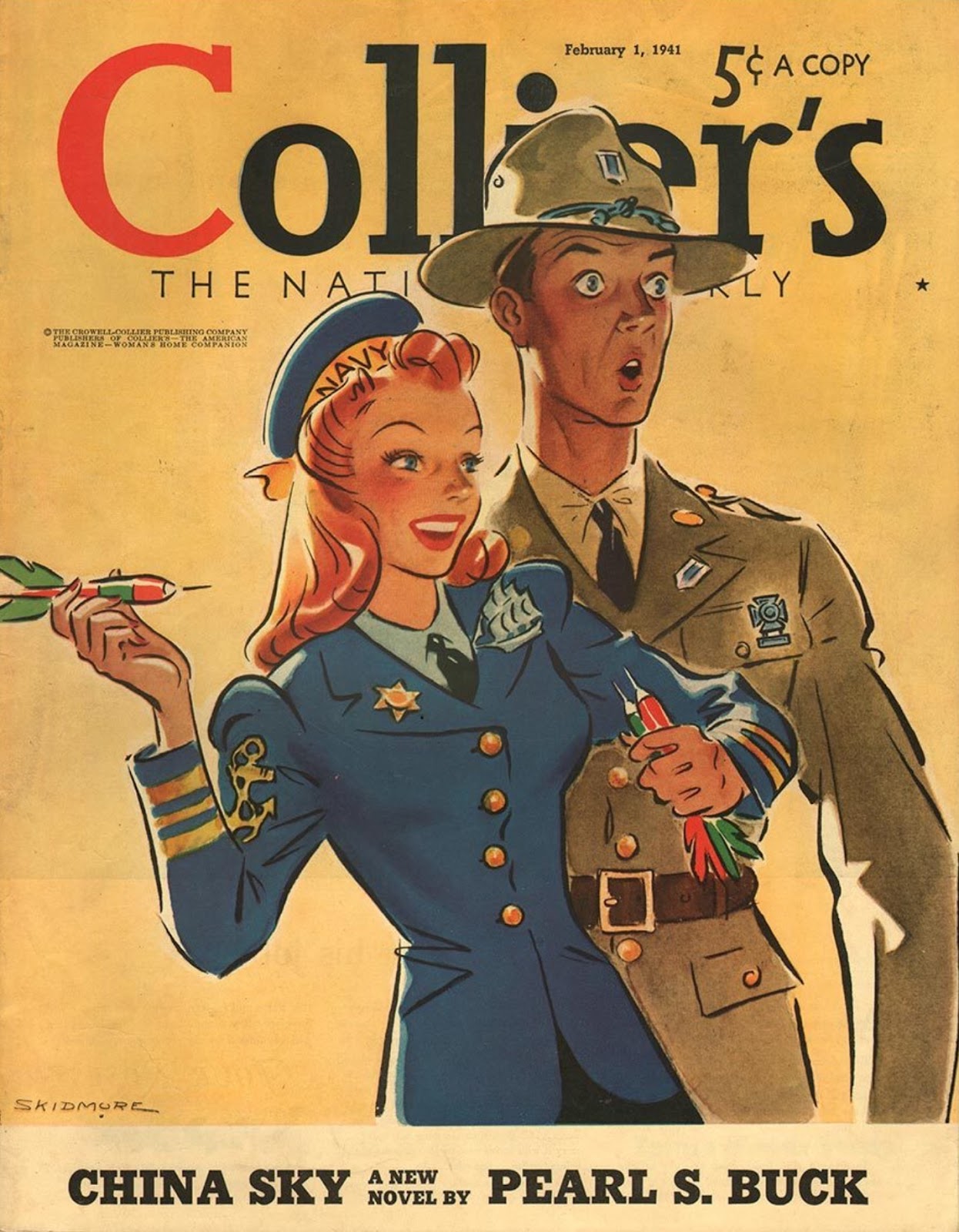
THIS DAY IN COLLIER'S WEEKLY: February 1, 1941

A few days ago, had I remembered, I could have shown you George Surdez's most famous story. It might be more correct to call it his most lasting cultural legacy, since very few people now, I imagine, can say they've read the story. Surdez honed his mastery of Foreign Legion stories in the pulps and continued publishing their throughout his too-short life. He broke into Collier's, which became his main slick market, late in 1932. By comparison, he appeared in The Saturday Evening Post only once. The January 30, 1937 Collier's included Surdez's story "Russian Roulette," which is credited with popularizing -- or, I should say, widening public awareness of the infamous game of death. In 1941 Surdez was writing "fall of France" stories in pulps and slicks alike, though these often sounded a strong note of continuing resistance to Nazi occupation. This issue's "The Men of Yore" is in that line, with an appropriate note of fatalism at a moment when Germany was still ascendant. For the mundane reader, Surdez would be deeply overshadowed by the issue's two star contributors: Nobel laureate Pearl S. Buck, who begins the "important new serial novel" China Sky, and Agatha Christie, who continues her famous Hercule Poirot serial Evil Under the Sun. Christie was a pulp veteran, many of her stories making their first American appearances in Blue Book or Flynn's (before it became Detective Fiction Weekly) in the 1920s. This number, like many a Collier's, is marred by one of Roark Bradford's negro-dialect comedies. The National Weekly kept publishing Bradford's stuff until he died, the last stories appearing as late as 1949. The Post had a similar series, while by comparison, with the sad exception of Blue Book, you didn't see that kind of crap much in the pulps. Anyway, browse at your leisure via this link.

Thursday, September 29, 2016

THE PULP CALENDAR: September 29

Little more than a week before this 1934 Argosy marked its anniversary on this blog, a member of the Yahoo pulpscans group uploaded a complete scan of it. Back in July, Foreign Legion fan and blogger Jack Wagner uploaded a scan of the issue's best story, Georges Surdez' "Military Prisoner." As there's no table of contents for this one in the FictionMags Index, it's my cultural duty to give you the original.


F. Van Wyck Mason's cover story is a typical pulp redemption tale. An American doctor is ruined professionally and socially after his performing euthanasia on a wealthy patient, at her request, is exposed and denounced. He becomes a hard-luck trader deep in darkest Africa, when who should show up looking for guides but his enemy and his former beloved. I think you can take it from there, but it's entertaining enough. Calling it a "Complete Novel" at 38 pages is a stretch, but Argosy was flexible about type size in its effort at this time to cram as much content into 144 pages as possible, and "River Raiders" is satisfyingly dense. Nevertheless, "Military Prisoners" takes the honors this issue, as an Surdez story is likely to do. The real disappointment here is the concluding chapter of W. Wirt's The Assassin, the last appearance of Jimmie Cordie and his merry mercenaries, thought they'd make at least one encore appearance in Short Stories the following year. In this three-parter,  Japanese conspirators hope to provoke a break between the U.S, and their country by having an American gangster assassinate Henry "The Last Emperor" Pu-yi, their puppet head of state in Manchuria.The main problem with the story is that Cordie and his band are so invincible by now that Wirt can't maintain any suspense. More than ever, the serial seems like an excuse for Wirt to indulge in the vaudeville shtick of those aggressively ethnic antagonists, Irish Red Dolan and the self-dubbed "Fighting Yid." I've liked the other Cordie stories I've read, but it was sad to read this. For most contemporary readers the real highlight was more likely the new installment of A. Merritt's long-awaited serial Creep, Shadow!, reviving his characters from Burn, Witch, Burn! I've never read any Merritt despite his great reputation as a fantasist, but I found this installment of his last major work pretty interesting. The rest of the issue is okay, and I'll reserve comment on J. E. Grinsted's The Kid From Hell until next week. For now, this issue of Argosy is sponsored by:


Thursday, June 30, 2016

THE PULP CALENDAR: June 30


The admirable Saskia van de Kruisweg scanned this 1925 Adventure and made it available on the Internet Archive. There's actually a nice chunk of 1925 available online in different places, as you'll see later this summer. The indisputable highlights here are Georges Surdez's long novelette "The Figurehead" -- not a Foreign Legion piece but set in French colonial Africa -- and Arthur Gilchrist Brodeur's intense novelette of the Volsungs, "Vengeance." "Figurehead" is a typical Surdez conflict of strong personalities under the pressures of colonial rule, the sort of thing that always manages to come out fresh no matter how many times he rehashes similar themes, thanks to his gift for character. The French characters are nearly overshadowed by the plight of an elite African soldier, one of the few to get officer's training, who only finds that his native troops resent him and are always looking for a white officer to overrule him, even though the whites all trust in his superior character. As for "Vengeance," if you like Arthur D. Howden-Smith's Swain the Viking stories, you should like Brodeur's work as well. I also enjoyed all the chapters I've been able to read of Hugh Pendexter's western serial Pards. I was disappointed, however, to find Alan LeMay, future author of The Searchers, to be in attempted humor mode in his short story, "Terlegaphy and the Bronc," while I liked George Bruce Marquis' short story of a Native American detective, despite the pidgin dialect the hero speaks. The rest includes a boxing novelette by Charles Victor Fischer, stories by Eugene Cunningham, Erle D. Hosmer and Alex McLaren, and another animal story by F. St.Mars. Surdez and Brodeur alone will make this one worth your time, and you may like some of the other stuff, too.

Sunday, April 10, 2016

THE PULP CALENDAR: April 10

This is Adventure going full blast. The April 10, 1924 issue assembles four of the magazine's mightiest writers, all with outstanding stories. Harold Lamb leads off with a massive 70+ page novel, The Making of the Morning Star, in which an English crusader encounters Lamb's Three Palladins, i.e. Genghis Khan and his Mongol companions, one of whom spends much of the story in disguise luring our hero to Tartary. You get a breather as Frank Robertson contributes a surprisingly entertaining story about sheep shearers; James K. Waterman offers what passes for a short-short in Adventure, a four-pager about blowing up whales with bombs, marred by a ship's cook's amosandandian dialect; and Bill Adams philosophizes for two pages. Then comes the third installment of Arthur O. Friel's four-parter The King of No Man's Land, an epic entertainment even on its own concerning men carving out empires in South America and running afoul of the established governments. This serial was the third outing of Friel's hero team of McKay, Knowlton and Ryan; the first, The Pathless Trail (1921) is available for download at the Internet Archive and is definitely a must-read for me. Following Friel is William Byron Mowery's grim tale of a northwest manhunt, "The Lob-Stick," a brief essay from Arthur Gilchrist Brodeur on "The Nordic Race," and a poem by Harold William Gleason. Then Georges Surdez takes over with his novelette "The White Man's Way." Surdez strays from Foreign Legion territory here but is as good as ever telling of a French colonial officer leading black troops into foreign territory to retrieve stolen rifles and falling in with an Italian officer who proves worse than he seems. Surdez is a little more racist toward Africans than he usually is toward Arabs ("Their business was killing. Thinking was the white man's.") but he's too good a writer not to invest the more important African characters with virtue and dignity, and as an adventure writer (both small a and capital A) he hasn't disappointed me yet. Our final intermission includes a sea story by a rare female contributor, Magda Leigh, a western short by Raymond S. Spears, and a poem about a returning war veteran by Leonard H. Nason who, had he appeared in prose, would have made it five titans this issue. As it is, the fourth is Arthur D. Howden-Smith, who tells another tale of Swain the Viking, who may be the most stone-cold badass hero in all pulpdom. Swain's salient characteristic is that he takes crap from absolutely no one. In "Swain's Justice" he feuds with a peer who makes the fatal mistake of bitching about his share of plunder from their last expedition. Howden-Smith writes with an archaic terseness that seems just right for Swain and his milieu, and he closes out the fiction section of this tremendous issue on a high note. After all that, there's still pulpdom's greatest letter column, "The Camp-Fire," in which Magda Leigh tells us about herself, while editor Arthur Sullivant Hoffman comments on an Army scandal, rants as usual -- lest you think "gun nuts" are a more modern phenomenon -- against contemporary gun control efforts, and publishes comments on a fascinating variety of subjects. Possibly the most amazing thing about this 192 page issue is that the publishers assumed that readers would be ready for another same-sized dose just ten days later. You, however, can take your time savoring pulp at one of its peaks after downloading this issue from the link below.

Monday, January 25, 2016

75 YEARS AGO IN THE ARGOSY: January 25, 1941

This is the second "bedsheet" issue of Argosy after the venerable weekly's latest format change in an increasingly desperate sequence. Blue Book would take a similar leap later in the summer of 1941, and Argosy probably showed the folks at the McCall company what not to do. As noted one week ago, the photo collage cover format is hideous. Inside doesn't look much better. Blue Book became, if anything, only more beautiful than it already was when it went bedsheet with its September issue; key to that was the monthly's pre-existing policy of lavish illustration from a whole stable of artists, with multiple illustrations for each story. Argosy gave you one picture on each story's title page -- except for a brief period around 1934-5 when you got spot illos of the main characters in some of the stories -- and that left the 1941 reader facing brutal walls of tiny three-column type on most pages. This issue exists in dowloadable form online and I read it on an e-reader with a 7" screen. It wasn't pretty. Worse, it looks they simply blew up illustrations intended for the magazine's smaller size, and not to the artist's advantage, while they didn't blow up Stookie Allen's one page "Men of Daring" cartoon feature at all -- perhaps he objected -- surrounding it with wide, bare margins.

Since the Fiction Mags Index doesn't list this issue's contents, here's my contribution to pulp scholarship.


Argosy turned to one of its legendary characters to help put over the new format. Johnston McCulley's Zorro first appeared in Argosy's sibling pulp, the All-Story Weekly, in 1919. The prolific pulpster didn't do much with his creation until Douglas Fairbanks brought Zorro to cinematic life. He didn't really make an industry of Zorro until he most likely could sell little else late in his career. The vast majority of Zorro stories appeared on a nearly-monthly basis in the Thrilling group's West between 1944 and 1951. Earlier, after a 1922 serial McCulley didn't return to Zorro until 1931. Between then and 1941 there were two novellas, a short story and a serial. Throughout that period, however, McCulley published a lot of serials set in what Argosy called "Zorro-land:" Spanish-ruled California in roughly the same period as Don Diego Vega's career. These are often entertaining, probably because McCulley had the freedom to experiment with character, within certain generic parameters.


By comparison, the first chapter of The Sign of Zorro seems inert. That may be because it finds Don Diego in a funk. He hasn't worn the costume in some time, and has been mourning for his original beloved, whom we learn died of a fever. His father has to goad Diego into resuming his swashbuckling career when the Vegas learn what we discovered first-hand earlier, that a wealthy young woman is being menaced by a villain whose "reputation stinks like the wind blowing across a dead whale." Diego then does little more than interview the woman, with the first real action reserved for the next installment. McCulley is clearly more interested in other characters, particularly a retired pirate in whom the woman confides, and who in turn informs Diego's old servant Bernardo -- who has been cured of his muteness, we learn -- about her request for Zorro's help. In continuity, it's widely understood or believed that Don Diego is Zorro, but enough time has passed since the hero's last exploit that many have come to doubt the fact. Diego's disinterested benevolence in this opening installment doesn't give us much of a hook, and Diego himself seems bland compared to all the duelling dons McCulley had invented through the Thirties. There may have been fresh interest in Zorro due to the 1940 Tyrone Power Mark of Zorro remake, but Sign isn't as strong a lead as Argosy wanted or needed at this point.

Instead, and to no real surprise for pulp buffs, the best story in this issue is the "short novel" by Georges Surdez. The king of Foreign Legion stories, which means the master of hard-boiled colonial military adventures, Surdez owns a footnote in popular culture as the putative popularizer of the deadly game of Russian Roulette, which he described in a 1937 story for Collier's, one of the "slick" weeklies all pulpsters aspired to appear in. "No Medals for Heroes" deals with the regular French army in its darkest hour, during the German blitzkrieg of 1940. Surdez was Swiss by birth and wrote for pulps in English but obviously identified culturally with France. "No Medals" captures the rage and recrimination rife in defeat and the urge to blame it all on espionage, while giving Surdez's heroes a chance at payback as a handful of fliers wreaks havoc with a German bomber squadron. There's an ironic echo in Surdez's own impulse to blame "Fifth Column" elements for the Fall of France of Germany's own "stab in the back" myth of the end of World War I, and for once the irony is probably lost on the author, who nevertheless invests the adventure with his characteristic grim intensity.

The best of the rest is Jim Kjelgarrd's modern-western short story "Good Leather," in which an elderly lawman tries to pay an old debt to a dead friend by helping his outlaw son. Its happy ending is a kind of cop out but Kjelgaard strikes a sharp note portraying his hero's mortal despair as he thinks he's guessed wrong about the kid. I have nothing to say about Bennett Foster's serial Thunder Hoofs, which concludes this week, because Argosy almost never included recaps with the final chapters of their serials, leaving me no way to get into the story. Richard Sale's second chapter of Design for Valor does get a recap -- Argosy always invited browsers to "start now" with Part Two -- but this by-the-numbers wartime stuff had little to offer. "Mr. Emerson Please Copy" is an odd piece of Americana with obvious slick ambitions from Frank Bunce, purporting to tell the story behind Ralph Waldo Emerson's aphorism about consistency being the hobgoblin of small minds by inventing a name-dropping correspondent for the philosopher who goes west with plans for a utopian community but acquires more practical pioneer values. There's nothing really wrong with the story except that it hardly seems like the stuff of pulp, which was often the problem with Argosy at this time. Finally, the larger size allows Argosy to offer short-short stories complete on one page, just like Collier's, and this issue's short-short, Ken Crossen's "The Bowmen of Mons," reads like wartime propaganda before we got into the war. It's a heroic French resistance story with German occupiers under attack by the legendary title figure, whose real identity is supposed to surprise us. World War II hurt the pulps, I feel, because an all-encompassing Manichean struggle of that sort limits the options of pulp heroes who are more properly freebooters or freelancers. But the war was only one of Argosy's problems, and none of them were going to be solved with this makeover.

If anyone wants to judge this issue for himself or herself, here's a link to a digital scan you can download for use on your favorite reading device: