Adventures in a Golden Age of Storytelling by SAMUEL WILSON, Author of "Mondo 70," "The Think 3 Institute," etc.
Showing posts with label Detective Story. Show all posts
Tuesday, December 6, 2016
THE PULP CALENDAR: December 6
Approximately one year before yesterday's cover, here's a Detective Story woman possibly putting herself in peril. I appreciate the artist's commitment to detail in illustrating the madman's drooling anticipation of freedom, however limited by the size of that window. The author of "The Madhouse Dupe," A. E. Apple, specialized in supercriminals, eventually pitting his two prize specimens, the Asian menace Mr. Chang and the more scrupulous thief Rafferty, against each other in two 1931 stories. Elsewhere this issue, Johnston McCulley's lisping safecracker Thubway Tham borrows the Street & Smith microphone from the cover for "Thubway Tham on the Air," while Charlotte Dockstader, Ronald Everson, Roy W. Hinds, Ray Humphreys, Ainsworth Morgan, Morgan I Tooke and Donald Van Riper contribute stories and Herman Landon continues the serial The Silver Chest. Tham, Humpheys and Van Riper would be the very next week, while Dockstader had been in just last week. A weekly story magazine was a dependable market for the industrious.
Monday, December 5, 2016
THE PULP CALENDAR: December 5
A starkly dramatic woman-in-peril cover fronts a 1931 Detective Story with two prominent female contributors. For cover author Marion Scott, the Street & Smith weekly probably was a step down in prestige as it became her primary market after several years of publishing regularly in Black Mask. Similarly, Elisabeth Sanxay Holding published mainly in the slicks, both before and after her serial Brides of Crime wrapped up this week. It was one of three serials Holding published in Detective Story between August 1931 and March 1932. She returned sporadically to pulp but continued to stick to the slicks as she became one of the most acclaimed mystery writers of her time. The male contingent is led by Johnston McCulley, who begins the three-part serial A Million-Dollar Dog, but his colleagues are as obscure today as Marion Scott is, compared to McCulley and Holding.
Monday, November 14, 2016
THE PULP CALENDAR: November 14
To be a twentieth century pirate all you needed was the open sea and a gun. Charles W. Tyler's Blue Jean Billy usually did have a boat -- you can tell because after her first couple of appearances, when she apparently went under the alias "Raggedy Ann," she got the cover every time she appeared in Detective Story, this 1931 issue being her last bow. Apart from being female -- and that probably isn't as atypical as I just made it look -- Billy is your typical pulp antihero, though her story may resonate more today because of the way police brutality looms large in it. From what I've read in reference works, Billy's father steered her to a life of crime in response to police brutality. Later, insensitive policing cost her a husband. Pulp fans would accept any excuse, of course, because that "crime does not pay" line didn't seem to play so well in those days for some reason.
Thursday, November 10, 2016
THE PULP CALENDAR: November 10
In September 1932 Street & Smith's Detective Story went from weekly to twice-a-month. It had the same cover-date schedule as Short Stories, the 10th and 25th of each month, for the next three years. I thought it would be neat to show you all three November 10 covers that appeared before Detective Story went monthly in the fall of 1935, but the only version of the 1932 cover I could find online is damaged, and in any event it still resembled the cover format for the weekly, while in 1933 and 1934 we see significant changes. Here's November 10, 1933.
And here's November 10, 1934.
I can't say whether this amount of experimentation over a short time represents pure creativity or some kind of desperation as sales apparently declined. As it happens, the 1934 sample is the debut of a new cover format. The cursive copy on the side was used frequently though not consistently until the switch to monthly publication inspired yet another change in cover design. By comparison, Street & Smith's western weeklies and its hero pulps see relatively little variation in cover formats over the same period, with Wild West Weekly probably the most conservative in that regard. I guess they didn't need to shake things up in the same way.
Tuesday, November 8, 2016
THE PULP CALENDAR: November 8
Here's a stark, simple cover design from a 1930 Detective Story, marred somewhat by the logo pushing Street & Smith's Shadow-narrated radio program. To some this may seem like an appropriate cover for this day in 2016, though they probably envision a different woman in the bullseye. Apart from the cover, the most noteworthy thing in this issue is probably the continuation of Black Star Back -- and How, the final appearance of one of Johnston McCulley's masked antiheroes. Black Star seems to have been McCulley's earliest series character, predating Thubway Tham and Zorro by a good margin. The author used a pseudonym, John Mack Stone, to introduce his gentleman thief in 1916, but decided to take credit under his real name by the end of that year. The war years and immediately after were Black Star's heyday. McCulley lost interest in him in 1921 but revived the character for a 1928 serial and, if the FictionMags Index is correct, a onetime appearance in Western Story the same week that the serial concluded. Back -- and How was the character's first appearance since then. Of the cover story's author, Neil C. Miller, I can say nothing except that "Woman Target" was his first Detective Story appearance since 1923, and that he would publish occasionally in Street & Smith pulps for the next decade.
Monday, October 31, 2016
THE PULP CALENDAR: October 31
Let's close out October with this mildly gruesome if not scary 1931 Detective Story cover by John A. Coughlin. John Jay Chichester's Maxwell Sanderson, who made his debut in 1925, is one of those gentleman thieves (his nickname is "The Noiseless Cracksman") who often turn up in detective pulps. Sanderson regularly earned Detective Story covers from 1926 onward, though there were periods when it wasn't clear whether the weekly cover was illustrating any particular story. Chichester would follow "Desperate Rogues" with a Sanderson serial in December, but after this issue Sanderson apparently lost favor. It's not clear whether Chichester wrote any more stories about him until 1934, and Sanderson seems to have been retired for good in 1935. This issue also continues a story written under Chichester's real name, Christopher B. Booth. The rest of the authors are the usual now-obscure lot, though I wonder who Asia Kagowan was. Kagowan wrote regularly for Detective Story from 1930 through 1935, including a series about a character named Pooglesnup. Before that the name turns up in the old Life humor magazine of Roaring Twenties fame as its Chicago correspondent. Beyond that Kagowan's identity seems to be as much a mystery now as any solved in this issue.
Tuesday, October 18, 2016
THE PULP CALENDAR: October 18
Do you find clowns scary? Many do, and perhaps Delton Prouse thought his red pagliacco suit and whiteface would strike terror into superstitious, cowardly criminals. Somehow it worked, and the mere idea of the Crimson Clown thrilled or at least amused Detective Story readers. Still, Johnston McCulley had neglected him long enough for his first new story since May 1929 to be heralded as "The Crimson Clown's Return" in October 1930. Notice how the hero needs no introduction, apart from the letter he presents on the cover. Prouse would make three more appearances in the next year and then go dormant again, finally getting another "Return" in Popular Detective in 1944. The Clown aside, this issue has an unusual number of continued stories, though one of the three is only the conclusion of a two-parter. There are also four standalone stories, all by names mostly forgotten now. One of the stories is "His Last Grin," which might make some clowns laugh.
Tuesday, October 4, 2016
THE PULP CALENDAR: October 4
How about a little voodoo? This 1930 Detective Story cover promises us a "Severed Head" but gives us a severed leg on that poor little doll. It has something to do, perhaps, with George Allan England's hero T. Ashley, who'd been around since 1918 but would really get down to business over the next few years. England may have been top-billed this issue but some people probably bought it to continue Edgar Wallace's serial The Clew of the Silver Key, complete with archaic spelling. In 1933 Street & Smith would take over Clues Detective Stories from Clayton but stuck with the modern spelling. Most of this week's authors are the usual Street & Smith veterans, though Leslie T. White makes his Detective Story debut at the precocious age of 27, after breaking into pulp at the start of the year.
Tuesday, June 28, 2016
THE PULP CALENDAR: June 28
Money! I picked this 1930 Detective Story for today entirely because of the cool cover. This seems to be one of the periods when Street & Smith indulged in symbolic cover imagery. No attempt is made to link the image to any of the stories inside or the authors advertised. The star among them seems to have been Herman Landon, whose novelette stars one of the magazine's most popular series characters, Martin Dale, aka The Benevolent Picaroon, a good-hearted thief who stole purely for the thrill of putting something over on the police. The Picaroon starred at Detective Story from 1921 through 1932 and made at least encore appearance in Detective Fiction Weekly in 1935. This issue is also unusual in featuring two stories that are their respective authors' only known contributions to pulp. However, that may only indicate that Richard P. Collins and Charles Valette Slattery are pseudonyms or house names, possibly covering for authors already credited with stories in this number. For all we know, however, this issue marks the career peak of two authors who are otherwise lost to history. There's a mystery for you....
Monday, June 13, 2016
THE PULP CALENDAR: June 13
I wish there was a better image of this 1931 Detective Story cover online, especially because I don't really have anything to say about the contents of the issue. The cover is a thing of beauty, unmarred by any sort of promo copy. There are no story titles, no authors' names. The newspaper copy may refer to a story inside, but you couldn't guess which unless you read the issue. The profile shadow is obviously suggestive of The Shadow, the still-new hero pulp spun off from the Detective Story radio program, yet is not so obviously the longer-nosed profile to be an advertisement, however subtle. I can only presume that some brave cover editor so enjoyed this piece of art that it was allowed to stand on its own on the assumption that it could attract readers on aesthetic grounds alone. I wonder what the sales figures were.
Monday, June 6, 2016
THE PULP CALENDAR: June 6
Here's a slightly suggestive cover by John A. Coughlin to a typical 1931 issue of Street & Smith's Detective Story. As often seemed to be the case, most of the authors published only or mostly in Street & Smith magazines. The cover story is credited to a husband-wife team (one of several in the mystery genre), The Cunninghams. After publishing four stories in Detective Story over the previous two years, their name apparently had become a selling point. They published five more stories over the next two years, never again receiving cover billing, before divorcing in 1934. William M. Cunningham was a leftist writer out of Oklahoma who wrote an early fictional treatment of the career of Pretty Boy Floyd and ended up a Washington D.C. correspondent for TASS, the Soviet news agency, while continuing to place stories in mainstream slicks like Collier's and Cosmopolitan. Another contributor of interest is C. Wiles Hallock, who was primarily a pulp poet. He made a good start landing verses in The Saturday Evening Post but published most of his work in western pulps. He published both prose and poetry in Detective Story, making me wonder what a detective poem looks like. He made his prose debut in February 1931 and landed a short story in Detective Story about once a month through the spring before his pace slackened. He remained a poet first throughout his pulp career, which extended all the way to the July 1952 issue of Adventure and some digest issues of Zane Grey's Western Magazine. It's remarkable to think that there was still a place for poetry in the pulps at that late date.
Monday, May 16, 2016
THE PULP CALENDAR: May 16
An understatedly creepy cover fronts this 1931 Detective Story, advertising Judson P. Philips' story "The Death Call." The big names this issue are Edgar Wallace, continuing the serial On the Spot, and Zorro creator Johnston McCulley, apparently intending to retire another of his creations. McCulley is one of the ancestors of superheroes by virtue of his costumed crimefighters. Perhaps the strangest of these, just on appearance, was the Crimson Clown, created in 1926. The mystery man who was really Delton Prouse often got the cover once his series was under way, but had just had that honor two weeks earlier. That May 2 cover probably is as formidable as the character would ever look. John A Coughlin's cover for that issue looks like something Alex Ross might come up with today.
I've never read any Crimson Clown stories, so I can't judge him on more than a superficial level. The May 16 story is "The Crimson Clown's Romance," but according to Robert Sampson's Yesterday's Faces it's not the Clown himself falling in love. The series simply stops here, but McCulley brought the character back for a belated encore in a 1944 story in the Thrilling group's Popular Detective. The rest of the May 16 lineup includes Detective Story mainstay Charlotte Dockstader, Ronald Everson, John Foland, Warren Kimsey and Charles Kingston. I can't say much about the stories, but for the first half or 1931 or so Detective Story has some great art direction on the covers. McCulley probably realized that a costume character often made a really cool cover. Street & Smith definitely took that idea to heart, but writers other than McCulley benefited the most from it.
Thursday, April 28, 2016
THE PULP CALENDAR: April 28
Detective Story seems to have been the primary American market for Edgar Wallace in the late 1920s, or at least in 1928. The British author appeared sixteen times in the Street & Smith weekly that year, though at the very end he moved to Munsey and spent most of 1929 in Detective Fiction Weekly. Wallace, perhaps the most popular thriller writer of his day, clearly was the star of this 1928 magazine, but pulp fans will recognize the prolific Judson P. Philips, who continues his serial The Marked Five. This issue offers more proof that pulps were more gender-balanced in the Twenties, since along with cover-billed Charlotte Dockstader Madeleine Sharps Buchanan appears with the conclusion of her serial The Hooded Horror. Roland Krebs presents the latest exploit of his team of Sheik and Simpson, who started out together the previous June and would continue until June 1930. Donald Van Riper has a short story but isn't mentioned on the cover, while Ernest Poate is mentioned on the cover, but his story isn't listed in the Fiction Mags Index. John A Coughlin's cover seems almost unfinished but I like its suggestion that something is going to go terribly wrong with man's modest-seeming science.
Monday, April 18, 2016
THE PULP CALENDAR: April 18
This will be brief, since I'm no more familiar with Street & Smith's stable of Detective Story writers circa 1931 than I was last week. But this is another awesome cover that I couldn't pass up. Of the contents, I'll note this issue's one series character. Charles W. Tyler had been writing adventures for Big Nose Charley since 1917. "Big Nose Charley - Gentlemun" was the 31st in the series according to the Fiction Mags Index. An extensively-researched biographical sketch at the Mystery*File website describes Tyler as "perhaps the most prolific pulp writer you have never heard of." According to this article, Big Nose Charley proves to have been a criminal, not a crimefighter, but the series is meant for laughs. It seems like you'll find a lot of forgotten men (and probably women) in Detective Story, but then a couple of weeks later you'll have Johnston McCulley, Erle Stanley Gardner and Edgar Wallace all in one issue. It might be more interesting to discover the unknowns, but I'm more an adventure and westerns man, so I'll probably leave the spadework to others.
Monday, April 11, 2016
THE PULP CALENDAR: April 11
I'm getting to like the cover designs on early-1930s issues of Street & Smith's Detective Story. Like their late-Thirties western covers, these benefit from a lack of verbiage, to the point where this and many contemporary issues aren't even promoting any of the stories inside. That's all right with me since I know none of the authors in this particular issue, with a particularly tempting cover, except Barry Perowne, an English author (writing pseudonymously) whose main gig was as the authorized chronicler of E. W. Hornung's archetypal gentleman thief, Raffles, after Hornung's death. His story, the second installment of a three-part serial reprinted from the English story paper The Thriller, introduced Perowne's own creation, J.L. "Rick" LeRoy, who continued to appear sporadically through the Thirties. You'll notice that Street & Smith is more interested in promoting The Shadow, who in April 1931 graduated from mysterious narrator of the Detective Story radio program to pulp hero in his own right. The character doesn't appear on the covers of his earliest issues. During that time, Street & Smith were running a contest offering a cool grand (it'd be like winning fifteen grand now) for the best physical description of the mystery man. Since February, Detective Story had been offering "clews," for so they were called spelled then, to help readers piece The Shadow together. This issue appears to be the last to offer a clew, but for some time afterward the weekly kept that microphone logo as part of its cover design to remind readers that Street & Smith were out to be kings of all media. With The Shadow eventually making it into movies, comic books, etc., they definitely made a good try.
Saturday, April 9, 2016
THE PULP CALENDAR: April 9
The Yellow Peril is on the prowl on this 1932 Detective Story cover. It's actually a pretty good cover, all the more suggestive by hiding the victim's face and letting her legs and fingernails do the talking. Unfortunately, I can't say much about the issue apart from the cover -- and I don't know who painted that -- because none of the authors except Leslie T. White is familiar to me. The presence of an openly female writer should be noted, however. Charlotte Dockstader contributes the last of a series of stories dating back to 1928 about Spud McGee. Dockstader wrote for Detective Story for most of her career, which dated back to 1923, but around this time she was starting to diversify. She'd place stories in Detective Fiction Weekly and Ten Detective Aces the following year. Of Hector Gavin Grey, the author of the story illustrated on the cover, I know absolutely nothing -- except, now that I've looked him up, that this immigrant from Scotland killed himself in 1941, aged 41, but sealing himself inside a coffin. Apparently, writing pulps got to some people. Makes me want to read something by the guy.
Saturday, February 27, 2016
THE PULP CALENDAR: February 27
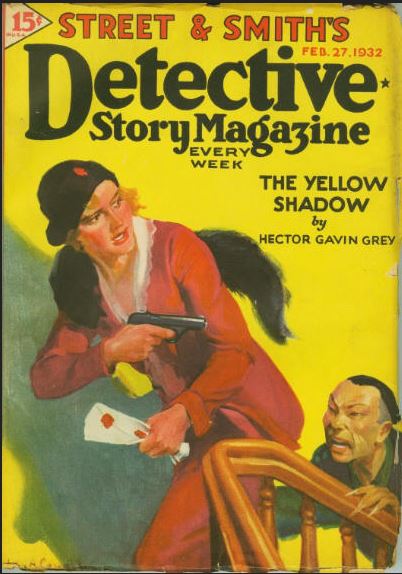
In its heyday, Street & Smith had three weekly "Story" magazines. Detective Story is considered the first detective pulp, though there were plenty of precursor detective dime-novel magazines. It may have been first, but it wasn't the best. Detective Story doesn't get the same love extended to Black Mask, Dime Detective or even Detective Fiction Weekly. I guess it missed out on or caught on very slowly with the hard-boiled trend. The canonical authors of the genre don't seem to have congregated there. The authors of this 1932 issue are completely unknown to me. That is a nice Yellow Peril cover by John A. Coughlin, however. For whatever reason, Detective Story didn't have the staying power of Street & Smith's other "Story" weeklies. While Love Story and Western Story maintained a weekly schedule all the way to 1943, Detective Story would lapse to biweekly before 1932 was over. It would go monthly in the fall of 1935 and stay that way for most of the duration. It was quarterly by the time Street & Smith killed most of its fiction mags in 1949.
Subscribe to:
Posts (Atom)