Showing posts with label Detective Fiction Weekly. Show all posts

Thursday, December 22, 2016

THE PULP CALENDAR: December 22

I remember reading about the time William Gaines, the publisher of EC Comics, was called before a congressional committee to testify about the violent content of his since-acclaimed horror comic line. Gaines was confronted with a cover that showed a woman's head that had just been severed from her body, and he was asked whether he thought the cover was in good taste. Gaines said he thought it was in good taste, since it did not actually show blood dripping from the victim's neck.

To my knowledge no one ever brought pulp publishers before Congress to answer for their youth-corrupting content, and yet ...


So I suppose the critics had a point who said that pulp magazine covers often repelled potential readers, or made them embarrassed to read them on the bus or train. I can definitely imagine this 1934 Detective Fiction Weekly turning off our more sensitive forebears, however much they may have wanted to read the latest exploit of Judson P. Philips' gentlemen vigilantes in the Park Avenue Hunt Club, or the latest caper of H. Bedford-Jones' gentleman thief Riley Dillon -- or, if it came to that, the latest, or to be precise the second adventure (of five total) of Richard Sale's Owl-Eye Venner. This doozy is particularly shocking because DFW covers at this time usually were relatively sedate compared to the rising "shudder pulps" or even to DFW's Munsey stablemate Argosy. It wouldn't surprise me if the editors got some negative feedback from readers, though we'd probably have to track down some early 1935 issue to find out what they let people say about it.

Saturday, December 17, 2016

THE PULP CALENDAR: December 17

Perhaps taking inspiration from Dashiell Hammett's description of Sam Spade as a "blond satan," Carroll John Daly, credited by some with inventing the hard-boiled detective before Hammett, created black-haired, vampiric looking Satan Hall, a police detective with a license to kill. After making his debut in Street & Smith's Detective Story, Hall moved to Munsey's Detective Fiction Weekly for an approximately five-year run. This 1932 issue was his fifth appearance; each time, Satan's picturesque features earned him the cover. His streak continued for another five appearances, and only once during his time at DFW did he not get the cover. Daly bounced the character from magazine to magazine, company to company for another two decades, including a brief stop at Black Mask, but Satan Hall never got another cover -- though that may be him under a hat in a 1954 Famous Detective featuring his final story. Also in this issue, Sidney Herschel Small's "The Crimson Coffin" is credited to his Jimmy Wentworth series in the FictionMags Index, but as far as DFW was concerned at this point, Small's recurring Tong villain Kong Gai was the main attraction. The other series character this time is Robert Rohde's Reggie Chivers, the Red Duke, who was near the end of a run that started in May 1929. Hulbert Footner continues a serial while John Reid Byers, John Hunter John H. Thompson and J. (Joseph, not John) Lane Linklater contribute short stories.

Tuesday, December 13, 2016

THE PULP CALENDAR: December 13

Not long after they slipped from weekly to biweekly status, the Munsey flagships Argosy and Detective Fiction experimented with photo covers that were (probably) paid publicity for movie studios. This 1941 effort is actually the only such photo cover for the former Detective Fiction Weekly. Gloria Franklin is identified as a Republic Pictures starlet but only made three pictures for that studio, and only appeared on screen seven times in a brief career, three times uncredited. Her big role, from a pulp standpoint, was Fah  Lo Suee in Republic's 1940 serial Drums of Fu Manchu. She had ninth billing in 1941's The Gay Vagabond. I guess the cover didn't help her much. Arguably, she was already finished. She wouldn't make another movie until 1947. No novelettes this issue; only short stories and an installment of Richard Sale's serial The Devil's Mistress. Dale Clark and William R. Cox are the best known of the other authors. The two "True Crime Mysteries" are the cover story, J. Hoyt Cummings' "Romantic Killer" and J. Denton Scott's "Marked for Murder." Detective Fiction would limp along in this fashion until March 1942, when it went monthly. In July, in a desperate attempt to woo the true-crime crowd, Munsey took "Fiction" off the cover altogether.

Friday, December 9, 2016

THE PULP CALENDAR: December 9

It seems like there was a perpetual struggle over at Detective Fiction Weekly against the temptation to make their covers look like vaudeville or fight-card posters with all the names and descriptions. Sometimes artists and editors resisted that temptation to tremendous effect, as we've seen a few times this year. More often, I fear, the thought was: "Let's try to mention as many things as possible that somebody might be interested in." One result is this wordy 1939 cover ballyhooing Handwriting Analysis and Cipher Solving along with the (hopefully) Outstanding Short Fiction. DFW probably needed all the specialized readers it could get at this point. It had been shrunk to 112 pages, presumably so the Munsey Corporation could use the paper saved for all its futile new Red Star magazines. They still had an ace to play in Erle Stanley Gardner, who was not so flush from the success of Perry Mason that he would not bother publishing in pulp anymore. That fall he had switched loyalties from Street & Smith to Munsey, moving his popular character Lester Leith from Detective Story to DFW. This week's "At Arm's Length" apparently was a standalone story without a series character. William Brandon's contribution is "Pat and Mike and Murder," while Hugh B. Cave contributed "Laugh, Clown!" DFW was still able to squeeze in short stories by Martin Lehigh and Lawrence Treat along with an installment of Dale Clark's "Cop's Crusade" serial, along with all the non-fiction stuff. Curiously unbilled on the cover is FBI director J. Edgar Hoover, who has a piece here on "Problems of Law Enforcement," which I suppose he'd know better than anybody.

Thursday, December 8, 2016

THE PULP CALENDAR: December 8


Who is this guy??? Someone new to Detective Fiction Weekly would probably get no clue from this 1934 cover, though the new reader probably could guess that it isn't Texas Kitty. I can eliminate H. Bedford-Jones' Riley Dillon, since I'm used to seeing him on covers in top hat and monocle. So he's either Anthony Rud's Jigger Masters, F. V. W. Mason's  Hugh North, or a generic gunman. Dillon was a gentleman thief HBJ brought over from Mystery magazine, where his stories appeared under the Rodney Blake pseudonym. Masters was a character Rud revived in 1933 after writing a run of stories about him back in 1918. North had been starring in his own book series since 1930, and would continue well into the 1960s, but Mason published a number of novelettes in the pulps; "Crime of the Legion" is one of two to appear in DFW. And if that weren't all for this week, there's the debut of a series character, Laurence Donovan's Pa Howdy, who would appear three times in DFW over the next few months before going into hibernation. Donovan would revive him for a run of stories in G-Man Detective beginning in 1942. Ernest Poate and K. (for Kay or Kaye, another case of initial only = female) Krausse contribute short stories. As for Texas Kitty, perhaps only those who've actually read this issue can tell who she was....

Friday, December 2, 2016

THE PULP CALENDAR: December 2

The man on the cover is definitely a bad guy, yet I suspect that, all else being the same, someone would object to putting him on a cover today because it would somehow glorify the organization he may be presumed to represent. He is not a Klansman, however, but a member of a cult investigated by T. T. Flynn's Mike and Trixie in a story that was reprinted in the mighty Big Book of Pulp Stories a few years ago. This issue also features a Daffy Dill by Richard Sale and the second Rex Sackler story by D. L. Champion, who would take the character to Black Mask for a decade-long run starting in 1940. Dale Clark continues the serial Cop's Crusade and Bert Collier contributes a short story to round out this issue's fiction content. The lead story may not be what the cover seems to promise, but if the cover got your attention it's still doing its job.

Wednesday, November 23, 2016

THE PULP CALENDAR: November 23


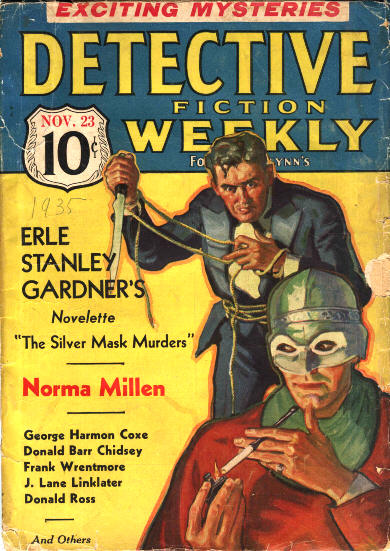
Apparently someone is going around murdering men in silver masks. Or maybe people are being killed with silver masks. The title of Erle Stanley Gardner's 1935 novelette suggests one or the other, and the cover definitely does not convey that the Man in the Silver Mask is committing the murders. Well, I'm sure someone 81 years later knows what really happened. This issue is heavy on series characters, by the way, including Donald Barr Chidsey's team of McGarvey and Morton, Charles Anderson's Indian John Seattle and H. H. Matteson's Ho-Ho Stevens. There's also a novelette by George Harmon Coxe, the continuation of gun moll Norma Millen's memoir, short stories by Maxwell Hawkins and J. Lane Linklater and the penultimate installment of Donald (Fred MacIsaac) Ross's The Eye of Isis, plus the usual columns. Looks like a pretty good issue overall.

Sunday, November 20, 2016

THE PULP CALENDAR: November 20


Rudolph Belarski cuts loose with a wild, comic-book like cover with a Washington D.C. backdrop for this 1937 Detective Fiction Weekly introducing John K. Butler's novelette "Death Rides the Wires." Death is pretty busy this issue, not only riding the wires but, as Denslow M. Dade reports, stalking at night. Also along for the ride are Bulldog Drummond, in one of his creator "Sapper's" last stories, Steve Fisher's Tony Key and Edgar Franklin's Johnny Dolan, while Robert E. Larkin and Roger Torry contribute standalone stories and Donald "Fred MacIsaac" Ross continues his serial Hot Gold. Death had skipped the last issue and would take the next three off before getting back to work in the December 18 issue.

Wednesday, November 16, 2016

THE PULP CALENDAR: November 16


The Park Avenue Hunt Club are supposed to be high-class vigilantes, so what do they have to do with that worried pug eyeing a gunman? I guess you'd have to get this 1935 Detective Fiction Weekly to find out, or pick up a reprint volume of Judson P. Philips' stories. The next obvious question is: who was Norma Millen, and what was Her Story? The answer is that Millen had just served two months in prison as an accessory to murder. Her husband Murton was a bank robber whose gang killed two policemen in Needham MA, one at the bank and one during the getaway, back in 1934. Murton Millen, his brother and another cohort got the chair, while Norma -- whose role in the crime remains unclear to the present day -- lived to tell what presumably reads as a cautionary tale. Her story started last week -- and she got the cover -- but she shares the spotlight this week with Richard Sale's Daffy Dill, stories by H. W. Guernsey, John H. Knox, Herbert E. Smith and Edward Parrish Ware, as well as Fred MacIsaac in his guise of Donald Ross. Millen will continue to recede from prominence in subsequent weeks. Next week her name will appear prominently in red on the cover, though not in the privileged banner position. The following week her name shows up as just another author. By the fifth and final installment of the memoir her name won't appear at all. Such is fame.

Friday, November 11, 2016

THE PULP CALENDAR: November 11

Emmett Watson makes a valiant effort to make the most of a copy-heavy 1939 Detective Fiction Weekly cover with that red curtain effect, but it still leaves you guessing what exactly the man with the gun is meant to illustrate. Is he the "sinister genius at war with humanity" in Carroll John Daly's new serial? If so, is he Mr. Sinister or did Daly not mean his title to be the villain's actual name? One way or the other, Daly liked the sound of the name -- or some pulp editors did -- and it would be used again as the title of one of his Satan Hall stories in 1944, generations before the name became identified with an X-Men comics villain. Meanwhile, William Brandon's Maggie and Ulysses apparently have made enough of an impression on readers since their debut in June to warrant a mention on that crowded cover. Hugh B. Cave, Norbert Davis and Walter Ripperger are worthy of mention, too, but Wyatt S. Blassingame and Bert Collier are not. They're shunted off with the nonfiction writers, columnists and cartoonist Stookie Allen in this issues "many others."

Monday, November 7, 2016

THE PULP CALENDAR: November 7


Who is that masked man? Is he a new hero or antihero for Detective Fiction Weekly? Or is it Lester Leith himself, Erle Stanley Gardner's hero who cons the cons? It looks like he's just another antagonist for Leith, a star character in DFW since 1929. "The Crimson Mask," from 1931, can be read by following this link to Evan Lewis's Davy Crockett's Almanack, where the story has been uploaded in its entirety. Gardner would continue to write Leith's adventures past his great breakthrough with Perry Mason, eventually taking the character to Street & Smith's Detective Story, where he got a big winking close-up at the end of 1938. An older but less active character in this issue is Arty Beele, the creation of Alexander and Ruth Wilson. "Cheap at the Price" is the penultimate story of a character who first appeared in December 1928, just two months before Leith's debut. Besides these characters, Fred MacIsaac continues his serial A Passport to Perdition while Ray Cummings, Stanley Day, Edward Parrish Ware and Russell Howells Watkins contribute short stories. The nonfiction pieces include Julien J. Proskauer's "Spook Crooks" column and Nelson Robins' "The Boy Executioners." Lejaren Hiller's covers from this period lack the pizazz of classic pulp, but this one definitely gets the point across.

Sunday, November 6, 2016

THE PULP CALENDAR: November 6


This 1937 issue looks more like Detective Fiction Western than Detective Fiction Weekly with that old prospector type on the cover. He's presumably a character in Donald Ross's (aka Fred MacIsaac) Hot Gold, though the setting is most likely more modern than he suggests. Along with the serial you get novelettes by Frederick C. Painton, Roger Torrey and H. H. Stinson and short stories by Dale Clark, Bert Collier and Samuel Taylor. I'd vouch for Painton but I don't know the other ones that well. There are plenty of DFW issues in the unz.org trove, most from 1936, but I haven't read those through as thoroughly as I have unz's Argosy collection. A project for another time, I suppose....

Wednesday, October 26, 2016

THE PULP CALENDAR: October 26


The combination of cover and title promise eccentric goings-on in Richard Wormser's "Sewn Up," the cover story of this 1935 Detective Fiction Weekly. While I know Wormser mainly for his Argosy adventure stories about entertainment-industry animal hunter Dave McNally, he's best known generally as a detective story writer. His "Complete Short Novel" is definitely short at 31 pages, but that is a long story for DFW. The other novelettes this issue are by Maxwell Hawkins and Ray Cummings, the latter continuing his "Crimes of the Year 2000" series with "The Metal Murderer." Fireman story specialist Karl Detzer and Harold de Polo contribute short stories, while Donald Ross (aka Fred MacIsaac) and Max Brand (aka we could go on all day) continue their serials, The Eye of Isis and Murder Me! respectively. In the spirit of the season, Robert W. Sneddon writes a nonfiction piece on "The Ghouls of Edinburgh." So will the lady remember the combination before someone she might care about gets his entire sock burned off? You'll have to buy this issue somewhere, for somewhat more than a dime, to find out.

Friday, October 21, 2016

THE PULP CALENDAR: October 21


Fred R. Miller, the author of this 1939 Detective Fiction Weekly's cover story, dabbled in pulp only briefly. He published two stories in DFW, including this one, and another in a 1941 issue of True Gangster Stories. Miller has a more interesting history outside pulp. Earlier in the Thirties he had been the editor of Blast: A Magazine of Proletarian Short Stories, where he published his first fiction. Miller criticized better-known leftist literary journals for being too refined or genteel, so perhaps pulp was a natural next step for him. "Dead Man's Blues" also appears to reflect Miller's interest in jazz, which found aborted expression in an unfinished collaboration with the poet William Carlos Williams. As a poet in his own right, Miller made it into The New Yorker a couple of times. Along with Miller's alleged "Feature-Length Novel" -- it's only 27 pages -- there's a serial chapter from Walter Ripperger, a novelette by J. Lane Linkletter and stories by Robert Leslie Bellem (a rare foray outside the spicy pulps), Hugh B. Cave and Philip Ketchum. This issue may lack DFW's big guns, but it may not be without interest.

Sunday, October 16, 2016

THE PULP CALENDAR: October 16


Detective Fiction Weekly was a little dodgy sometimes about crediting the authors of their cover stories. It makes for neater covers from an artistic standpoint but it wasn't really fair to the writers. The author of "If I Should Die" was Edward S. Williams, who wasn't exactly a nobody in the business. After an apparent false start with a 1931 western, Williams returned in 1934 as a detective writer and stuck. He'd been publishing in DFW since 1935, but it looks like he hadn't succeeded yet by this 1937 issue at creating a successful series character for the Munsey mag. He'd do better later with Dennis O'Ryley, aka The Voice, who became a regular feature in Popular Publications' Ace G-Man Stories in the early 1940s. Richard Sale, who had better luck with series characters, has a Daffy Dill story this week, while Edgar Franklin has a novelette about a relatively short-lived series character, George Batey. There are also novelettes by Maurice Beam and Joseph Millard, stories by Bert Collier, William T. Bannon, Vincent Hall and Carl Rathjen, and a serial chapter from Fred MacIsaac. Plenty of variety, at least.

Friday, October 14, 2016

THE PULP CALENDAR: October 14


From 1933, here's a somewhat grotesque Detective Fiction Weekly cover. Along with Francis Cockrell's cover novelette and a Judson Philips serial, this issue presents two established series characters: Sidney Herschel Small's Jimmy Wentworth and Stanley Day's Shamus Maguire, along with H. Bedford-Jones's one-week old Colin Haig, the protagonist of a six-week series of apparently interrelated short stories. Next week's entry, by the way, is "The Backward Swastika." Frank King contributes a short story while the ever-popular Convict No. 12627 contributes the purported nonfiction "Big Shots in Big Houses."

Thursday, October 13, 2016

THE PULP CALENDAR: October 13


Here's a slightly startling cover from a 1934 Detective Fiction Weekly. Among the weeklies, biweeklies and twice-a-months that make up the Calendar, DFW is probably your most likely source for spooky images, apart maybe from the twice-a-month days of Dime Detective. Herman Landon has the lead novelette and Edward Parrish Ware has the last of four Ranger Jack Calhoun stories to appear this year. The other series character this issue is Laurence Donovan's Boxcar Reilly, who had a sporadic existence. After making his debut here, Reilly went dormant, according to the FictionMags Index, until Donovan revived him for Street & Smith's character-driven Crime Busters pulp in 1937. According to the Index, Donovan wrote three Boxcar stories for Crime Busters, while Norman A. Daniels contributed another. Hulbert Footner of Mme. Storey fame continues his serial The Four-Toed Track, while David Crewe and Stephen Terry contribute short stories. David Crewe is listed as a house pseudonym for Popular Publications, but that doesn't account for the four stories under that name that appeared in Munsey's DFW in 1934-5. There's also a good-sized nonfiction piece by Tom Roan and the first in an occasional series of "Jujutsu" lessons from one John Yamado. Really, though -- how can you turn that face down???

Sunday, October 2, 2016

THE PULP CALENDAR: October 2


Here's a just mildly spooky Detective Fiction Weekly cover from 1937, promoting Richard Sale's novelette, "Give, Ghost, Give!" Overall the issue has a decent-sounding lineup, with a novelette by Cleve F. Adams, stories by Wyatt Blassingame, Whitman Chambers, Bert Collier Norbert Davis and Eric Howard, plus a serial installment from Fred MacIsaac. Don't expect a lot of really scary stuff from the weeklies and twice-a-month mags in October, but I'll see what I can come up with just the same.

Wednesday, September 28, 2016

THE PULP CALENDAR: September 28


The Vivian Legrand story in this 1935 Detective Fiction Weekly is actually titled, "The Adventure of the Maharaja's Wife," but the cover editor knows how to sell his magazine. This is The Lady From Hell's first cover appearance since her debut in January, but it's Eugene Thomas's twelfth story about his antiheroine in that time. She'd get twelve more stories and three more covers over the next year. Apparently the Lady outranks Richard Sale's Daffy Dill, who stars in the novelette "Man Bites Dog" this week. The actual long story this time is Maurice Beam's "Bad Blood," which clocks in at 33 pages. Max Brand continues his serial Murder Me! while Ray Cummings resumes his sci-fi series "Crimes of the Year 2000." Short stories by H. W. Guernsey, Robert McBlair and David Redstone round out the issue, along with a "How Good A Detective Are You?" vignette by Richard Wormser. Looks like a pretty good lineup overall.

Saturday, September 17, 2016

THE PULP CALENDAR: September 17

Here's an awesome Rudolph Belarski cover introducing a ten-part 1938 Detective Fiction Weekly serial. It's the only pulp work, apparently, by Lewis Clay -- presumably the same man who wrote a number of serials in the 1940s, including the original Superman chapterplay from 1948. So awesome is the cover, if not the concept behind it, that DFW regulars like Richard Sale's Daffy Dill don't even merit a mention up front. Overall, it's a pretty good sounding lineup, also including Roger Torrey, Hugh B. Cave, Lawrence Treat, Robert Arthur and two relative unknowns: Bert Collier and the more prolific Eric Howard. If you buy pulps for show, this one looks like a must-have.