Showing posts with label George F. Worts. Show all posts

Tuesday, September 12, 2017

SINGAPORE SAMMY: 'Save the bother,' Lauzanno snapped, 'I'll shuck my own clothes off.'


For Singapore Sammy's last bow (and only cover feature) in Short Stories, George F. Worts reverts to the formula of the second Sammy story. As in "Cobra," "Octopus" (May 10, 1931) makes much of its villain's resemblance to the title animal. Pierre Lauzanno isn't a half-caste, but he's nearly as bad in his author's eyes, "American born, of Portuguese ancestry and Oriental upbringing." While Worts mixes metaphors by giving Lauzanno "the arms of a gorilla," he is a moral octopus in the writer's eyes, "a man who would indulge in any form of murder to accomplish an object." "Octopus" also reproduces the earlier story's motif of partnership between a properly "hard" man and someone whose addictive nature makes him unfit for the life of a South Seas adventurer. The difference this time is that Sammy isn't one of the partners. Instead, back in the burg that gave him his nickname, he encounters a mismatched pair at a crooked card game. One of them, Kelvin Broome, "the Viking," is just like Sammy's protege from the earlier story, only more belligerent; he can't lay off the cards or the booze. The other, "the buccaneer," is virtually another version of Sammy Shea. The improbably named Lucifer "Lucky" Jones will end up being Singapore's sidekick in future stories; he proves a resourceful companion here as the men join forces to avenge Broome, who gets knifed in an alley after the card game breaks up violently. They mean to secure Broome's map of a sunken treasure; finding the treasure, they hope to send it to the dead man's poor family on an Arizona orange grove, to help his sister go to art school. These are the same guys who go around boasting of how "hard" they are, and who we're told are hard by the author. Mush!

Anyway, Singapore and Lucky catch up with Lauzanno and prove just how hard they are by torturing him into giving up the map, with unplanned assistance from an actual octopus that attaches itself to the villain while our heroes are dunking him in the sea. In the middle of this there's a weird moment when Sammy "placed the flat of his hand against a davit and looked at Lauzanno dreamily. Those who had experience knew that this was by far the most dangerous, most sinister expression that the red-haired young man used." I'm sure Worts only means that Sammy's on the brink of going psycho on his antagonist, but given the context of torture, and maybe because I'm a 21st century reader, I can't help reading something even more sinister into our hero's dreamy expression. Despite that, Lauzanno proves a tough egg until the octopus intervenes and makes him beg for mercy. Shay and Jones then make the mistake of letting Lauzanno live.

"Octopus" is the longest of the early Sammy stories, but the way it breaks into nearly equal halves  suggests that Worts (or the editor of Short Stories) may have slammed two novelettes together. The second half of the story becomes a tag-team match as Lauzanno hooks up with the infamous Bill Shay, Sammy's reprobate father, whom the villain tracks down with an alacrity that puts all of Sammy's previous efforts to shame. Things went badly for the old man after we left him at the end of "The Pink Elephant." Held responsible for the sacred title creature's death, Bill was tortured by angry Siamese authorities. Already poised to benefit from Sammy's death according to the will of Sammy's grandfather, Bill, who was previously amused to lead the boy on wild-goose chases, is now out for blood. He and Lauzanno lay in wait while Sammy and Lucky hunt for the treasure, then pounce when the younger men go down in diving suits to retrieve the sunken gold. Worts is good at selling every encounter between Shay the elder and Shay the younger as a big moment, especially when Sammy is shocked to discover Dad in a diving suit attacking him alongside Lauzanno. There's also a very cinematic moment when, in the midst of another intervention by a real octopus, Sammy catches one last glimpse of Bill before the old man zips up to the surface to escape the carnage that consumes Lauzanno, and from which our heroes barely escape. It's an exciting finish to a story that's just slightly overlong, though by modern standards the extra length is put to relatively good use building up Singapore and Lucky's friendship.

From here Worts took Singapore Sammy to Argosy, where he debuted in an eponymous serial in December 1931. As for me, I'll be going back to where I discovered Sammy, in the invaluable Big Book of Adventure Stories, before proceeding to items from my own collection. Of his three major characters -- Peter the Brazen and Gillian Hazeltine are the others -- Worts stuck with Sammy the latest. The conclusion of the 1936 Sammy serial Murderer's Paradise was the effective end of the author's pulp career.

Wednesday, August 23, 2017

SINGAPORE SAMMY: 'You ain't hard. You ain't smart. You're just a sucker.'

George F. Worts pulls off a nice piece of misdirection in the fourth Singapore Sammy story, "The Pink Elephant." (Short Stories, October 25, 1930). At the same time, he raises the stakes in Sammy Shea's hunt for his reprobate father, since I believe it's established here for the first time that the will which left Sammy his grandfather's fortune, but was stolen by his dad, contains a clause bestowing the estate upon the father in the event of Sammy's death. So just as we get our first real look at Bill Shea, we learn that he has a motive to kill his son. Sammy has tracked him to Siam (the present-day Thailand), where our hero's sob story has earned him the sympathy of a local prince who's equipped him with a handsome entourage of elephants and hunters to find the elder Shea. Early on, Sammy finally tracks has the old man in his sights -- or at least he finds a man who matches the description he depends on, that of a bearded man in the robes of a Buddhist monk, since Sammy himself hasn't seen the guy since he was two years old. After a tense, almost glancing encounter, Sammy is distracted from the chase by his abrupt discovery of the title creature, whom he rescues from crocodiles in a mud pit. The baby pink elephant is a phoouk, a rare and virtually sacred creature in Siam, and on sight of him Sammy is distracted from his potentially parricidal quest by that streak of greed that Worts has already well established. This changes the whole direction of the story, as Sammy realizes that he can earn a literally princely sum by delivering the phoouk to the king. The discovery also changes his relationship to the local prince and his minions, who feel that the pink elephant, being found in their master's territory, is his to deliver to the king, for whatever reward. Sammy understands that his trip to the capital will be dangerous, and that his erstwhile host will likely prove his enemy.

Into this tense situation wanders Sir Lester, a stereotypical Englishman touring the country "lookin' for big cats." His warning that Sammy runs "rather a risk" taking the phoouk all the way to Bangkok makes our hero suspicious. "Sammy looked quickly in Sir Lester's eyes," Worts writes, "saw something there that he did not like." But what else is new? Why wouldn't Sir Lester be just as eager to nab the elephant as anyone else? So Sammy has someone new to worry about -- except that the Englishman is not so new.  After inviting Sammy to sit in a blatant trap and then springing it, Sir Lester reveals himself as Bill Shea. For this one time we can buy that Sammy could be so easily fooled because he hasn't had a good look at his father for so long. Once Sammy identifies him, Bill greets him with, "Smart boy! All you needed to find it out was a moving picture and a full set of directions!" Luckily for our hero, the old man is content to taunt him and steal his elephant.

They told me that you were one dangerous guy to cross. Hell, you ain't hard. You ain't smart. You're just a sucker. I was almost gettin' proud of you -- and then you have to up and pull this stunt. You sucker!...What did I tell you in that letter I sent you when you were in the Singapore Hospital? 'The hand is faster than the naked eye. A wise man knows the aim of a bottle!' I warned you. You're just dumb.

Worts uses the occasion to recap the Sammy series to date from Bill's second-hand point of view before the old man absconds with the phoouk. He's arranged to have Sammy freed some time later, well after Bill and the pink elephant are out of reach -- or so Bill assumes. He hasn't reckoned with the bond Sammy has formed with Bozo, the prince's mighty alcoholic elephant. In the story's silly finish, Sammy steals Bozo from the prince's estate, fuels him up with whisky, overtakes Bill's party and manages to sneak off with the pink elephant. Score one for Sammy Shea! Silly as it is, "Pink Elephant" is a strong entry in the series thanks to its spectacular introduction, four episodes in, of the main villain, who promises to give Sammy still more trouble in the future.

Monday, August 7, 2017

SINGAPORE SAMMY vs 'the toughest egg south of Shanghai'

Still hunting his reprobate father, Singapore Sammy Shea is hunted himself in his third story, "South of Sulu." (Short Stories, June 25, 1930). Ever since word got out that he had brought in the infamous Blue Fire Pearl of Malobar to be appraised, the scum of sea of land have been gunning for him and the pearl. Following a lead on his father, Sammy encounters three such characters on the island of Pelambang. Peddy the trader, stereotypically fat, runs the place. Whisky Wallace is one of his henchman. Their uncomfortable partner is Big Nick Stark, "the toughest egg south of Shanghai," who feels that his cut of the loot to be taken from Sammy doesn't really reflect his contributions to the endeavor. Sammy's no fool and leaves his pearl in a secure location on his boat before setting foot on Peddy's island, where he is predictably ambushed by the terrible trio. They tie him up and threaten torture if he doesn't come across, but with each working at cross purposes against the others Sammy has an opening to escape. Things get pretty hard-boiled as the bad guys threaten to put a lit cigar, a broken bottle, etc. in Sammy's face, but this all proves to be prelude to Sammy's battle of wits with Big Nick. Detecting a double-cross from Peddy, and killing him off-stage, Stark offers to join forces with Sammy, luring the good-but-greedy Singapore with the long-sought mate to the Blue Fire Pearl. Sammy is greedy enough to gamble his pearl against Stark's, and once he agrees to that we remember the scene early in the story where Big Nick impressed Peddy with his fancy shuffling and dealing. Worts knows how to keep things suspenseful by having his bad guys often stay at least a step ahead of Sammy, and he increases readers' anxiety by having Sammy lose at cards to Nick not once, not twice, but thrice -- the last time with his life at stake, since losing obliges Sammy to swim through shark-infested water to get rescuers to their stranded boat.

Stark apparently has an uncanny yet deceptive shuffle that looks guilelessly awkward even to a practiced eye like Sammy's, yet infallibly delivers Big Nick the winning hand. It's a bit of a cheat that Worts never actually explains Nick's technique, but has Sammy finally find proof of his cheating by accident -- he'd left an ace in the box quite by mistake, yet Nick dealt himself four aces. Worts is also wise to give Nick plenty of time to make his spiel, as if trying to wear down the reader's resistance as Nick is trying to wear down Sammy's. And for the hell of it, the antagonists have to forget their differences long enough to get their boat through a nasty storm. It keeps you wondering whether Nick will prove a good egg after all, rather than a mere tough one. "South of Sulu" gives us a likably nasty Sammy instead of the self-righteous con man of the previous story, "Cobra." He gets great tough-guy dialogue, telling Nick that "If you put her aground, one second later your backbone's gonna think an elephant's takin' a walk on it," or that "for the pure pleasure of it, I could turn you into curry of lead." It's still not as good as the original entry, "The Blue Fire Pearl," but you're more likely to keep following Sammy on his quest after this one than after "Cobra." There are two more to go in the first Altus Press volume of Sammy stories, and then I'll jump ahead in time to some later items from my own collection. Stay tuned.

Monday, July 24, 2017

SINGAPORE SAMMY: 'A wise man knows the aim of a bottle'

The second Singapore Sammy story by George F. Worts, "Cobra" (Short Stories, May 25, 1930) takes place "several months" after the events of "The Blue Fire Pearl." By now, it's widely known that Sammy Shay has in his possession that famous bauble, and some people would like to take it off his hands, or from around his neck. The story opens with Sammy, ever on the hunt for his reprobate father, walking into an ambush set by our new villain. He is that most despicable of persons for George F. Worts: the half-caste. "This man was part Portuguese, part Malay, and part God knows what," we learn, "In him, the West met the East and became a power for unlimited malice." The narrator, and in turn Sammy himself, is obsessed with the way the villain resembles a cobra in his "steady, wicked stare." Singapore fights his way free from the ambush but suffers a severe stab wound in the process. If not for a good samaritan who arranges to have him hospitalized with private nursing care, our hero might have died in the street. Once Sammy recognizes his savior, he wants nothing to do with the man.

The man, or "rat" in Singapore's estimate, is Ted McAlister, a onetime protege of Sammy's who couldn't lay off gambling, and couldn't lay off the booze and opium while gambling. It takes a while for Sammy to understand that Ted is on the wagon, except for the gambling that is. He owes $15,000 in chits, proving to Singapore that "You don't belong in China." Ted wants to go back to America and make a fresh start in his dad's business, but can't afford passage with his debts. Now that Sammy owes him something and feels sorry for him, and with his dad's trail gone cold, he works on a way to send the American home while getting his revenge on that human cobra, Armand De Silvio.

Whether you like "Cobra" better than "Blue Fire Pearl" depends on how you like your pulp fiction. Sammy's debut was an all-out action story, while "Cobra" becomes a con-man caper as Sammy uses Ted's own black pearl to con the cobra. He has Ted show the pearl to De Silvio, who runs a jewelry store, and inquire as to whether the half-caste has a matching pearl, for which he'll pay a tremendous price. Sammy then arranges to sell De Silvio the very same pearl Ted showed him, at an inflated price that will more than cover Ted's debts and his passage home. While Sammy comes across as a goody two shoes for much of the story, the way he lectures Ted, he shows a more familiar ruthless streak while working his con. He's going to sell the pearl to De Silvio while disguised as a Hindu. Since he doesn't have a Hindu costume in his wardrobe, he lures some poor mark into an alley, beats him up and takes his clothes. His ultimate revenge on De Silvio is twofold. He has Ted tell him that he no longer wants the matching pearl, meaning that the half-caste has wasted his money. Then, out of a spiteful sense of poetic justice, he throws a real cobra into De Silvio's cashier's cage to terrify the villain into returning the money his men had taken from Sammy at the start of the story.

In an epilogue, a fresh lead puts Sammy back on his father's trail, despite a warning letter in which the old man had told him, "A wise man knows the aim of a bottle." According to Singapore, this is a Siamese saying meaning, in a more contemporary idiom, that "a hunch to a wise guy is plenty." The thought returns to him as the police discuss the cobra attack on De Silvio and express their reluctance to investigate anything having to do with such a dangerous creature. If this story proves anything, it's that Singapore Sammy is not about to take anyone's advice, including his own. His mentorship of Ted McAlister seems to have worked on a "Do as I say, not as I do" level, but you can only teach some people just so much. Sammy can be sentimental about people, as his first adventure showed, but whether that makes him a good guy the way he apparently wanted Ted to be is another story -- or several more to come.

Wednesday, July 5, 2017

"Sentimental Sammy was a pagan ..."

The Blue Fire Pearl is the first volume of Altus Press's planned complete edition of the Singapore Sammy stories of George F. Worts. The volume is part of Altus's "Argosy Library," but like some previous volumes in this series, the stories actually appeared in another pulp, Short Stories. Sammy did have his best-known run in Argosy and actually made some covers of the venerable weekly, but Worts didn't take him there until late 1931. The five stories in Blue Fire Pearl date from  March 1930 to May 1931, though the copyright information in the e-book backdates them to 1928-29. It's noteworthy in comparison to comic books in particular that pulp publishers didn't often claim series characters as their intellectual property, the great exceptions being the hero-pulp stars like The Shadow and Doc Savage. Characters like Singapore Sammy or W. C. Tuttle's Hashknife Hartley could bounce from magazine to magazine, presumably because the authors were never contract employees of the publishers. In any event, Sammy Shea emerges pretty much fully formed in his debut, "The Blue Fire Pearl" (March 10, 1928), in which Worts shows admirable restraint by not frontloading the story with Sammy's origin. Sammy is a fortune hunter working his way through Asia in search of his father, possibly pulpdom's ultimate deadbeat dad. Shea the elder abandoned Sammy and his mother, taking with him a will that gave Sammy his mother's fortune. Our hero's only clues on his vengeance trail is that Dad was obsessed with pearls and elephants.

Tales of an older man pursuing pearls and elephants take Sammy to Malobar, where he's arrested for invading a temple and slugging a guard, though he only wanted to ask if his father had been there. He becomes the captive of a decadent maharaja whose idea of modernity is an obsession with boxing. With two Americans as his prisoners, the maharaja decides it would be sporting to give them a chance at freedom and a great prize -- the title pearl -- by staging a fight. The winner goes free with the Blue Fire Pearl, while the loser is tossed into a panther pit. Not eager to kill or be killed, Sammy entertains Burke's plan for them to carry each other to a draw before making a break for it with the help of a Chinese boy Sammy has befriended. Worts does a great job keeping us suspicious of Burke's true intentions while emphasizing Sammy's self-interest throughout. Sam Shea is a good guy overall, but Worts makes it clear that he is greedy for that pearl and realistic about his own chances in a real fight with a bigger man, despite a fluke championship in his backstory. As the fight progresses, Sammy realizes that Burke is really out of shape and presumes that he proposed the fix for his own self-preservation. No sooner has he drawn this conclusion, however, than we realize that Sammy has underestimated his possum-playing opponent. Our hero is floored for a seven count, but Burke's treachery and the maharaja's contemptuous prodding ("Get up and fight, you white dog!") only make him mad. Now he's looking for a way to kayo Burke, break free from the ring and steal the pearl -- and, despite himself, to save Burke from execution, because it's the holiday season.

While Worts was also known for his series about defense attorney Gillian Hazeltine and the Peter the Brazen stories (under the pseudonym Loring Brent), his Singapore Sammy stories are by far his best work as far as I'm concerned. They're more hard-boiled and less melodramatic than Worts's other stuff, while Sammy himself is convincingly a good guy without being a goody two shoes. I look forward to reading and reviewing the other stories in the Altus Press collection, and then jumping ahead to some Sammy material from my own collection in the near future. Stay tuned....

Monday, December 12, 2016

THE PULP CALENDAR: December 12

George F. Worts' Singapore Sammy made his debut in Short Stories in 1930. After five appearances in little more than a year, Sammy moved to Argosy, where Worts was publishing his Gillian Hazeltine series under his own name and the Peter the Brazen stories as Loring brent. This 1931 issue reintroduces Sammy to the pulp public with a two-party story named for the protagonist. It may be Sammy's first cover. His last Short Stories appearance is top-billed on the May 10, 1931 cover, and I assume the same cover was used for the "Mid-September" British reprint, but the character coming out of the water in a diving suit with a rifle doesn't look like the redhead Argosy readers would come to recognize. In any event, after being reintroduced in dramatic fashion Sammy went on hiatus until 1933, which is regrettable since the adventurer with a grudge against his dad is easily the best of Worts/Brent's three major creations. Overall this looks like a decent issue to have, thanks also to novelettes by Eustace L. Adams and F. V. W. Mason. The continuing stories are Kenneth Perkins' bayou mystery The Tavern of Terror and J. E. Grinstead's western Golden Derringers, while Foster-Harris, Kenneth MacNichol and William Merriam Rouse contribute short stories. Should you choose to get Singapore Sammy complete you'd get novelettes by Erle Stanley Gardner and H. Bedford-Jones in next week's issue. You could definitely do worse.

Wednesday, June 22, 2016

THE PULP CALENDAR: June 22


Back to my 1935 Argosy collection, here's the start of the one complete Singapore Sammy serial by George F. Worts in my collection. Shark Bait is only a three-parter so it's not that impressive an achievement but I'm pretty proud just the same and I look forward to reading the whole thing over the summer It looks like Sammy hasn't been doing so hot since dealing with The Monster of the Lagoon earlier in the year -- he definitely doesn't look as cool and badass as he did on his last cover back in February -- but he has one more serial in him after this so I wouldn't worry too much. This issue is strong on the serial front, also including part two of F. V. W. Mason's Lysander of Chios and the penultimate installment of Hulbert Footner's Sink of Iniquity.


June 22 also has a solid lineup of standalone stories, led by novelettes from Tom Curry and George Bruce. The latter, an aviation specialist who contributes an autobiographical sketch on the "Men Who Make the Argosy" page, had recently been so popular with pulp fans that he had had magazines named after him. The short stuff may be the weakest this issue. Anthony M. Rud contributes an animal story, while Ted Copp is a relatively unknown quantity for me. His looks like an attempt at humor, however, so I'll be on my guard. I prefer to emphasize the positive, since this starts a run of four consecutive issues encompassing two complete three-parters, the second of which I'll introduce a week from now. This number was brought to you by:


For all the emphasis on action stories, this ad reminds us that Argosy was aiming at a female audience as well, as the Argonotes letters pages often remind us. This week, for instance, while praising Monster of the Lagoon, Frances Gunther of Yamhill OR tells readers that "I could love Sammy. He isn't really bad." She's also glad that Worts "did not forget the girl, which made the story more interesting for us female readers." You wouldn't take Singapore Sammy for girly stuff, but there it is.

Thursday, May 26, 2016

THE PULP CALENDAR: May 26


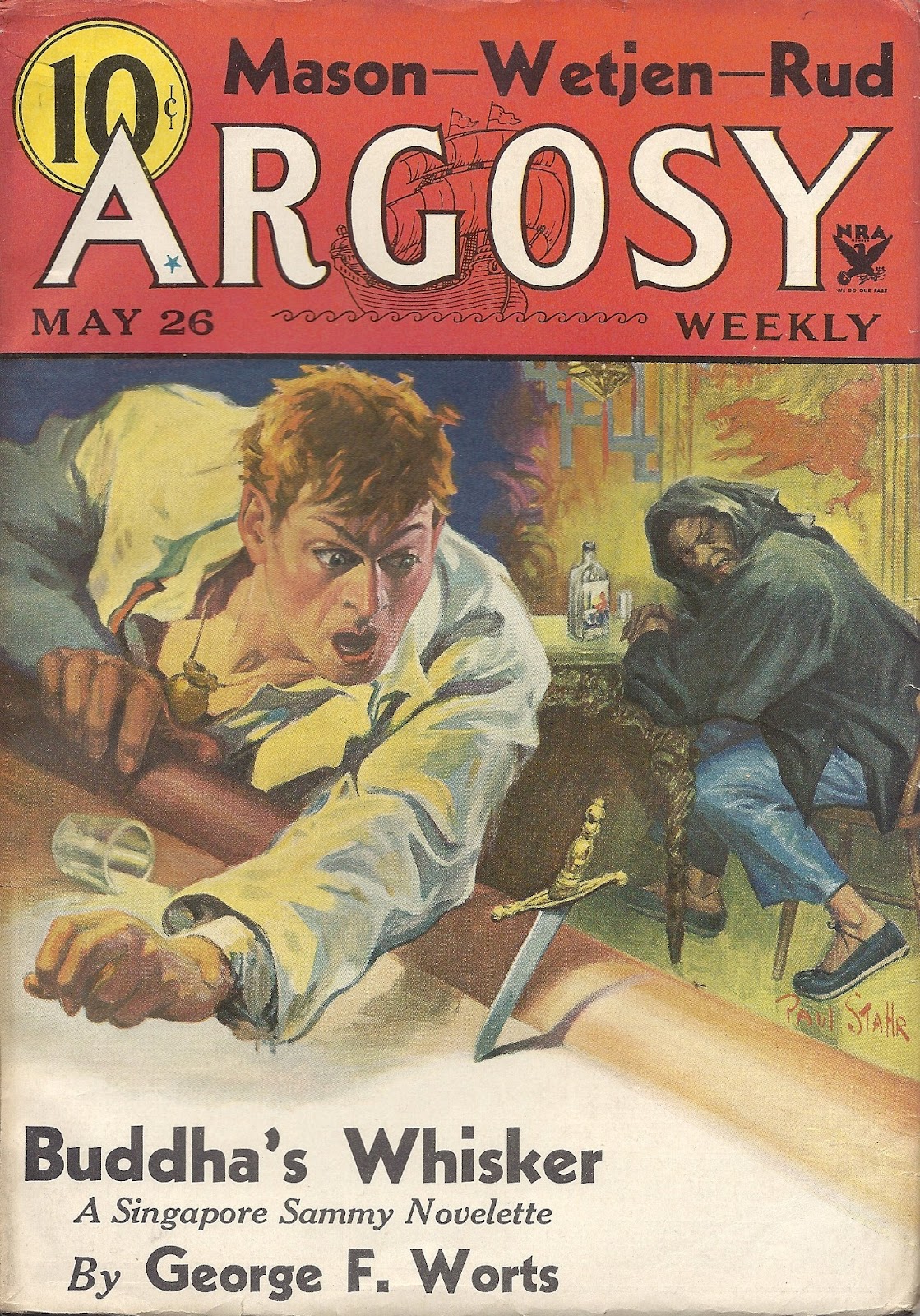
The main attraction of this 1934 Argosy for me is right on the cover. "Buddha's Whisker" is a fun standalone Singapore Sammy story by George F. Worts. Sammy Shea is always on the trail of his deadbeat crook of a dad or else raising money to continue the hunt, and in this novelette he and sidekick of the moment Lucifer "Lucky" Jones get drawn into a plot to steal a sacred relic that ends with Sammy thisclose to finally catching up with his punk parent. While Worts's Peter the Brazen stories, written under the name of Loring Brent, feature a stalwart, upright hero, the Sammy stories are charmingly disreputable in the almost amoral manner of South Seas or Asian adventure. "Whisker" is the last Sammy novelette; Worts would bring the character back in three serials over the next two years, including the 1935 three-parter Shark Bait that will be showcased on this blog.

There are no new serials this week as the issue concludes J. Allen Dunn's Forbidden Mountain while continuing F. V. W. Mason's The Barbarian and Frederick "Evan Evans" Faust's Montana Rides Again. Anthony M. Rud contributes the novelette "The Marked Deuce" set in South America, while Theodore Goodridge Roberts writes a short story, "The Hero," about an unlikely hero who inspires a ship's stand against an infamous pirate and his ship.Albert Richard Wetjen usually wrote stories of men at sea but with "Hammerhead" he tries his hand at animals at sea and comes up with something reasonably entertaining for the genre. The serials are as entertaining as fragments can be but "Buddha's Whisker" and the Wetjen story really make this issue worthwhile. I like The Barbarian enough that I'm gradually piecing it together. I have the next chapter, for instance, but the main attraction of the June 2, 1934 Argosy, as you'll see a week from now, is another Bellow Bill Williams story by Ralph R. Perry. Don't miss it.

The May 26 Argosy is sponsored by:


Thursday, April 7, 2016

THE PULP CALENDAR: April 7

This 1934 Argosy is from my own collection. One of the "Two Adventure Novelettes" advertised on the banner is Ralph R. Perry's "The Wrong Move," which I'll be sharing with you later today. It's one of seven Bellow Bill Williams stories Perry published in Argosy that year, his most productive with his tattooed pearler. Let's find out a little more about the rest of the issue:


Cover author Karl Detzer specialized in firefighting stories. I like what I've read of him, and the first installment of The Fatal Alarm was pretty entertaining. Billing it as a "Chicago novel" rather than a "fireman novel" is apt, because Detzer is attentive to the role of petty politics in a firefighter's career. I haven't read more past this issue (there's an installment in the unz.org trove) but I'd consider a chapter an incentive when considering issues for future purchase. The other adventure novelette is Jack Allman's "The Curse of the Khans," a survival story set in Tibet back before the present Dalai Lama became a global icon of benign spirituality. The pulp Tibet, by comparison, is a barbaric place where the lamas often are far from benign. That may be unsettling if not scandalous to some modern readers, but on its own terms Allman's is a decent action story. Better still is Robert Carse's short story "Adios," in which an old American mercenary is drawn reluctantly into a Latin American revolution, only to take revenge on both sides. The other serials are Max Brand's Brother of the Cheyennes, which I find hard to judge, having dropped in the middle of it, and the conclusion of George F. Worts's The Gold Coffin, featuring his fighting defense attorney Gillian Hazeltine. It was the first bit of Hazeltine I ever read and I wasn't really impressed. Lawyers growl at one another a lot to set the overwrought tone. Read a Hazeltine, I say, and you'll appreciate how good Erle Stanley Gardner really is at this sort of thing. Lest I forget, Samuel Taylor contributes a western short story with a stuttering hero. The hero narrates the story, but Taylor thankfully refrains from having him narrate with a stutter. Instead, Stuttering Steve narrates in the colloquial present tense I associate with Frank Richardson Pierce's No-Shirt McGee -- not quite dialect, but not quite formally grammatical, either. Overall, it's a strong issue from one of Argosy's strongest years. I may share more of it with you besides the Bellow Bill story, and if I feel really ambitious I may scan the whole thing eventually. For now, this issue was sponsored by:


Thursday, March 24, 2016

THE PULP CALENDAR: March 24

Here's another Argosy that's available at unz.org. I don't know if The Gold Coffin is, indeed, Gillian Hazeltine's strangest case, but having read one installment I'll concede that it is strange. The high concept is that a popular Hollywood actor, someone in the James Cagney-Clark Gable "caveman" mold -- he pushed an actress's face into a half-watermelon in one picture -- who made such a big hit playing a lawyer in another picture that he was admitted to the bar, asks to be hired by Hazeltine, for the moment still the nation's best known defense attorney -- the clock is ticking, though, for the first Perry Mason novel had been published recently -- as a publicity stunt designed to intimidate the studio that had been ripping him off to offer him a new contract appropriate to his studio-saving popularity. This guy is a regular Lon Chaney, as actors in pulp fiction usually are, making his entrance in weird old man disguise for no good reason. While Hazeltine can't figure out this (superficially) thuggish thespian's appeal to women -- both his wife and his secretary are smitten -- his own sensationalist impulses lead him to take the lad on. Then the story proper begins, which has something to do with a mean old miser who's hoarding gold in spite of FDR's order and hurting the already damaged U.S. economy. Unz doesn't have the other two installments, but I have the conclusion in my own collection, so maybe I'll let you know how it all turns out. For me the highlight of the issue is the ill-described "Air" novelette, Eustace L. Adams's "Hideaway Island." It has a scene in which characters in the story travel by airplane, but in fact it's a vigilante story of the sort then in vogue, in which a quartet of war veterans, the wealthiest of whom had received a kidnap threat, turn the tables on gangsters by kidnapping them and imprisoning them at the title location. For extra measure Adams hits the island with a hurricane. It's an okay story but really has too many heroes, with not enough personality, for its own good. Meanwhile, the rival kings of pulp, Max Brand and H. Bedford-Jones, each continue serials, Brand's Brother of the Cheyennes and HBJ's Jungle Girl, the latter really more about the man who finds the jungle girl and thus disappointing for anyone expecting a precursor to Sheena, Queen of the Jungle. The "Sports" novelette is Richard Howells Watkins's racing story "Dirty Driving," but since it's a sports story I skipped it. Wrapping up the lineup is William Merriam Rouses's story of the 19th century Adirondack wilderness, "The Witch of Silverwood," and another of John H. Thompson's series of shorts about his two tramps, Bill and Jim. From "Cappers" I learned that a capper is something like a shill, someone who pretends to win a big prize in a carnival game to entice others to play and lose. It's not a bad racket but Bill and Jim tend to screw up any racket they get involved in. Their misadventures are brief enough to amuse without growing annoying. This is a relatively weak issue from a peak Argosy year but when it's free reading you can find some things worth your while. Check it out through the link below to judge for yourselves:

Monday, March 21, 2016

THE PULP CALENDAR: March 21


This 1936 Argosy comes from my personal collection. I acquired it because the Ralph R. Perry story advertised on the cover, "Shark Trail," is the last appearance of his tattooed pearler Bellow Bill Williams. I acquired this issue recently and haven't read the story yet. My habit is to read my pulps in chronological order, which means I have a way to go before I get to 1936, though I may jump ahead for the sake of Bellow Bill. This is a milestone issue for another reason: the cover story is the final appearance of George F. Worts' mystery-solving defense attorney Gillian Hazeltine, a Perry Mason precursor who'd been an Argosy star since 1929. I've read some Hazeltines and you can see why Mason, not he, became pop fiction's iconic lawyer. The Hazeltine stories I've read, which have a running subplot of his rivalry with a corrupt district attorney, are actually pretty dumb and not on the same level as Worts's Singapore Sammy stories. Worts was phasing himself out of Argosy in 1936. Having retired Peter the Brazen and his own Loring Brent alter ego the year before, Worts would follow Mr. Hazeltine -- Murderer with one more Singapore Sammy serial, and then it was on to the slicks. The other serials this week are Eustace L. Adams's Death Rides the Wind, which should be good stuff, Traitor's Shadow, a Revolutionary War story by John Wilstach, whose other specialty was circus stories, and Ted Copp's The Wildcatter. Wilstach and Copp are authors I haven't read yet but I have some of Wilstach's stuff in my 1935 pile, so I should have an opinion of him soon. Serials of a sort are Judson P. Philips's series of sports stories set at Madison Square Garden and George O. Norville's White Adventure, a longform non-fiction account of an Antarctic expedition co-written with up-and-coming pulpster T.C. McClary. Perry's novelette is the only real stand-alone story in the entire issue, but it was reason enough for me to get it. The extra serials (there were only two at a time a year earlier) make 1936 Argosies more of a chore to collect but with the magazine still arguably at its peak they're probably worth the trouble. This particular issue is sponsored by:


Tuesday, February 23, 2016

THE PULP CALENDAR: February 23


The February 23, 1935 Argosy is as loaded an issue as you're likely to see. For starters, it concludes Eustace L. Adams's serial Anywhere But Here, which I'll have ready for you to download later this week. And as Adams wraps up his story, George F. Worts launches a Singapore Sammy serial. Worts was one of Argosy's superstars in the first half of the Thirties, with Sammy and ace defense attorney Gillian Hazeltine being two of the pulp's most popular recurring characters, and that's not even counting his side gig as Loring Brent, the creator of Peter the Brazen. Singapore Sammy Shay is the best of Worts/Brent's creations: a slightly disreputable globetrotting treasure hunter with a grudge against his devious deadbeat dad. While Worts would close up the Loring Brent shop with a final Peter the Brazen novelet later in 1935, Sammy would get three serials, counting this one, over the next two years before his creator jumped to the slicks and got boring.

Now that I've covered the serials, let's see what else this issue has to offer.


Two top pulp hands introduce new characters this issue. "Spy Against Europe" is the first of three H. Bedford-Jones stories about a spy who comes to be known as The Sphinx. To be honest, I can understand why the series didn't last long after reading this one. More of a milestone is W. C. Tuttle's contribution, "Henry Goes Arizona." To explain the apparent illiteracy, one "goes Arizona," presumably, the way one "goes Hollywood." Henry, to introduce him fully, is Henry Harrison Conroy, a relic of vaudeville who finds himself heir to a ranch in Wild Horse Valley, Arizona. Dismissed as a dude and a drunk, and decried as "The Shame of Arizona," Henry's sardonic intelligence, and a little help from his eccentric new friends, always gets the better of the bad guys in the modern but still wild west. Perhaps the ultimate embodiment of Tuttle's specialty, the comic western detective story, Henry was an instant hit with Argosy readers, and proved popular enough to justify an M-G-M adaptation of this issue's origin story, only with Frank (Wizard of Oz) Morgan in the title role rather than the too-obvious W. C. Fields, though Fields alone, as both actor and writer, could have done the part real justice. Before 1935 was over Henry got his first Argosy cover, and from that point forward his red-nosed rotundity fronted any issue that started one of his serials. Henry survived the collapse and near-demise of Argosy by moving to Short Stories, where his adventures continued to the end of the 1940s.

While Henry's debut makes this an historic issue and the two serials are terrific, the true highlight this week, for me at least, is Ralph R. Perry's "Fangs of the Fetish," an appearance by my own favorite Argosy character, Bellow Bill Williams. I'll be spending a large part of this week proselytizing for Bellow Bill: scanning "Fangs" for your reading pleasure and linking you to other tales while compiling a preliminary checklist of the tattooed pearler's career that will expand greatly on the Fiction Mags Index's inventory. Argosy hardly gets more pulpy in the blood-and-thunder sense than when Bellow Bill roams the South Sea islands, as you'll find over the next few days.

Once I make the Adams and Perry stories available, most of the contents of this issue will accessible to non-collectors in one way or another, as the Bedford-Jones and Tuttle stories have recently been republished by indispensable pulp-fiction preservers Altus Press, while RadioArchives.com recently issued The Monster From the Lagoon in its entirety as an e-book. If I'm feeling generous I'll scan the Kenneth Gilbert and Frank Triem stories, one an animal story, the other a western short, so that pulp fans can collect a virtually complete issue of the venerable weekly from somewhere near the peak of its powers. For now, I leave you with a word from this issue's sponsor:


Wednesday, January 6, 2016

THE PULP CALENDAR: January 6


I can't say much about this 1934 issue of Detective Fiction Weekly, but that cover is pure pulp. It reminds me a little of the "shudder pulps" that were becoming popular around this time, but DFW never really went that way. The mummy wrapping illustrates the lead story by George F. Worts, who may have been as close to a house star the Munsey line had at the time. Worts spent most of his time writing for Argosy, publishing occasionally in the slicks and starting a western comedy series for Blue Book in 1935. At Argosy Worts was the author of long-running series about the dynamic defense attorney Gillian Hazeltine, a Perry Mason precursor who feuded with a corrupt D.A., and Singapore Sammy, a globetrotting adventurer in pursuit of his unscrupulous father. As Loring Brent, Worts had yet another series of oriental adventures starring Peter the Brazen, named for his complexion rather than his attitude and thus arguably pulp fiction's original man of bronze. He had no series characters in DFW, as far as I know, but contributed the occasional stand-alone story like this one. I'll have more to say about Worts when he shows up in Argosy. Also noteworthy here is a serial chapter from Frederick "Max Brand" Faust. You never know when or why Faust will use his best-known pseudonym or one of the others. It doesn't seem to be genre-specific since he published both his westerns and his Dr. Kildare stories as Brand, though some of his alternate tags were associated with specific genres, e.g. George Challis's historical swashbucklers. Adding to this issue's interest for me is a Donald Barr Chidsey story that apparently didn't merit a mention of his name on the cover. Since Chidsey was placing stories in Black Mask around this time, this one, "Just Another Bum," is probably decent but not up to the top detective pulp's standard. Before this year was out he was showing up in Dime Detective, too, marking him as an elite mystery writer. Chidsey and Worts together might make this issue worth having, but they're both hit-or-miss writers in my opinion. I would like to know the story behind that cover, though.