Adventures in a Golden Age of Storytelling by SAMUEL WILSON, Author of "Mondo 70," "The Think 3 Institute," etc.
Wednesday, April 6, 2016
THE PULP CALENDAR: April 6
As was often the case in 1935, George "Frederick Faust" Challis's Tizzo the Firebrand gets the cover of this issue of Argosy, but while I enjoy the Firebrand stories they really should have given the cover to Peter the Brazen. Loring "George F. Worts" Brent's "Over the Dragon Wall" is the final appearance of his beloved Orientalist hero and a direct sequel to the 1934 serial Kingdom of the Lost. That serial ended on a stunning note with the apparent death of Peter's longtime girlfriend Susan O'Gilvie as a heroic sacrifice. In this coda to the entire series Brent takes that back in order to set up a romantic finale following the hero's hunt for a supposed dragon, commissioned by an American circus, in the Himalayan foothills. I don't know whether contemporary readers saw Susan's survival as a copout -- I remember seeing an "Argonotes" writer some time earlier demanding that she be killed -- or whether Brent/Worts was responding to popular outrage over her death. In any event, "Dragon Wall" was his final word on the subject and the beginning of the author's gradual withdrawal from Argosy and the pulps. As for the Firebrand, in The Storm Tizzo proposes to liberate his English mentor (and probable father) from a Perugian prison, cutting quite the swashbuckling figure along the way. Along with Brent and Challis this issue has a pretty solid lineup, including war-story specialist George Bruce, who was popular enough to have magazines named after him, and the outstanding action author Tom Curry. Bruce's "Tomorrow We Die" traces the feud of two American soldiers from the Boxer Rebellion to World War I, while Curry's "Jungle Guillotine" is characteristic Devil's Island adventure. In addition, you get an Anthony M. Rud animal story, H. H. Matteson's "Hind Hide," which lost me with all the silly nicknames he sticks on his characters, and the third installment of Fred MacIsaac's serial The Wild Man of Cape Cod. 1935 is my favorite Argosy year and this issue gives you a few reasons why. You can sample it for yourself by following this link to unz.org.
Tuesday, April 5, 2016
THE PULP CALENDAR: April 5
Here's a stark cover from a 1930 Western Story, though I don't know whether an old man with a gun was really an inducement to buy or not. The actual main selling point of the issue was a nearly 50 page short novel by Max Brand, "Two Masters." In a Faustian bargain, you also get the continuation of a serial published under another of Frederick F's aliases, John Frederick. Speaking of aliases, it looks like either Frank Richardson Pierce or his alter ego Seth Ranger was placing a story in this magazine on a weekly basis in this period. In this number it was Ranger's turn with the short story "Wiped Clean." The other usual suspects include Robert Ormond Case and Jackson Gregory, while the less familiar (to me) George Cory Franklin and E. C. Lincoln contribute short stories. I actually have read some fiction from the few issues of Western Story from this period available at unz.org, and they're not bad at all.
Monday, April 4, 2016
VINTAGE PAPERBACK OF THE WEEK: F. Van Wyck Mason, CAPTAIN JUDAS (1931-55)
When paperback books -- or pocket books, to distinguish them from bulkier 21st century paperbacks -- supplanted pulp magazines, pulp writers outside the detective and science fiction genres had to satisfy an appetite for novels rather than short stories or novelettes. For many pulp veterans there was an easy way to satisfy this demand: convert old serials into novels. That's what F.V.W. Mason, already a busy novelist in the historical adventure and spy stories, did with the many serials he published in Argosy. Captain Judas, for instance, appeared exactly 85 years ago in the venerable weekly.
Pocket Books assures us that "This edition of Captain Judas was completely rewritten" by Mason, who clearly took advantage of the opportunity to make the language slightly saltier with a few "bastards" and at least one "son of a bitch." The Pocket Books edition seems just a little large for a pocket book at 234 pages, but Mason might not have needed to add too much to a six-part serial.
Amos Trent is a rugged American sea captain during the Jefferson administration with a grudge against the family who set him up to be court-martialed and dropped by the U.S. Navy, while pining for the family's beauteous daughter, Dorothea Sayles. He's manipulated into fighting a duel with Dorothea's brother in the middle of a high-society soiree, and the slight wound he suffers gives rival captain Arnold Estes a head start on a big payday with a much-wanted shipment of sugar. Trent tries to catch up but is burdened by unexpected passengers: Dorothea, her friend Sally Severn and Sally's banker father. While Dorothea is refined and retiring, all beauty but little brain -- her nickname is "Dodo" -- Sally is vivacious, hoydenish and witty, and her Paris fashions look like "near nudity" to the unsophisticated Trent. Still, he finds herself warming to her as she shows grace under increasing pressure. Trent's ship is beset first by the British Navy, seeking alleged deserters to impress, and then by the dread Barbary Pirates, who capture the ship with intent to enslave the surviving crew and passengers. Dodo and Sally are doomed to the harem unless Trent can convince the mirant, a Scots renegade turned Muslim corsair, to hold them for ransom in defiance of the local bashaw's will. The women are subjected to the ultimate humiliation of being paraded around naked, but Sally takes it like a trouper, while cowardly, selfish Dodo leaps at the chance to become the wife of the odious Arnold Estes who, also captured, sells out to the Muslims, converts and is made an officer. Trent, whom Estes framed for selling out an escape attempt, decides that since his people already see him as "Captain Judas," that he may as well convert himself as the only way to save Sally from transport to Constantinople. The odd thing here is that wild Sally finds that a step too far -- not that Trent doesn't feel guilty as sin himself. "What chance of the least happiness would we have, with me knowing you'd denied your God for me and you knowing I made you do it?" she protests. Not to worry: Amos Trent still has an exit strategy for both of them....
Captain Judas is to a degree a riff on Rafael Sabatini's The Sea Hawk -- not to be confused with the virtually unrelated Errol Flynn film of the same name -- in its focus on a Christian who turns renegade Muslim corsair. The story, with its dread of conversion, probably has fresh resonance in the 21st century, and may serve as a corrective in spirit to a more recent paradigm that portrays pirates and corsairs as a kind of primitive egalitarian democracy in which religion matters little. Authentic Muslims actually figure little in the story, as our hero deals mostly with the Scots renegade, who gives Mason an opportunity to play with dialect more, unsatisfied, presumably, with having given Trent a Scots sidekick. Modern readers find dialect of any sort repellent but, for good or ill, it was part of the music, so to speak, of pulp fiction, and Scots dialect, at least, isn't as stigmatizing as other possibilities. For the record, the Sayles family has a black butler but Mason goes a little easy on his dialect and fortunately the butler doesn't get much to say. Returning to Islam, Mason avoids casting aspersions on the faith itself, having Trent note while studying for his conversion that "it was the human distortion of Mohammedism that had made it a hateful creed, as the Inquisition had twisted Christianity into a grim mockery of its intended philosophy." The hate is real in the story, however, and readers today may be less inclined to dismiss it as a pejorative "Orientalist" fantasy -- though on the other hand the more likely you are to know what "Orientalism" is, the more likely you may be to see it everywhere. Enough of academia, though: the main point of this novel is exotic action, and Mason delivers the goods, from an early riot that menaces poor Dodo to the later naval action. He writes in an easy, readable style that makes Captain Judas an acceptable page turner. I have more Mason in my pulp collection, including most of his irreverent Macedonian serial Lysander of Chios (1935), and on the strength of Judas I'll be on the lookout for his novels in the used-book stores I haunt both locally and farther afield.
THE PULP CALENDAR: April 4
If anyone thinks of T. T. Flynn, it's probably as a western writer, his best known work being the Saturday Evening Post serial-turned-novel The Man From Laramie, the source for Anthony Mann's classic 1955 movie. But it wasn't until relatively late in Flynn's career -- no earlier than the late 1940s -- that westerns formed the majority of his output. He started out writing detective stories and in 1936, when this issue of Detective Fiction Weekly appeared, that was still his main gig. "Nitro! Nitro!" features his hardboiled team of Mike Harris and Trixie Meehan, who started out together in 1933. Only Mike gets billed on the cover but posterity treats man and woman as equal partners in the series. Another series character in this issue is Carroll John Daly's Satan Hall, who's in the middle of the serial Satan's Vengeance. Daly is a founding father of the hardboiled school of detective fiction as the creator of Race Williams for the legendary Black Mask magazine. Satan got his start in Street & Smith's Detective Story before making DFW his regular home from 1932 through the end of this serial. After taking a two-year sabbatical Satan made two appearances in Black Mask in 1938. He then showed up sporadically in Popular Publications crime mags through the war years. Two stories in Thrilling's Black Book Detective were followed by a very late outing in Columbia's Famous Detective Stories in 1954. While Daly is still known only to specialists, Cornell Woolrich has virtually been canonized; all he's lacking is a volume of his own in the Library of America. After spending much of his time at Popular's Dime Detective in 1935, Woolrich was placing more stories in the Munsey pulps in 1936, both in DFW (see this issue's "Mystery of the Blue Spot.") and Argosy. Along with these big names there's a serial by Donald Ross, who turns out to be the prolific Fred MacIsaac, who'd published two serials in DFW under that pseudonym the previous year. In addition, there's a novelette by Preston Grady, who's a mystery to me, a short story by Houston Day, and Richard Wormser contributes a puzzle, of all things, while Robert W. Sneddon contributes a nonfiction piece on werewolves. The John Knox mentioned on the cover doesn't actually contribute anything, according to the Fiction Mags Index, but the lineup looks pretty good without him.
Sunday, April 3, 2016
THE PULP CALENDAR: April 3
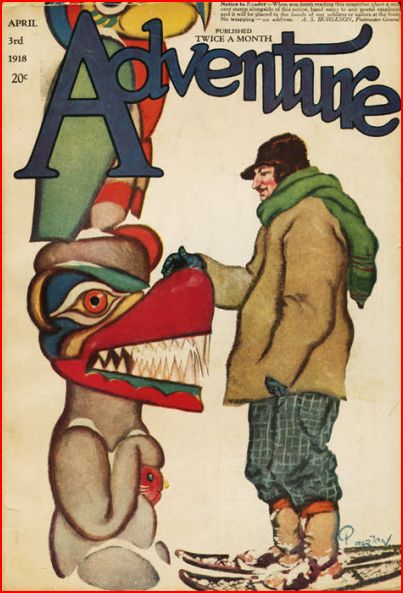
This 1918 issue is the earliest Adventure and earliest magazine to make the Calendar so far. I notice they weren't billing the authors at this point, probably not wanting to detract from the cover art. This relatively cartoony image comes from Ralph Barton -- his only Adventure cover, according to the Fiction Mags Index -- who became one of the early star cartoonists for The New Yorker before killing himself at age 39. Some familiar names -- W. C. Tuttle, Hugh Pendexter, Hapsburg Liebe -- were already contributing to Adventure. Two of the bigger writing stars of this period were the team of Farnham Bishop and Arthur Gilchrist Brodeur, who wrote historical adventures, including the exploits of medieval heroine Lady Fulvia, one of which appears in the next issue. A Fulvia story appears in the Black Lizard Big Book of Adventure Stories and is pretty good. Most likely overshadowing all these writers when this magazine was actually published was Edgar Wallace, whose Sanders of the River story this issue was a reprint from a 1914 British weekly. The lead novel (75 pages) is by Samuel Alexander White, who from his c.v. seems to have been a Northwest specialist. Ed L. Carson, Roy P. Churchill and T. Nichols contribute short stories, and that's all I can say about them. I can say no more about William Patterson White, who here continues the western serial Hidden Trails. I'm only slowly adapting my taste to the more distant past of pulp, having preferred stuff from the Twenties forward reflecting the hardboiled influence, but now I have someplace to go on the third of the month besides the predictable weeklies, so here's to variety!
Saturday, April 2, 2016
THE PULP CALENDAR: April 2
Here's something modern readers can identify with: an Arab peril! This 1932 cover presumably gives a scene from Sinclair Gluck's serial Red Emeralds. I was surprised to see that Gluck wasn't a very prolific pulpster. I found some of his Argosy stories with his series character Dan Brice in the unz.org trove, and the very first Argosy I bought for my own collection, a 1934 issue, had a Gluck story in it. It proved mediocre but the Brice stories were pretty good. I'd give this serial a chance, especially given the apparently exotic setting. The latest Tarzan serial continues, as do serials by Theodore Roscoe (a two-parter, really) and Thomson Burtis. Dependable Eustace L. Adams has a short story while veteran western writer J.E. Grimstead contributes a novelette and Charles S. Verral makes his fiction debut with "The Sharpshooter." One M. L. McEuen publishes his (or her) only pulp story this issue, "Don't Get Rough With a Lady." Most noteworthy of all is the debut of Stookie Allen's "Men of Daring," a weekly one or two-page comic in the style of Ripley's Believe It Or Not dedicated to courageous men as well as the occasional Women of Daring. Allen continued the feature for nearly ten years, publishing his last comic at the end of 1941. Some readers complained about the subtraction of a page or two of fiction, but I appreciate how the comic breaks up the monotony of the sparsely-illustrated Argosy and the content seems consistent with the magazine's commitment to action -- not to mention quality and variety.
Friday, April 1, 2016
THE PULP CALENDAR: April 1
Here's another title we haven't looked at before on the Calendar, though you have seen it on this blog. Dime Western was the flagship of Popular Publication's western line, founded at the end of 1932. Dime was a monthly for most of its existence, but flush with success Popular promoted the title to twice-a-month in September 1934 -- the same time it restored its recent prize acquisition, Adventure, to twice-monthly status. Popular's Dime Detective had been going the same pace since early 1933. Dime Western kept it up for not quite a year and a half, reverting to monthly in December 1935. The yellow cover background was a Dime Western constant, in contrast to sister pulp Star Western's red background. This issue sports a characteristic Walter M. Baumhofer cover featuring a badass female. Women on Dime Western covers in this period seem either to be shooting people or freeing their men from captivity. This was, in fact, a longstanding feature of pulp westerns and no doubt one of the keys to the success of the last pulp standing, Ranch Romances, the covers for which, especially in the 1950s, often weren't what you'd expect from such a title. Getting back to Dime Western, this April 1 issue is typical if not generic by virtue of the participation of Walt Coburn, Harry F. Olmstead and Bart Cassidy -- the last of whom much of the time was Olmstead. John G. Pearsol was nearly as constant a presence; looking at the page on the Fiction Mags Index where I got this cover image, I see that he gets published in three of the next four issues. Oliver King was just getting started in pulps, having been the main writer, as Kent Thorn, for Popular's short-lived hero-team western mag, Mavericks. As King and Stone Cody, the author known in real life as Thomas Ernest Mount would be a popular mainstay for a generation. E. B. Mann wrote this issue's only series character, The Whistler, who wasn't the busiest gun-dummy out there. "The Whistler's Gallows-Trap" was only his fifth appearance since April 1933, and there'd be only one more. George Armin Shaftel published his first Dime Western story on New Year's Day; "Meat for the Vigilantes!" was his fourth of the year, but by the end of 1935 he would develop into more of a detective and crime story man. I've only read issues of Dime from the Forties forward, and I've liked them all. I remain tentative about Thirties westerns because I don't really care for the "yuhs" and "tuhs" and the more old-timey writing, but I do know that early Coburn is better Coburn and editor Rogers Terrill has a high reputation among pulp western helmsmen, so I'd probably trust a Dime Western, if not any Popular western from this period, more than others in the genre.
Subscribe to:
Posts (Atom)