Showing posts with label Dime Western. Show all posts

Tuesday, November 1, 2016

THE PULP CALENDAR: November 1


For Dime Western in 1935, Walter Baumhofer illustrates one of the pitfalls of building a wall between the U.S. and Mexico: it could make it more difficult for Americans to get back where they belong. Dime was near the end of its early prosperity by this point; it would revert from twice-a-month to monthly in December. It would remain one of the best western pulps for almost two decades more. This issue gives you a fairly typical Dime Western lineup, led by the almost omnipresent Walt Coburn. "Bart Cassidy" and "Oliver King" are pseudonyms, the latter covering for Thomas E. Mount, the former for whoever could be roped into writing a Tensleep Maxon story, Edgar L. Cooper or Harry F. Olmstead. Tensleep, Dime's comedy relief, showed up even more often than Coburn did, and even received billing on the spine of the magazine. Never a fan of comic westerns, I can only shrug and let others have their entertainment.

Thursday, September 1, 2016

THE PULP CALENDAR: September 1


With this 1934 issue Popular Publications' Dime Western, which started life as a monthly in December 1932, made the jump to twice-a-month status. Like most pulps on that schedule, it carried the 1st and the 15th of the month as cover dates until reverting to monthly in December 1935. Over that time thirty issues of Dime Western were published. Walt Coburn, this issue's featured author, appeared in 27 of them. That's impressive, but if Harry F. Olmsted wrote all the Tensleep Maxon stories attributed to "Bart Cassidy," then he appeared, under one handle or the other, in every single issue. Ray Nafziger was nearly as prolific as these two, while Cliff Farrell only began to pick up the pace, at least as Dime Western was concerned, in 1935. This is pretty much an all-star lineup except for short story contributor Stewart Van der Veer, an occasional alias for one Lurton Blassingame.  If any of the big names dropped out for a couple of weeks, T. T. Flynn and others were on hand to take up the slack. I haven't read Dimes from this far back, but based on what I've read from the Forties the quality level was consistently high here.

Friday, April 1, 2016

THE PULP CALENDAR: April 1

Here's another title we haven't looked at before on the Calendar, though you have seen it on this blog. Dime Western was the flagship of Popular Publication's western line, founded at the end of 1932. Dime was a monthly for most of its existence, but flush with success Popular promoted the title to twice-a-month in September 1934 -- the same time it restored its recent prize acquisition, Adventure, to twice-monthly status. Popular's Dime Detective had been going the same pace since early 1933. Dime Western kept it up for not quite a year and a half, reverting to monthly in December 1935.  The yellow cover background was a Dime Western constant, in contrast to sister pulp Star Western's red background. This issue sports a characteristic Walter M. Baumhofer cover featuring a badass female. Women on Dime Western covers in this period seem either to be shooting people or freeing their men from captivity. This was, in fact, a longstanding feature of pulp westerns and no doubt one of the keys to the success of the last pulp standing, Ranch Romances, the covers for which, especially in the 1950s, often weren't what you'd expect from such a title. Getting back to Dime Western, this April 1 issue is typical if not generic by virtue of the participation of Walt Coburn, Harry F. Olmstead and Bart Cassidy -- the last of whom much of the time was Olmstead. John G. Pearsol was nearly as constant a presence; looking at the page on the Fiction Mags Index where I got this cover image, I see that he gets published in three of the next four issues. Oliver King was just getting started in pulps, having been the main writer, as Kent Thorn, for Popular's short-lived hero-team western mag, Mavericks. As King and Stone Cody, the author known in real life as Thomas Ernest Mount would be a popular mainstay for a generation. E. B. Mann wrote this issue's only series character, The Whistler, who wasn't the busiest gun-dummy out there. "The Whistler's Gallows-Trap" was only his fifth appearance since April 1933, and there'd be only one more. George Armin Shaftel published his first Dime Western story on New Year's Day; "Meat for the Vigilantes!" was his fourth of the year, but by the end of 1935 he would develop into more of a detective and crime story man. I've only read issues of Dime from the Forties forward, and I've liked them all. I remain tentative about Thirties westerns because I don't really care for the "yuhs" and "tuhs" and the more old-timey writing, but I do know that early Coburn is better Coburn and editor Rogers Terrill has a high reputation among pulp western helmsmen, so I'd probably trust a Dime Western, if not any Popular western from this period, more than others in the genre.

Sunday, January 31, 2016

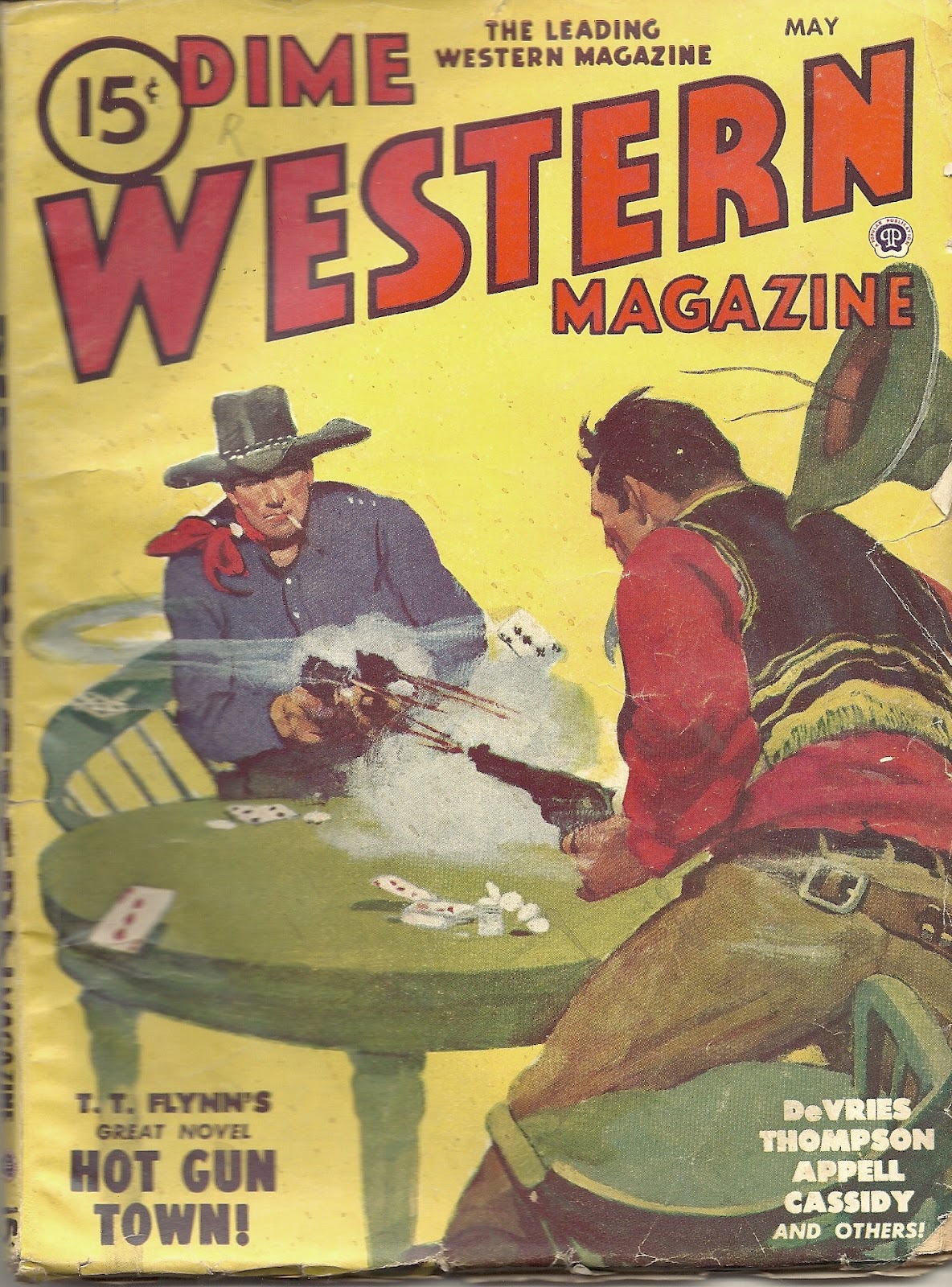
DIME WESTERN May 1948, COMPLETE

After posting individual stories from my copy of Dime Western for May 1948, I've finally completed my first cover-to-cover scan of a pulp magazine. Compared to many scanners out there, my resources are very limited. I use an HP C309 printer-scanner and the photo enhancement software that comes with it and Windows. After years of happily downloading incredible stuff from the Yahoo Pulpscans group, however, I decided that I had no more excuses for not doing my part to preserve the pulp heritage. Since Dime Western at this time was only 100 pages long, counting the covers, I set myself a relatively easy goal. Still, you'd be surprised at how hard it is to align a page just right, especially if your magazine is still intact, and how many botched scans had to go to the Recycle Bin. Finally, I have something complete with the cover coming up as your thumbnail the way it should. Let's review the contents once more:


You have major genre authors in Flynn and Thompson on top of the good short stories I'd downloaded earlier. The file downloadable from the link below is 100 MB. Like the story files, it's in the CBZ format, which is just a glorified .zip file in readable form. If you have Calibre's free text-conversion software you can turn this magazine into whatever file format suits you best. Enjoy this issue of Dime Western for posterity with my compliments. Click on the link below to begin:

Sunday, January 24, 2016

PULP READING: Bill Gulick, "THE MADNESS OF BIG OLAF," DIME WESTERN, MAY 1948

Here's another scan from my copy of the May 1948 Dime Western. Bill Gulick was one of the last surviving western pulp writers -- I suspect the precocious John Jakes will be the last if he isn't already -- living 97 years to 2013. Several of his novels were made into movies, most notably Bend of the Snake, which became Anthony Mann's Bend of the River. May 1948 sees Gulick at the brink of a hiatus; he would not publish another pulp story for more than a year; he may have been working on Bend of the Snake at the time. "The Madness of Big Olaf" would be a textbook example of pulp's political incorrectness if anyone really cared how Swedes were portrayed in popular fiction. Gulick's title character is as much a stereotype as any ethnic character you might encounter. "You know Swedes," a character says, "And you know how they get after a winter in the woods. Like wildmen." The titular Swede's madness if only one of the protagonist's problems. The other is that he has to lay a certain amount of railroad track by a certain time to fulfill a contract -- a typical pulp situation -- but a business rival is running a saloon nearby to keep the hero's work crew, including numerous Swedish wild men, good and drunk. Big Olaf is mad at our hero because the hero knocked him out with a lucky punch in their first encounter. The hero figures out a way to solve both problems at once. I'm not really bothered by the stereotyping, but then again I'm no Swede. The story is neat and concise and as the first piece from Gulick that I've read it made a good impression. Click on the link below to read and judge for yourselves.

Dime Western, May 1948

P.S.This story is sponsored, as you'll see, by the Mutual Radio Network. I find it interesting that the list of mystery programs in their ad doesn't feature their best-known show, The Shadow. Could that have something to do with him being a creature of a rival pulp publisher? He knows, probably.

Wednesday, January 20, 2016

PULP READING: Tom W. Blackburn, "Bring 'Em In Kicking!" DIME WESTERN, MAY 1948


Here's another story scanned from the pages of Popular Publications' May 1948 issue of Dime Western. Tom W. Blackburn was a busy pulpster of the period. In May 1948 he placed stories in seven different pulps, all but one for Popular. Four of those were novellas or novelettes, but "Bring 'Em In Kicking!" is a seven-page short story, refreshingly free of melodrama, by-the-numbers romance angles or the "yuhs" and "tuhs." It's basically a survival story as the hero has to bring an injured, uncooperative survivor of a raid back to the fort. Blackburn started out as a ghostwriter for some of the reputedly more prolific authors before publishing under his own name. By 1950 he had broken into the slicks, but his biggest success was to come in Hollywood, and not in prose. By far, Blackburn's most famous piece of writing is "The Ballad of Davy Crockett," the theme song for the epochal Disney TV series that he also scripted. Our story is just a little bit more edgy than that and is typical solid pulp writing from Blackburn. Click on the link below to download it and judge for yourself.

Dime Western, May 1948

Sunday, January 17, 2016

From My Collection: DIME WESTERN, MAY 1948


My pulp collection consists of two types of magazines: general-interest adventure pulps like Argosy and Adventure, and westerns. You won't see my westerns on the Pulp Calendar because they're all monthlies. I don't own any of Street & Smith's weeklies or early biweekly issues of Dime Western. If I had any copies of Ranch Romances, the longest-surviving biweekly pulp, they'd be no good for the Calendar because they were dated as "First January Number" and so on. So my own westerns will appear on the blog as special attractions, including the added attraction of scanned stories and, depending on my ambitions, complete scanned issues down the line.

My pulp western collection ranges chronologically from 1948 -- this issue of Dime is my earliest -- to 1953, near the end of the pulp era. My thinking has been that pulp westerns should get better as time marches on, and that pulps from this particular period should share some of the virtues of the more mature movie westerns that were appearing in the same time period. Perhaps inevitably, the majority of my westerns are from Popular Publications. I have a few from the Thrilling Group, a couple from Stadium (some of the same people who gave us Marvel Comics) and so far only one title from Fiction House, and I probably should include two digest issues of Zane Grey's Western Magazine from Dell as well. Popular appears to have had the best westerns in this period, with less kiddie-like fare than Thrilling's more hero-oriented pulps. Many of the best authors appeared in pulps from all publishers, excepting probably bargain-basement Columbia, which ended up the only game in town at the bitter end of the era at the end of the Fifties.

Dime Western was the flagship of Popular's western line, though by 1948 the price belied the title. At this time Dime was smaller than Popular's other western monthlies at 98 pages, but the typeface was also smaller than the others', at least as far as I can tell from my contemporary copies of Star Western and scans of other Populars. You could feel like you were getting your money's worth despite the smaller page-count, and even at 15 cents Dime was still a dime cheaper than the other monthlies. This issue, at least, had some respectable advertising on the back cover. I like the audience targeting here; pulp readers are presumed to want to be writers someday.


The May 1948 issue has a respectable lineup. T. T. Flynn, author of the lead "novel" -- all 23 pages of it -- is the author of The Man From Laramie, from which the classic Anthony Mann-Jimmy Stewart film was made. Thomas Thompson is another major writer from this period, one who moved into TV writing post-pulp, mainly for Bonanza, for which he served for a time as a consultant. Marvin de Vries, Bill Gulick and Tom W. Blackburn were all dependable writers, while Bart Cassidy had been doing the comedy series about Tensleep Maxon since 1933. It was such a popular feature that issues used to have "A Tensleep Story" printed on their spines. I don't care for western comedy much, but to each his own. You'll see more of these people later, some of them in the week to come as I scan more stories. For now, your first taste of this issue will be George C. Appell's short story "Parson of Damnation." It's a harsh little tale of a man of God who proves to be not so much a man of peace as one might assume. I've liked just about everything I've read from Appell so far and I hope "Parson" at least amuses you. You can download it using the line below. Over the next week I plan to upload some more stories from this issue so be sure to come back for more.

Dime Western, May 1948