Friday, November 30, 2018

'I regret that one cannot speak freely in France these days unless one carries a bomb.'

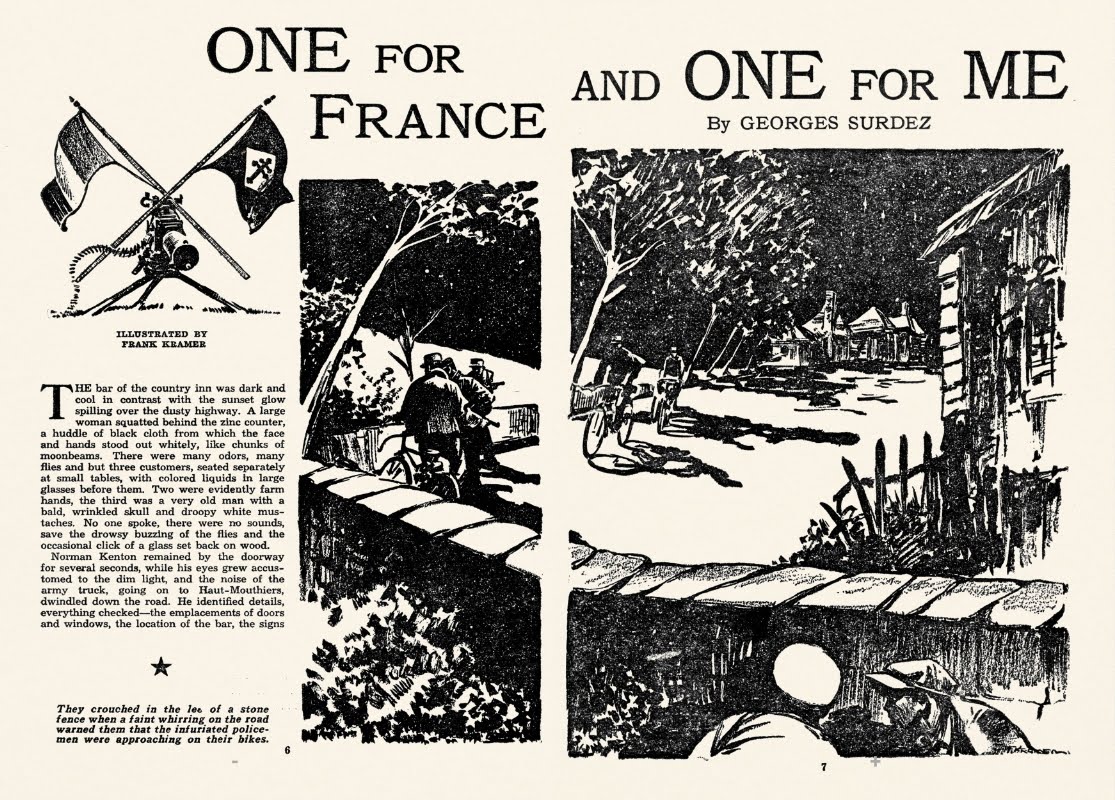
When World War II came, Georges Surdez, who had been the Foreign Legion writer par excellence in pulp, made the new war his subject, whether it was fought by the Legion or by others. With the end of the war came a new shift, or at least the hint of one. "One For France and One For Me" (Adventure, January 1946) sees Surdez moving in an almost noirish direction, with an abrupt cynicism about the French Resistance so soon after the war. Norman, an American point-of-view character returning to a town where he'd been harbored by resistance fighters during the war finds himself caught up in a manhunt that appears mostly to be a settling of scores. His old buddy in the resistance, Frederic, is still a fugitive, only now hunted by a sovereign French regime that sees him as no more than a bandit. The more Norman learns about the war within the more, the darker and murkier the picture grows. Ordinary Frenchmen took advantage of both the Resistance and the Nazis to get rid of personal enemies, and the same situation holds, more or less, now that the war is over.

Suppose you are an employee in some large firm, next in line for a good job. You make your choice between the Gestapo and the Resistance. In the first case, you write, 'So-and-so takes strolls near the railway station often - he notes the troops passing through.' That's enough to get him picked up. To the Resistance you write: 'You wonder who tipped off the Boches about the aviator? Ask so-and-so.' And you get your promotion while the other chap's in jail, or after he's killed. Or say you're a middle-aged man with a pretty wife younger than yourself. She has a cousin of whom she's very fond. There's nothing wrong as yet, but you think there may be soon. A couple of notes and he is arrested as hostage, or deported to Germany. It's the lettre de cachet within the reach of all.

Frederic has many scores to settle. He wants to publish lists of informants that the new government would rather see suppressed. He especially wants revenge on a pathetic informer who turned his own daughter, the resistance fighter's lover, over to the Gestapo, supposedly on the naive assumption that she would quickly confess under pressure. She proved tougher than anyone thought and ended up dying under torture without naming names, and her blood is on her father's hands. Over time, Frederic killed the Germans who'd tortured his love, but his vengeance is incomplete while the old man lives. He's a juror for the trial of Frederic's grandfather, a fascist and collaborator. Tricking Norman into acting as his escort, Frederic invades the courtroom carrying a bomb. He wants the opportunity to denounce several of the jurors as crooks or collaborators, but wants to act as judge, jury and executioner for the old man. Living up to the principle that gave Surdez his title, Frederic kills his grandfather ("One for France"), then delivers the coup de grace to his true enemy after the spectators virtually lynch him ("One for me."). As a bonus, Frederic finally shoots himself. Almost inevitably, Norman learns that Frederic's bomb was a fake. A fellow American laughs cynically, but Norman "had believed in the bomb. And then, when you thought of Emilie and the others ... you did not feel like laughing at all." For one of Surdez's first postwar stories, this is an extraordinary piece of work.

Sunday, November 18, 2018

'You might think you was a killer but you ... you didn't have the stuff'

In "Heritage of the Owlhoot" (Action Stories, October 1939) Walt Coburn strives to get into the head of a young outlaw. The first part of the "complete novel" is a harrowing account of Dave Sandall's killing of an abusive, alcoholic father and his sentencing to a cruel reform school. Everything seems to go against the youth, from the booze-sozzled attorney assigned him by an indifferent court to a bungled escape that leaves him in the wilderness with a broken leg. His fortunes turn, though not necessarily in the right direction, when he befriends another delinquent, Hutch, after earning his respect by beating him senseless with a crutch. They team up to escape, Hutch killing a sadistic guard in the process, and turn owlhoot to survive. Tension develops early as Dave stops Hutch from killing a cowboy who gives them shelter in a line camp shack. Dave may have killed his own father, but that was a "him or me" moment; as a rule he doesn't believe in killing harmless or defenseless men. Hutch has a "take no chances" mentality when it comes to potential snitches, and in general he has more of a mean streak than Dave, if not a compulsion to provoke life-or-death fights. From that point, Dave has a hunch that Hutch will try to kill him someday, if only because, so he intuits, Hutch is afraid of him. For all that, Hutch remains a loyal partner on the owlhoot trail. Given an opportunity to abandon Dave to the mercies of a theoretical posse, Hutch chooses to stick with him overnight. He has what Coburn calls a "queer code," by which he means (I think) nothing subtextual but something paradoxical if not unfathomable. He may well want to kill Dave someday, or it may be inevitable that something would provoke him into trying, but that doesn't contradict an equally compelling loyalty -- maybe solidarity might be a better word -- he feels toward his comrade in escape and banditry.

The pair finally end up with some version of a "Hole in the Wall" gang where Hutch exposes some fundamental weakness of character through his desperate efforts to impress veteran outlaws with his bragging, while Dave simply sits aloof. The plot takes a sadly melodramatic turn here when one of the outlaws reveals that Dave had not committed parricide after all. The drunken bum who raised him wasn't Dave's father at all, it turns out. His real father, long dead, was a rancher who bequeathed Dave his ranch. The outlaw arranges for Dave to leave and claim his heritage, but not before Dave saves Hutch from a sudden attacker bent on revenge for something -- it's actually a nice touch that Coburn doesn't fill in the backstory, though we can conclude that he was the man who left horses outside the reform school for Hutch and Dave's escape -- by shooting him in the hand. That itself may sound corny but Coburn actually treats this in a more realistic way than the movies or funnies, since the next time we see this man, he's minus the hand. By that time he also has Hutch as an ally, as several years later they visit Dave's ranch to shake him down for money. That tells us something about the sort of co-dependence Coburn perceives among the outlaw kind; they may hate each other but sometimes they have no one but each other to stick with.

The stage is set for a final showdown in which Hutch will likely have the advantage because of his preternatural ability to see in the dark. Fortunately, Hutch is backlit when the final showdown comes, but even then Dave takes a bullet to put one in Hutch. Dave will live but Hutch will not. His final words are "no ... hard ... feelin's." An interesting sentiment at the end for someone shown as such a hater, and maybe a suggestion that on some level (he also says "Pick up the marbles") none of it was ever more than a grim game for him. For Dave's part, "Somehow, he had never been able to hate Hutch." Instead, he weeps at his sometimes friend's passing. His old friend and his new friend, the line shack cowboy who's heir to a ranch of his own, agree that, despite all we've seen, Dave "never was a killer." To be a killer is something different from killing, it seems, but Hutch's sudden loss of rancor at the end of his life may make you wonder how much of a killer he really was. Coburn's story is suggestive rather than incisive, maybe raising more questions than it can answer, but it's certainly a more sympathetic attempt to understand the outlaw than I was expecting from a 1939 story. Despite its corny turns, I appreciate it for that.

Monday, November 5, 2018

'I belong here, where life is rough -- like me,' he refused.

Ralph R. Perry's "Missing" (Argosy, August 1, 1931) is the earliest Bellow Bill Williams story I've read so far. The tattooed pearler was already a well-established character by this point; he's mentioned as a favorite character by some Argonotes letter-writers as early as 1930. Perry is careful to remind us right away that Bellow Bill isn't the superhuman sailor of the sort Albert Richard Wetjen and others wrote about; it's practically a defining characteristic of him that "he is not a particularly good shot." Otherwise, he's strong as a bull and blessed with the proverbial hollow leg. Bill's task this time is to recover the archetypal wayward son of a rigid American businessman. The old man is offering a big reward, but the boy, for a time Bellow Bill's protege, now stands accused of piracy and attempted murder. Bill's partly responsible for the heir's plight, for to get him away from the local police the pearler sent him to "the den of the worst scoundrels in the pacific," the leader of whom now claims never to have seen the young man known as Pug. But Pug can be identified as part of a pirate gang by a distinguishing scar seen by witnesses, so Bill will be hard pressed to clear his name.

Even though there's plenty of action, this is more a battle of wits than many of the later Bellow Bill stories I've read. On Thursday Island he has to negotiate with a cunning crook, the half-caste proprietor of the Hall of the Five Benevolent Virtues, who combines "the cunning and the ambition of a Dutch father .. with the savage passions of a Papuan mother." He has to convince this Mitaki that it'll be worth his while, in pearls, to deliver Pug back to his father without first killing Bill. Mitaki is counterscheming just as fast and figures out a way to frame Bill himself for another murder in the course of the negotiations. All through this, Perry goes to great pains to describe the layout, above and below, of Mitaki's place, where most of the action takes place. You practically could draw a blueprint from his description, the point of which is to emphasize the advantages Mitaki enjoys on his home turf, including such modest ones as his ability to evade violence on Bill's part simply by taking a few steps from his office into plain view of the bar patrons. However racist Perry's description of Mitaki may be, the story's success as a thriller depends on establishing the half-caste as a very intelligent, hence very dangerous antagonist -- though the author makes it just a little too easy for Bill to see through Mitaki's subterfuge thanks to a telltale bloodstain on his sleeve. Everything turns out all right, of course, and for some reason Perry closes the story on something like a note of pathos as Pug invites Bill to come to America with him and take a job in the family business, only to be rebuffed. Bellow Bill belongs in a rough and tumble world, no matter how qualified he might be for success elsewhere. "Fact is," the pearler confesses in Perry's last word, "I like it that way, even at the worst."

Saturday, November 3, 2018

'Kinney was only eighteen,but moocah salesmen get them young.'

Donald Barr Chidsey worked in a wide variety of pulp genres from historical swashbucklers to contemporary crime stories. In "The Prairie Stretched Away" (Short Stories, July 25, 1940) he tried his hand at drug humor, though the story is probably on funny in retrospect. It intends to be a taut, suspenseful story, and I suspect that Chidsey brought a sense of irony to his sensitive subject matter, since narcotics are, in fact, instrumental to the story's happy resolution. The hero, Kinney, is introduced hitchhiking, hoping to make his way across the country after kicking what seems to have been a bad drug habit. Chidsey portrays a bleak, empty landscape, emphasizing his hero's isolation, until a truck nearly sideswipes Kinney on the shoulder of the road. As the truck goes on its way, Kinney finds that he's stumbled onto a line of wires that lead to the underside of a nearby bridge. Sure enough, he's also stumbled onto a band of gangsters who plan to blow up the bridge when a bus passes over it. The killers are professional and impersonal; they don't know who specifically ordered the atrocity or why it was ordered; it's all just a job of work to them, and though they're not to thrilled about the idea, they realize that they're going to have to kill Kinney as well. They're hiding out and shivering cold in a nearby shed and Kinney proposes to make himself useful by getting some kindling for a fire. You see, before they got to the shed, they passed over a stretch of weed that's actually a stretch of weed.

Kinney, seeing those weeds in the beam of the flashlight, swallowed hard and tried to think about something else. Sure he knew them! For he had not only used the stuff but when he got hard up he'd peddled it and packed it into cigarettes. So naturally he knew those weeds. They'll grow wild about anywhere. There's nothing fastidious about them.

Naive as I was, I thought, when his addiction had been mentioned earlier, that Kinney had been hooked on harder stuff than this. I had forgotten that circa 1940 many folks found it hard to imagine harder stuff than marijuana, the weed with roots in hell! Fearful though he is of falling back into addiction, Kinney calculates that his only way to thwart the bombing and escape alive is to set a heap of the stuff on fire -- Chidsey emphasizes that the weeds are sun-dried and ready for use -- and get both his captors and, inescapably himself, high as a kite. This gives Chidsey an opportunity to experiment, based on what experience I dare not say, in portraying a marijuana high.

He heard an automobile. This was with one mind; the other mind said that there were no automobiles in the world, and what of it anyway. But he heard this. It was far away. He glanced first at the tall man, then at the short one. Had they heard it too? Was it possible they didn't hear? Were they deaf?
After a long while the taller man got to his feet and moved slowly toward the door, which was very far away. He did not seem to walk; he seemed to float along. His lips were moving but Kinney did not hear any words.
*   *   *
Through every thinnest corporeal tissue and every minutest vein he could trace the circulation of his blood along each inch of its progress. He knew where it slowed, and where it churned fitfully ahead. He knew when every valve flapped. His heart had been beating so loudly that he was amazed that the others did not hear it, but now the shack was filled with glory that suffocated, and his heart labored no longer, a mere pump, but had become a fountain; the jet surged upward and struck against the roof of his mouth, and fell noisily back, splashing and scampering through his body, so that he tingled all over. Maybe he was having a hemorrhage? He thought that he would die very soon.

Meanwhile the tall gangster falls into  the telltale giggle of the marijuana addict familiar to all fans of Reefer Madness. He then grows agitated and violent, like the marijuana-smoking Mexican bandits of many another pulp tale. He's convinced that Kinney is trying to run away while Kinney is convinced that he isn't moving at all. He threatens Kinney with a shotgun that Kinney perceives to be "half a mile or more away. He fires, and Kinney hears "a dull, delayed, apologetic 'boom' which tumbled into oblivion, as though ashamed of itself." This failure reduces to gunman to helpless laughter. All the while, the short gangster remains in a stupor. Finally, when neither criminal can function, Kinney staggers out to catch the transcontinental bus, then wakes to learn that he's a hero, offered a big reward by the bus company, but like a proper pulp hero, Kinney would rather have a job. His mentor, the man who saved him from addiction, approves of his choice and tells him, "Give you a job? Why, if that's all they give you I'll go out and dynamite a few of their buses, myself!" That's so pulp, but so's the whole story.

Sunday, October 21, 2018

'Hissing steel answered 'political correctness'..."

Over the last week I read my way through the May 1944 issue of Adventure. It was quite a bit of reading because the pages had that tight 63-line layout I described from a later issue of Fifteen Western Tales. It enabled the editor to brag that even though the new issue, at 146 pages, was 16 pages less than the previous issue, it actually had more content. I believe it. Unsurprisingly, a lot of the stories were set in the wartime present. For whatever reason, the wartime stories in this issue mostly dealt with the Pacific war. Also unsurprisingly, there's an inescapable propaganda aspect to those stories. The proof of real quality, especially in retrospect, is how well any author transcended the propaganda imperative.  Allan R. Bosworth's "The Steamboat Breed" is hopeless, mainly because of its silly gimmick, apparently popular at the time, that has ghosts of heroes past helping Americans fight the Japs. In this story it was Davy Crockett and his backwoods buddies helping out in the Aleutians. Worse still, in its own way, is Sidney Herschel Small's "The War Fan." This was a story in Small's Koropok series, in which American airman Llewelyn Davies carries out sabotage inside Japan in the guise of a light-skinned "Hairy" Ainu, a despised minority in that country. In the past, Small had often written sympathetically, if also stereotypically, of Japan and other Asian cultures, but on this evidence the Koropok stories give a vicious caricature of the Japanese that probably should have been forgotten after the war. By far the best story here dealing with the Japanese is the conclusion of E. Hoffman Price's two-parter "Sign of Fire." To be clear, I don't expect to see the Japanese treated as anything other than bad guys in wartime stories. But while Small's Japanese are doomed idiots, and Bosworth's are thankfully faceless, Price at least gives us a Japanese antagonist who seems like a human being, and for that seems like a genuinely dangerous antagonist. More importantly, while there's still an inescapable propaganda element to his series of stories about Jim Kane and his fellow American guerrillas in the Philippines, Price doesn't see that as a reason to compromise his style of storytelling or his feel for character.

By wartime standards, "Sign of Fire" is hard-boiled stuff and more introspective in allowing Kane to feel doubt and anxiety while interned with a group of "sunshiners," Americans who are basically on the bum and no threat to the Japanese. There's a harder edge to Price's writing that allows Kane to express contempt for the sunshiners and for the sunshiners to behave contemptibly. There's also a whiff of racism in Kane's resentment of American subservience toward the Japanese occupiers. Kane, infiltrating the sunshiners, is put to work with them on street-cleaning detail, sometimes having to pick up trash, from cigarette butts to animal droppings, by hand. "But the worst part of the whole nasty job was seeing, from the corner of the eye, that white women, halting as prescribed to bow to the skibbie [Japanese] guard, saw white men fumbling in the many weeks' accumulation of offal." To put this in a larger context, the guerrilla band in the Kane stories includes an American-educated Chinese who talks like a gangster and a black American, "Bishop" Jackson, who talks in something like the typical minstrel dialect but, judging from his brief appearance here, is a more assertive character than his sometimes deferential tone (addressing our hero as "Mr. Kane") suggests. So even with the bit I quoted my overall impression is that Price is a far less racist writer than Small, while Bosworth gets a pass because his Japs don't have speaking roles. In any event, this was war and hate is part of war. Interestingly, though, the most violent, horrific moment in Price's story, or this chapter of it, isn't perpetrated by the Japanese or the Americans. In a chapter titled "Juramentado!" he describes a suicidal murder rampage by Don Hilario, just released from Jap custody but unable to endure the humiliation. This man, "a Christian and the descendant of Christians, was going fundamentalist according to the Malay spirit," Price writes, and his principal targets aren't the Japanese occupiers but Filipino collaborators, those who have become "politically correct" in the World War II sense of the term. The Japanese soldiers react as anyone might react to such a scene, and while Price has Kane make a big deal of their alleged racial nearsightedness, he never makes that an excuse not to take them seriously. In a crucial scene in which Kane is interrogated by a Jap officer he's met before, Price scrupulously emphasizes the rational calculations the enemy makes and his inability to be fooled by Kane's sunshiner disguise. For the author, it seems to suffice that the man is the enemy; he doesn't need to be a monster or a clown as well. For now, then, Price sets the standard for wartime pulp writing, and the fact that some stuff on that subject from that period can be good gives me the confidence to try more.
Sunday, October 7, 2018

'Always a German, but only since sunrise an enemy'

L. Patrick Greene's "One Man's Flag" (Adventure, March 15, 1931) is a bit of sentimental hogwash set in South Africa at the outbreak of World War I. "Papa" Haydn is the founder and patriarch of the little community of Williamstown, where nearly everyone is English, but when war breaks out between England and Germany in Europe, the old man remembers his heritage and an obligation to treat his neighbors as enemies. Despite his patriotic conscience, he can't generate very much hatred toward them, and they find his hostile gestures mostly amusing. At first, when he raises a German flag upon hearing of the war, the neighbors think he's simply made a typical old man's mistake. Soon enough, they realize that he knows full well what flag he's raised, but they still find it hard to hold that against him, in part because Haydn, old and fat, is effectively harmless. They have to rescue him from foolhardy attempts to link up with German forces in the wild, but all seem satisfied to let him carry on his old business despite theoretically being a prisoner of war. Given the ethnic tensions that must have existed from the Boer War to 1914, this all seems far too good to be true, especially when you read of how Germany's enemies effectively whipped up hysterical hatred toward ethnic Germans in their midst -- but maybe it was different in South Africa. In any event, when Haydn's shop is appropriated by Allied forces as a temporary command center for Gen. Jan Christian Smuts, the old man sees a final opportunity to serve his native country by informing the Germans of the enemy commander's position and plans. On the way, however, he rescues a lone British homesteader family he'd befriended long before from an attack by a band of native marauders, getting himself mortally injured in the process. His neighbors humor the old man to the bittersweet end, with the military getting in the act as all pretend to award the dying Haydn the Iron Cross. This was already a nauseatingly heartwarming story before the climax with its implication that black Africans, not English or Germans, are the real enemy. I know that wasn't an article of faith for Greene, who created one of pulp's best black characters in The Major's sidekick, Jim the Hottentot. But the more the main story seemed too good to be believable, the more the business with the natives seemed obnoxious if not offensive. No doubt, too, that Greene meant well, and that by 1931 the argument that English and Germans shouldn't be enemies was probably well received. By today's standards, however, "One Man's Flag" is probably too idealistic and at the same time not idealistic enough.

Sunday, September 30, 2018

'I hate to soil my decks,' he said crisply, 'But I shall kill the first man to board me.'

Albert Richard Wetjen had created a host of arguably interchangeable sailor heroes by the time he thought up Stinger Seave in 1938. This time he was determined to give readers a different type, at least physically, and a different style of story. The Seave stories are written in a retrospective style by an omniscient narrator who knows the character's entire history, foreshadowing Seave's death on at least one occasion. In an early outing, "Davey Jones' Loot" (Action Stories, December 1938), the narrator goes so far as to note that Seave would kill the story's villain on a later occasion, but not on this one. Seave himself was envisioned as nearly the opposite of Wetjen's other giant brawlers. The Stinger is "a small, frail man with a sandy, ragged mustache, mild blue eyes and a suit of comfortably baggy whites." A cold rage often seethes beneath his mild manner, and his threats are never bluffs. He is the most heartless and possibly most nearly psychopathic of Wetjen's violent heroes, though all the stories I've read have shown him in the right, or as much in the right as a "free trader" can be. Stinger Seave's idea of free trading is poaching pearls from an atoll claimed by Japan, as a matter of law, and by Buck Morgan, by right of might. Morgan is enraged when Seave, at this point a relative newcomer, muscles into Laviata Lagoon and hurls backs Morgan's efforts to drive the Stinger out. Morgan then commits the worst sin imaginable among free traders: he rats Seave out to the Japanese, forcing the Stinger to dump his cargo of pearls into the open sea to avoid arrest. The typical battling pearler might bellow and roar in anger, but Wetjen, playing the historian and claiming the Stinger's mate as his source, writes that Seave "sat at his table in the main cabin, a bottle of gin beside him and a glass in his hand ... and did not move, save to call the steward to bring a fresh bottle, right up to the time Morgan's brig was sighted." Over the objections of his crew ("The Stinger had not with him at this time that bunch of hard cases he was later to gather"), he sets a course to ram Morgan's ship before confronting the half-drunk, terrified Morgan and making him vacate the vessel. Morgan doesn't quite go without a fight and actually wounds the Stinger, and for that Seave spares him -- for the time being. "You're the first man who ever caught me off my guard, and I'll let you live to talk about it." The story ends on an ironic note, as Seave, who had earlier advised against cleaning Laviata out, sets a course to return and take every pearl remaining. Before Morgan's treachery, Seave had been a kind of conservationist poacher; leave something behind, after all, and you'll have another harvest later. Now he no longer cares. "I am a very impatient man," he says, "and I have patiently stood for a lot the past few days." It's a slightly ominous note to end an early adventure on, but Wetjen meant these to be darker stories than normal, and at the very least he succeeded at making them entertainingly different.