Showing posts with label Frank Richardson Pierce. Show all posts

Sunday, December 25, 2016

THE PULP CALENDAR: December 25


Argosy's editor sounds almost ashamed of his 1937 Christmas cover in his intro to this issue's Argonotes page, which he declares an Xmas-free zone.

In spite of the date on this week's cover, the general reindeer and mince-pie effect of our cover, and the novelet-gesture in the general direction of the merry gentleman in the fur-trimmed red suit, this is going to be one place in the magazine where the Yule is a Forgotten Season. In fact, right here and now we declare this corner a Hospice Sacred to All Ye Winded Shoppers and Package-Laden Pedestrians who firmly intend to let out a Loud Scream if anyone so much as hums Jingle Bells within earshot.

The editor confesses to Christmas fatigue, reminding us that already by 1937 people felt that the Holiday (shopping) season went on all too long. I've wondered this month why there weren't as many holiday-themed pulp covers in December as you might expect, and the answer should have been obvious to me. Pulps were all about escapism, and for many people Christmas itself was something to be escaped. Despite that, here is Frank Richardson Pierce's "Christmas on the Trail," starring his beloved sourdough No-Shirt McGee in his younger "beshirted" days. In fact, it's a tale of his first adventure in the Yukon as the greenest of checakos, back in 1897 -- McGee is presumably in his late fifties as he narrates from 1937. He isn't really the protagonist of his story, however. The real hero of the story is Two-Step Sue, a dance-hall girl with a heart of gold who takes pity on a young family risking everything on the trip north and acts as their secret Santa as well as morale-booster for McGee and the whole struggling group. There's pathos to the story as she breaks up with her more mercenary boyfriend along the way, but this turns out to be the sort of Christmas story with a happy ending for everybody, or at least for everyone who survives the avalanche midway through the tale. It went over well enough that a late December McGee story became a short-lived Argosy tradition (1937-40), though there was only one other Christmas cover during that run. For a pulpy dose of holiday cheer from almost eighty years ago, give "Christmas on the Trail" a look by following this link.

Friday, December 23, 2016

THE PULP CALENDAR: December 23

For a brief time in the late 1930s, Argosy made a No-Shirt McGee story by Frank Richardson Pierce a holiday tradition. No-Shirt was a versatile character. Pierce could write tales of the old sourdough's youth, back when he was a mere chechako in the Klondike, as in 1937's "Christmas on the Trail." Or he could write about McGee in the present-day, when he drifted up and down the Pacific Coast with his protege, Bulldozer Craig. That's the approach he took for his 1939 story "Christmas on Ice," in which No-Shirt is in Hollywood as a technical advisor to the movies. They're making an Alaska picture, Icebound, but it lacks authenticity. No-Shirt, a sourdough Stanislavsky, says the problem is that the actors have never experienced Arctic cold. He suggests a location shoot and in this fantastic tale the studio chief thinks that's a swell idea. His next brainstorm is to tell the actors that their boat is stuck in the ice, in order to put some anxiety into their performances. But of course the boat really gets stuck in the ice, only for Hollywood gossip columnists to dismiss the story as a publicity stunt. Pierce had done this sort of story before, down to tempers flaring and snapping and the crew fighting with one another. He throws a few twists in, including a romantic triangle that doesn't turn out as expected and a not-quite-murder mystery -- a couple of people get stabbed -- in which nobody dunnit. Overall, this is a less Christmasy story than "Christmas on the Trail," which we'll take a closer look at shortly, but at least it justified a festive seasonal cover. You can read "Christmas on Ice" and the rest of the December 23, 1939 Argosy which includes the final story in Philip Ketchum's Bretwalda cycle and the conclusion of Robert Carse's Nazis-in-Haiti serial Dark Thunder, at unz.org.

Saturday, July 23, 2016

THE PULP CALENDAR: July 23

To my knowledge, this 1938 Argosy is the only cover appearance of Frank Richardson Pierce's No-Shirt McGee, presuming that he's the man selling tickets. The Yukon sourdough, created in 1937, became a popular character who continued into World War II in Short Stories after Argosy's collapse and transformation, but as an old-timer who was more a fount of wisdom than anything else in present-day stories he wasn't really the ideal cover subject. He's supported here by Murray Leinster's story "Board Fence," Allan Vaughan Elston's "Trade Winds" and the second installment of Frederick C. Painton's The Invasion of America. Serials by Norbert Davis and Eric North continue, while one Robert L. Blake makes his sole Argosy appearance with "Romance on Rye." Blake may have been one of the other contributors in the customary disguise for a second story, however.

Sunday, April 24, 2016

THE PULP CALENDAR: April 24


I bought this 1937 Argosy in part to complete the two-part Joel Townsley Rogers story "Locusts From Asia" that began in the April 17 issue. The other main reason was Frank Richardson Pierce's "Sourdough," which is, I believe, the first appearance of possibly his most popular character, No-Shirt McGee. He's definitely in it, and that requires an update to the Fiction Mags Index, which lists the two-parter "Sable" (October 30 - November 6) as McGee's first-known appearance. Pierce would develop No-Shirt's backstory in later tales. In "Sourdough" we learn nothing about him except his reputation as "a man of strong character, great determination, with a thorough knowledge of Northern life and its various ramifications." He is, in fact, a sourdough, and we do learn what that means.

"To qualify, you've got to have seen the ice come in the fall, go out in the spring, and lived with a squaw and killed a caribou. And danged if I've ever been able to kill a caribou," No-Shirt tells his protege, Hollister Cadwallader Algernon Jones, scion of a very wealthy British family and determined to become a sourdough in his own right. No-Shirt assures him that "A man doesn't have to graduate in all subjects to get a diploma," but this is to discourage young Jones from disgracing himself with a native girl up north. McGee has been hired by the elder Jones to keep an eye of Hollister to make sure the lad neither disgraces himself nor gets ripped off. Over the course of the 13 page story No-Shirt himself gets conned by a sharp operator and persuades Hollister to buy a "salted" tract of land, despite McGee's assurance that he can detect any attempt to salt land with gold samples. No-Shirt ends up a bystander as Hollister figures out a way to con the conman -- but McGee often isn't the protagonist of his stories. He's as much a narrative device as a character much of the time. Pierce writes in a once-popular style through which a relatively uneducated character seems to address an audience rather than write a text. Thankfully, McGee doesn't speak in any ethnic or regional dialect. He makes a few grammatical errors, but mainly he narrates past events in present tense -- or he will in later stories, but not here. I think that device gives his stories an added immediacy, while McGee's personality gives the tales an entertaining slant. He's a man of experience, presumably in his fifties or sixties, who also knows his limitations and has a sense of humor about himself and the situations he finds himself in. The No-Shirt stories are the best things I've read from Pierce, and No-Shirt's narrative voice has a lot to do with that.

I haven't had time this week to get too far into this issue, but I have read the cover story, the opening installment of Max Brand's War For Sale. For whatever reason Frederick Faust used his most popular pseudonym for contemporary spy stories instead of using another established alias or making up a new one. In this serial an international cast of super agents vie for possession of blueprints for France's Maginot Line. Like most people, Faust/Brand assumed that the Germans would make a frontal assault on that fortress network and so want plans that would reveal its weak points. That assumption gives the story a certain tragicomic quaintness. In a subplot, a French journalist disappears in the middle of a series exposing a continental super-spy, only to appear in London, where our British female spy tries to recruit him on the assumption that he and his subject are one and the same. I don't know if any man in the story will wear a mask like the gentleman on the cover, but I think the cover would be less without it.

As for the rest:


I've also read Roy de S. Horn's novelette "Walls of Jericho," in which our protagonist, framed for a crime he didn't commit, breaks out of prison as a flood breaks out, only to break back in to rescue inmates and guards while taking revenge on the con who framed him, a man he thought had been executed. There are some dramatic descriptions of the flooding, but the resolution is too neat. Our hero was framed because a certain kind of knot, known only to sailors, was used to strangle a man, and wouldn't you know? During the crisis his supposed partner in crime has to use some rope and makes a perfect sailor knot, interpreted by all as instant exoneration for our hero. I've read better from this author, usually in the historical genre.

While I haven't read these installments yet, I can vouch for Eustace L. Adams's Revolution - With Pictures and Garnett Radcliffe's Doomed Liner based on last week's reading. I'm hoping that the conclusion of "Locusts From Asia" will reveal the fantastic reality behind last week's feverish imagery of a Yellow Peril intervention by air in World War I, led by a topless woman. Rest assured that you'll find out eventually, since I intend to upload complete scans of both April 17 and April 24 in the near future. I'll brief you on the Richard Howells Watkins and Dale Clark stories later. For now, this issue is sponsored by:


Sunday, March 13, 2016

PULP READING: Frank Richardson Pierce, "SNATCHERS" (Short Stories, March 10, 1935)

Back on March 10 when I put a 1935 issue of Short Stories on the Pulp Calendar, I remarked that Frank Richardson Pierce's "Snatchers" was one of the few stories from that issue, readily available at unz.org, that I hadn't read. I've now rectified that omission. "Snatchers" was one in a series Pierce did for Short Stories about the heroic film actor Stan Dvorak. The Fiction Mags Index lists only "Snatchers" and a two-part serial from the following month as Dvorak stories, but Short Stories itself indicates that there were stories before "Snatchers." Perhaps inspired by The Spider, Pierce conceived Dvorak pretty much as Lon Chaney, Detective, with the added gimmick that Dvorak was only the nom de film of bland, handsome socialite John Stanley. Because his employer, the Para-Art studio, made sure that no photos existed of "Dvorak" out of makeup, Stanley could move freely in public and use his quick-change makeup skills, which extend in Chaney style to physical contortion, to solve mysteries and fight crime.

The movie milieu might seem a change of pace for Pierce, who's best know to me, at least, for westerns and northwesterns. But I recall that one of his most popular creations, the Yukon sourdough No-Shirt McGee, acted as a technical advisor for a movie production in one of his earliest appearances (the Arogsy two-part serial Sable, 1937), and subsequently spent a lot of time in the neighborhood of Hollywood. Anyway, "Snatchers" is a topical tale of kidnappers, that kind of crime having become more notorious if not more common in the early 1930s thanks to the kidnapping and killing of the Lindbergh baby, the exploits of Machine-Gun Kelly, etc. In the story, "Snatchers" is the title of a Para-Art production about a kidnapping carried out by the Yellow Peril menace Foo Yung, played by Stan Dvorak, who presumably brings a degree of authenticity to his performance thanks to a previous exploit involving a local tong. As a celebrity, Dvorak himself is a target for kidnapping, and in fact a gangster has infiltrated the Para-Art lot, disguised as a small-town theater-chain owner, looking for opportunities to snatch Dvorak. The gangster is given a copy of the "Snatchers" script, which gives him an idea for stashing or disposing of a victim. Seeing no prospect of snatching Dvorak, the gangster and his crew take the next best target, Dvorak's co-star Gladys Gale, by muscling in on a team of stunt drivers as a scene is filmed in which Gale's character is, in fact, kidnapped. As John Stanley, Dvorak has the studio publicize that he's Gladys's boyfriend so he can negotiate her release. The gangsters get their money and release Gale, only to take Stanley, assuming such a young swell should be worth some money himself. Now the gangsters' reliance on the "Snatchers" script works against them, since they don't realize that Stanley is Dvorak and knows exactly what they plan to do and how they plan to do it. Our hero prevails, inevitably, on the author's assumption that he keeps enough makeup stashed in a secret compartment in his show to turn himself into one of the gangsters at a crucial moment.

"Snatchers" left me unclear about whether Stan Dvorak or John Stanley was the real person, but earlier stories probably made that as clear as it would ever get. The hero doesn't really have much personality in either guise, while his boss at Para-Art is a mild Jewish stereotype. Pierce has an overconfidence typical of all pulp media in the power and efficiency of makeup that no one, I think, shares today, but this particular story amuses on a meta level as crime imitates art, only to find the truth about John Stanley stranger than fiction. I suspect the Dvorak stories were throwaway stuff compared to the No-Shirt McGee, or maybe even the Panhandle Series Pierce had started in Short Stories earlier in 1935. But Pierce is competent enough to ensure that "Snatchers" is a mildly entertaining page turner. For those who want to prove that to themselves, follow the link below.

Sunday, January 24, 2016

THE PULP CALENDAR: January 24

This is the first time I want to criticize a cover artist. It seems like Paul Stahr should sell the drop and the peril facing the overdressed fellow trying to cross that body of water hand-over-hand by pulling back, but he goes for the relative close-up instead. Meanwhile, I don't know what the logger on the riverbank is staring and making a fist at, but it doesn't seem to be our hero. The story's probably better than the cover because it's by Frank Richardson Pierce, who I've found to be a dependable author, albeit best in the sardonic humor mode of the No-Shirt McGee stories. Apart from his opening chapter of a five-part serial the biggest attraction of this 1931 issue for me would be the novella by Theodore Roscoe, "Nightmare Island." Roscoe could get pretentious later on, at the end of the Thirties, in his American gothic Five Corners stories and his speculative history tales, but when he got good and pulpy, as in his zombie serials and Thibaut Corday's tall tales, he's very good indeed. This issue has four serials running, the others being Ralph Milne Farley's fantastic Caves of Ocean, George F. Worts's Gillian Hazeltine courtroom drama The Diamond Bullet, and Fred MacIsaac's Balata, which was recently reprinted by Altus Press as part of their Argosy Library collection. Pierce gets to profile himself in the occasional "Men Who Make the Argosy" page, and short stories by Harold dePolo, Alan K. Echols and Lt. John Hopper round out the issue. I'm not well-read enough yet to judge how good a lineup this is, but it looks promising.

Wednesday, January 13, 2016

THE PULP CALENDAR: January 13


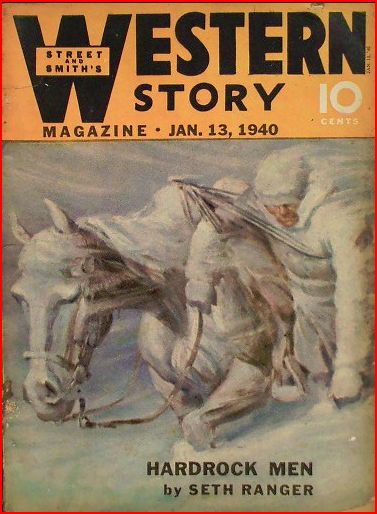
In the wintry spirit of The Hateful Eight and The Revenant, here's a snowy cover scene from 1940. Edward Stevenson came up with this white-on-white composition, which may or may not illustrate the cover story. Seth Ranger is only in this issue because Frank Richardson Pierce is. That's because Ranger was Pierce, who I know and like best as the author of the No-Shirt McGee stories in Argosy and Short Stories. An editor might accept two stories from one author for an issue, but it somehow never looked good to let one author have multiple bylines. That's why torrential authors like Frederick Faust and H. Bedford-Jones had so many pseudonyms, and it's why Pierce had Seth Ranger. For whatever reason, Ranger is credited with the five-part serial starting this issue, while Pierce uses his own name for a short story. You'd think you'd use your real name for the big stuff, but maybe Ranger had become the more bankable name, or maybe Pierce felt the short story was the better work. That's presuming he had a say in which name got either byline. Also inside are the then-ubiquitous Walt Coburn and up-and-comer Wayne D. Overholser, who still had a long career ahead of him. If Ranger's westerns are as entertaining as Pierce's sourdough stories, this issue and the whole serial are probably worth getting.