Thursday, November 30, 2017

'Foreigners don't enjoy the sanctity that we had a few years ago.'

"Black Powder Diplomacy" (Adventure, March 30, 1926) is H. P. Guiler's only known pulp story. Set at a chaotic moment in Chinese history when a young republic  was beset by warlords, it portrays increased resentment by Americans of a perceived lack of deference on the part of the Chinese, who requisition resources with little regard for white supremacy. "They've forgotten the lesson learned during the Boxer trouble [in 1900]," one American remarks, "and it looks like we shall have to give them another -- if we expect to stay here." An eager officer misses the good old days "when action was taken on the spot, and explained much later by letter when the affair had been settled and forgotten." Radio brings accountability all too quickly in the ultramodern 1920s, but our American protagonist insists on doing something now to restore the white prestige compromised by an influx of refugees from revolutionary Russia who've sunk to doing "coolie work." The problem with that is "when one white man loses caste out here, we all do." Unsurprisingly, the American's conclude that force is the only thing the Chinese will understand. Their challenge is to make their show of force look like something else. The arrival of a British admiral's ship gives them a pretext and an opportunity. The joke of the title is that the Americans fire the appropriate salute to the dignitary with live ammunition, out of alleged necessity, effectively terrorizing Chinese troops and ensuring compliance with previous American demands. "You will beat up Americans, will you, you yalla -----s," the American skipper roars, his meaning obscured slightly by Arthur Sullivant Hoffman's typical editorial reticence. This is the sort of "diplomacy" the Chinese still remember resentfully, though now, when they may think themselves in a position to practice similar diplomacy in the South China Sea and elsewhere, that same attitude they've long resented may be making a comeback in an America where the old nationalism seems new again. Not so long ago scholars might have read Guiler's story and deplored the arrogance it portrays, but the same story might find more appreciative readers today.

Tuesday, November 28, 2017

'By ---, if it ain't Slim Evans I'll kiss your foot to a cherry red!'

Thomson Burtis broke into pulp in 1920 and quickly made himself a star of Adventure magazine, specializing in aviation stories. Two of his longest-lived characters were army fliers Slimuel X. Evans (usually just "Slim") and Tex McDowell, who star in "Mistaken Island" (Adventure, March 30, 1926). I'd found earlier stories of Slim and Tex to be rather stilted affairs, but by this point, with Slim now a self-deprecating narrator, Burtis seemed to have found a comfortable storytelling voice, though it clearly made editor Arthur Sullivant Hoffman a little uncomfortable. He cut any hint of blasphemy out of the stories he published, which means, on this occasion, that many oaths and adjectives disappear, though readers could guess easily enough what Slim or other characters were saying. "This is a --- farce!" Slim protests at one point, "And by --- I'm getting tired of standing here talking in circles to you three bozos here for no reason." The three bozos are a motley crew of disreputable types holed up with an apparent prisoner on an island in the flood-swollen Ohio River, on which Slim and Tex have to make an emergency landing. They first big mystery is that the trio seem to recognize Slim and Tex, even though our heroes have never seen them before. It turns out that they know the pilots by reputation, as related by the pilots' colleague, Hal Ellis. The problem with that explanation, however, is that our heroes have no idea who Ellis is. Ellis proves to be a charismatic scoundrel, not to mention an imposter, vying with the island trio, his erstwhile partners, to claim a bounty on the trio's prisoner, a hillbilly feudist. Burtis seems to be planning for the future while introducing Ellis, giving him an extensive backstory while putting a detailed description of the man in Slim's mouth. "I've seen some types in my time," Slim also observes, "but Mr. Happy Hal Ellis wins the slightly used beef-stew as far as I'm concerned, and I don't know whether I can explain the reasons for that statement or not." I know I can't.

Hal Ellis is slick enough to convince our heroes that he's the good guy in the scenario they've stumbled into, and to convince his enemies to play him, Slim and Tex in an epic card game for the rights to the prisoner. Playing for matches, the gamblers embark on a 72-hour marathon. "In poker, as in flying and other things, I sort of muddle through," Slim observes, but despite some reservations about Ellis's "somewhat mangy proposition," he and Tex decide that it'll be fun to play, especially if they can share in the bounty on the prisoner. "It all comes down to one explanation -- a couple of cuckoo flyers couldn't turn down a chance for excitement," which probably was what Ellis was depending on. Reserving his own strength and sobriety while the others exhaust or inebriate themselves, Happy Hal simply waits for the moment to start a fight so he can get away with the prisoner and keep the bounty all to himself. The island threesome provides the pretext by actually cheating at cards, but Slim and Tex learn that they're actually more in the right than Ellis was -- which makes it a good thing that they're able to stop him from flying away with his captive, though Ellis himself gets away, presumably to fight another day. "Mistaken Island" is easily the best Burtis story I've read to date, and while that isn't saying much considering what I've forced myself through before, it's actually good enough to make me more willing to seek out stories of Slim and Tex in the future.

Monday, November 27, 2017

'When a puny fool gives orders, inkosi, what can men do but laugh?'


L. Patrick Greene is best known now for his series of pulp stories about "The Major" and his sidekick Jim the Hottentot, but on the side he was the Georges Surdez of British imperialism in Africa. That is, Greene wrote a good number of stories dealing with the challenge of military discipline amid the clash of personalities in a military and colonial hierarchy. "Discipline" (Adventure, March 30, 1926) is an obvious case in point. Simmons, our protagonist, is tasked with whipping the Black Watch of the British South African Police into shape. They're an awkward squad, inconsistently uniformed and clumsy in half-hearted drill with that inattention to cleanliness than considered characteristic of nonwhite peoples. Simmons gives them a stern talking to, breaking their complacency to remold them into some semblance of soldiery.

'Pigs!' he ejaculated. 'Pigs!' he said again, very slowly, as his finger traveled down the line.
The men stiffened perceptibly.
'You do not like to be called pigs, eh?' Simmons said with a harsh laugh. 'Then you must have pride and you are not altogether lost to shame. And yet --' the men squirmed under the lashing sarcasm of his voice -- 'I should have called you buloyi; I should have pointed my first finger at you. But, see how merciful I am, I only call you pigs.'
A cloud of dust arose from their embarrassed scuffling.
'You are liars, all of you,' Simmons continued in an even, unimpassioned voice. 'By your mouths you proclaim yourselves to be men and warriors of the great white chief, but by the filthiness in which you live it is plain that you are no men. No. Not men, but brothers to the dog-apes. Tchat! I spit your filth from me! I weep for you.'

This has a positive effect because many of the men do have warriors' pride and they are capable of shame, even if they want to blame their lax ways on their corporal, whom they disdain as a "puny fool." They respond well to harsh drilling, but a busybody English missionary, Banning, doesn't like what he sees when Simmons sends his men charging through a patch of thorns. The missionary, one of a brother-sister team, is determined to have Simmons written up for brutality. Greene wants us to recognize Banning as a naive idealist; the one thing he doesn't understand, it seems, is force. He doesn't take Simmons seriously when the officer warns that the missionary has hired porters from a hostile tribe, and sure enough, the tribe ends up kidnapping Banning's sister with intent to sacrifice her to one of their gods. "The curs! And I treated them like friends!" Banning protests.

The payoff reminds us that Greene was the creator of one of the more consistently heroic black characters in pulp in Jim the Hottentot. When the time comes to carry out a rescue mission, Simmons is prostrated by fever, and it's up to the Black Watch, including the "puny" corporal, to vindicate their commander's methods and his ultimate faith in them as men. Their mission, Simmons says, is "only another lesson in discipline. For us as well as them." The Black Watch, it turns out, has new pride in their imperial role. "Our voices are the voices of all white men," their top man tells the hostiles. In the face of the enemy's defiance, they ford a deep river, scatter their foes with disciplined, non-lethal fire and rescue Miss Banning. For some modern readers, the climax might reveal the Black Watch as tragic sellouts, brainwashed by the British, but Greene obviously had a different intention: to show that Africans were capable, if not of civilization as whites knew it, then of that discipline that arguably forms the foundation of any civilization. In short, "Discipline" is meant as a positive, if patronizing, portrait of black men, whatever people may think of it nearly a century later.

Sunday, November 26, 2017

So, what have I been reading lately?

The short answer is: not much pulp. Back in late October I caught a cold  that seemed to go away after a few days, but by early November it was back as something more like full-blown flu. I functioned minimally, dragging myself to work and back but not doing much otherwise. When my eyes stopped watering enough to let me read, my interest turned to non-fiction, particularly books on the Bolshevik Revolution in Russia 100 years ago. I finally started feeling better a week ago and I became conscious of neglecting pulp fiction. It was easy to start up again on the daily commute, and the good people of the Yahoo pulpscans group have been doing heroic work making vintage pulp available in scanned form for me to choose from. One relatively recent scan was the March 30, 1926 issue of Adventure. This was a milestone issue marking the end of the magazine's thrice-monthly schedule, which began back in October 1921. Editor Arthur Sullivant Hoffman put a brave face on it, explaining that it was necessary to cut back because readers hadn't been able to keep up with the serials while promising that editorial standards would be even higher, as would the quality of the fiction, now that Adventure would come out less frequently. I'll let more extensive readers judge that, but I'm sure there was a more bottom-line explanation for the change than Hoffman let on. In any event, this issue itself was the usual mixed bag. I found myself with little patience for the lead novel, W. Townend's "A Light for His Pipe," which promised only to be an interminable feud of two crews of sailors. Nor did I bother with the fourth chapter (of five total) of Hugh Pendexter's serial "Log Cabin Men." These longest stories aside, there was still plenty of entertaining content. I'll deal with some of them in more detail later, but for now I'll note Walter J. Coburn's "Smiley," a short tale of a slightly sozzled, slightly crazy but ultimately heroic saloon swamper, and Robert Carse's "In the Boneyard," an atmospheric anecdote in which a mutilated U.S. Navy vet of the great war encounters a German U-boat officer on a repentant pilgrimage to America, even though the German has less to repent of than some of his peers. Over the week to come I'll review some of the longer stories as I get back into the swing of this pulp-blogging thing. I hope no one missed me too much!

Tuesday, October 17, 2017

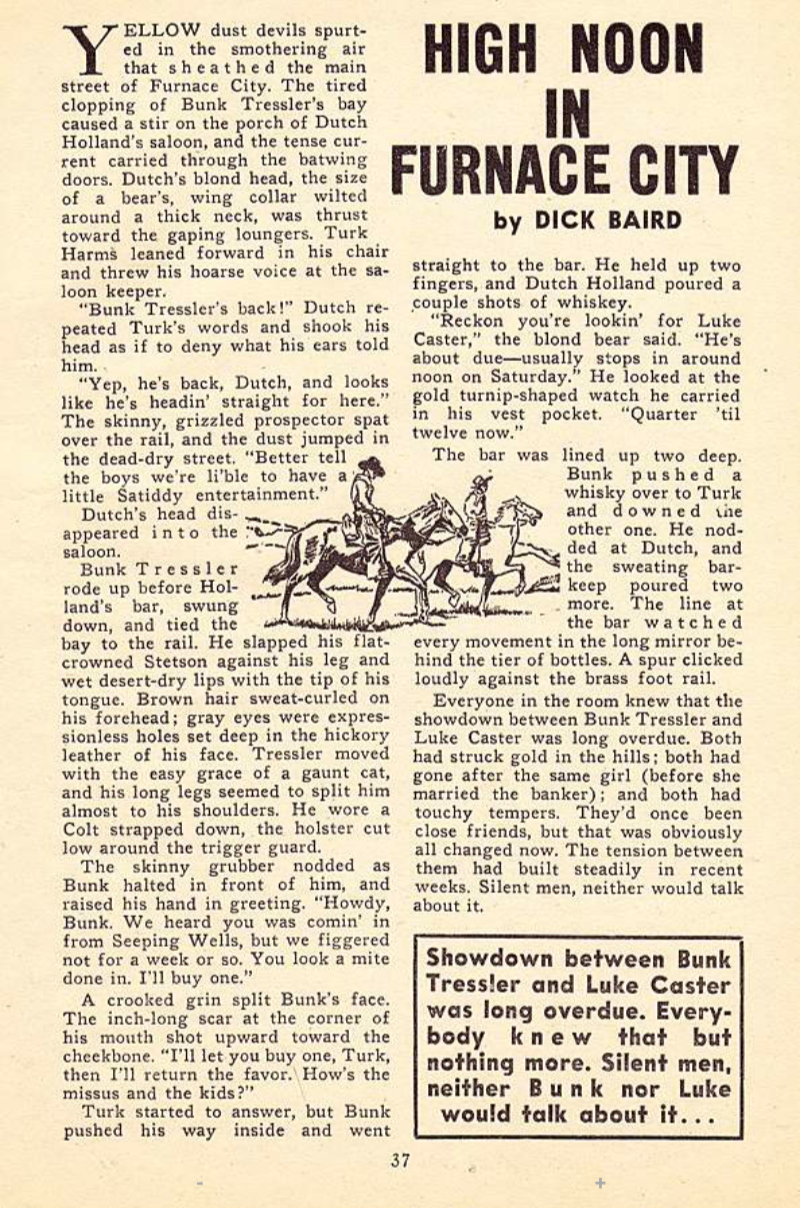
High Noon in Furnace City

For a change of pace, I'm not going to summarize or criticize some pulp story in this space. Instead, for the heck of it, I'm going to share with you a complete short story from the June 1955 issue of Western Short Stories, with the emphasis on short. The FictionMags Index describes Dick Baird's "High Noon in Furnace City" as a vignette; in a slick magazine it'd be called a "short short story." The Index offers no description at all for Baird, under whose name -- most likely a pseudonym -- appeared just two stories, both for Martin Goodman's Stadium outfit in 1955. It's reminiscent in length and format of the sort of two-page pieces that would have appeared in Goodman's Atlas comics in this period. The story is a simple set-up for a twist ending, but you may end up wondering whether what happens at high noon in Furnace City actually makes sense. Judge for yourselves, for here it is, straight from the twilight days of western pulp.


Thursday, October 12, 2017

'Look at their skins and ye can see who their father is.'

The four-page short story "Oysthers!" (Adventure, September 30, 1923) makes a better case for Gordon Young as a pioneer of the hard-boiled style, or at least the hard-boiled manner, than any of his longer works that I've read to date. It's an absolutely amoral tale told by a deliberately unreliable narrator, Patrick O'Flynn Delaney -- a sailor with "a brogue that was as thick as the San Francisco fog." In oldschool style Young introduces us to Delaney through the eyes of another first-person narrator, who meets the sailor in an oyster house where Delaney has spent his last dime on a bowl of soup. Once, however, "t'was less than six month ago that Oi was one of the richest men in the whole South Seas -- f'r ten minutes, but no longer." The rest of the story relates the rise and fall of Delaney and his fellow castaway on the isle of Rigoro, Buck O'Malley. Buck has "a way wid womin," having stolen a Dutch trader's "naygur wife" along with his schooner before picking up another woman on the island. Delaney practices abstinence, since "naygur womin [are] too [expletive deleted by editor A. S. Hoffman] handy wid knives an' ugly in other ways," but O'Malley enjoys having the women vie to service him in every way imaginable. To make a short story shorter, One of the women finds an oyster with a pearl inside "wid the shape of a hen's egg an' as big." The end of paradise follows quickly as Kate, the Dutchman's wife, ends an argument with her rival, Betsy, by burying a knife in Betsy's breast. "That for you, pig-woman," she says in farewell. O'Malley approves and has Betsy thrown to the sharks. "It was Kate that I love best anyhow," he remarks. He loves her too well and not enough, however, entrusting her to hold the great pearl while he does the dirty work of dumping Betsy overboard, only to have Kate pull a knife on him. She's worried that he'll find a way home to cash in the pearl, abandoning her. Extracting his promise to stay with her on Rigoro, she throws the pearl into the sea.

O'Malley he stood there gaspin' for air; then wid a yell he jumps, an' the fist of him took her in the jaw an' she fell over the skylight and her laigs quivered like a frog's that's dying. 
'Ye black dirt, into the water wid yez an' find that pearl -- Oi'll kill ye! Don't ye come up widout it!'

Finally Delaney intervenes to save Kate, only to get stabbed by her while he fights his former friend. Both white men go over the side, but our raconteur makes it back on board while the sharks -- or "maybe as Oi sometimes think, 't was the black Betsy girl" -- pull O'Malley under. There's nothing left for Delaney but to take Kate back to her trader and then make his furtive way back to America, where "Some day we'll have a real dinner, wid radishes an' beer, an then Oi'll tell ye a story worth two of this an' ivery bit as true!" Even with the brogue, I wouldn't mind hearing another one from Delaney, as long as he keeps it just as short.

Tuesday, October 10, 2017

'Mohammedans interest me. Supermen of the East. Excitable, you know; rather fanatical.'

During the 1910s, Presbyterian minister George McPherson Hunter was secretary of the American Seamans' Friends Society and editor of its magazine, The Sailors' Magazine. He started writing fiction for the pulps in 1919, in his fifties, and made it into Adventure only once. "Seven Rugs and Seven Men" (September 30, 1923) resumes the adventures of McGregor Sahib, a character Hunter created for The Green Book. Here, McGregor is ship's doctor for the City of Manila, currently docked in New York. The author's knowledge of the sailor community in the metropolis adds some color here as the ship has to recruit not merely new crewmen but new lascars, Asiatic seamen, from "Brooklyn's Asiatic boardinghouses." McGregor, "steeped in Indian ways," sees that the wrong men may have been hired.

The stokers were Sunnites, Arabic Mohammedans, owing allegiance to the Sultan of Turkey. And the men brought aboard were Shiites, Indian Mohammedans. The Arabic crowd, fanatical and clannish, wanted their own kind.

Sunnis and Shiites at odds? That sounds right, even if they're not as neatly divided geographically as Hunter seems to think. Still, McGregor is a veritable scholar of Islam compared to Chief Engineer Miller, who's astonished to find that the Muslims own prayer rugs. "Ain't they heathens?" he asks. Told about Muslims' five daily prayers, he remarks, "If them poor black guys can't pray without rugs below their knee-bones it's not me that'll be hindering them."

The City of Manila sets sail at a moment of international tension caused by resurgent Islam. "Turkey's defeat and humiliation [in World War I] had shaken the Moslem world and stirred the leaders of the faithful into action. her sudden rally and stab back at Greece [in 1921] had given courage and hope to the Moslem hierarchy. Followers of Mohammed were being urged to preserve the faith of the Green Banner." Little do those followers know that Turkey, under Mustafa Kemal, will shortly stab them in the back by abolishing the Caliphate and embarking on a radical program of secularization and westernization, but where's the fun in that for a pulp writer? In any event, the British navy and British intelligence are ordered to keep an eye out for Muslims using the sea lanes to spread seditious literature. The stakes are high, since "They man the merchant ships of the East. A holy war could be waged on sea and land." So says Ames, a scholar of Islam whose movements begin to arouse suspicion. Personally, I began to suspect that Ames was some sort of Bolshevist, but that idea went overboard when Ames is found dying, apparently captured and tortured by some of the lascars. He turns out to have been an intelligence officer like McGregor, who breaks the case with one of those weird tests that "appeal to the pageant sense of the Oriental" and the pulp writer.

In this trick, McGregor gathers the lascars together and sets them to the task of licking envelopes. The ones who fail are guilty of killing Ames and concealing the jihadist literature inside their carpets. "The strain of smothering all [their] fears was considerable and affected them physically, parched their tongues, dried up the saliva in their mouths," McGregor explains, "They hadn't enough moisture to wet the mucilage on the stamps. They betrayed themselves!" I might have expected editor Arthur Sullivant Hoffman to ask the author, "Was it the stamps or the envelopes they were supposed to lick?" but perhaps the great man had made up his mind to indulge Hunter by publishing his tale before reaching the end. Hunter missed his one-and-only chance to contribute to "The Camp-Fire," and quit pulp for several years to edit the Pittsburgh Presbyterian Banner before placing a run of stories in the Clayton magazines. His last pulp fiction appeared in Short Stories in 1938. He retired from the ministry at age 90 and died three years later, in 1961. If only today's seditious plots could be discovered as easily as Hunter imagined.