Sunday, October 21, 2018

'Hissing steel answered 'political correctness'..."

Over the last week I read my way through the May 1944 issue of Adventure. It was quite a bit of reading because the pages had that tight 63-line layout I described from a later issue of Fifteen Western Tales. It enabled the editor to brag that even though the new issue, at 146 pages, was 16 pages less than the previous issue, it actually had more content. I believe it. Unsurprisingly, a lot of the stories were set in the wartime present. For whatever reason, the wartime stories in this issue mostly dealt with the Pacific war. Also unsurprisingly, there's an inescapable propaganda aspect to those stories. The proof of real quality, especially in retrospect, is how well any author transcended the propaganda imperative.  Allan R. Bosworth's "The Steamboat Breed" is hopeless, mainly because of its silly gimmick, apparently popular at the time, that has ghosts of heroes past helping Americans fight the Japs. In this story it was Davy Crockett and his backwoods buddies helping out in the Aleutians. Worse still, in its own way, is Sidney Herschel Small's "The War Fan." This was a story in Small's Koropok series, in which American airman Llewelyn Davies carries out sabotage inside Japan in the guise of a light-skinned "Hairy" Ainu, a despised minority in that country. In the past, Small had often written sympathetically, if also stereotypically, of Japan and other Asian cultures, but on this evidence the Koropok stories give a vicious caricature of the Japanese that probably should have been forgotten after the war. By far the best story here dealing with the Japanese is the conclusion of E. Hoffman Price's two-parter "Sign of Fire." To be clear, I don't expect to see the Japanese treated as anything other than bad guys in wartime stories. But while Small's Japanese are doomed idiots, and Bosworth's are thankfully faceless, Price at least gives us a Japanese antagonist who seems like a human being, and for that seems like a genuinely dangerous antagonist. More importantly, while there's still an inescapable propaganda element to his series of stories about Jim Kane and his fellow American guerrillas in the Philippines, Price doesn't see that as a reason to compromise his style of storytelling or his feel for character.

By wartime standards, "Sign of Fire" is hard-boiled stuff and more introspective in allowing Kane to feel doubt and anxiety while interned with a group of "sunshiners," Americans who are basically on the bum and no threat to the Japanese. There's a harder edge to Price's writing that allows Kane to express contempt for the sunshiners and for the sunshiners to behave contemptibly. There's also a whiff of racism in Kane's resentment of American subservience toward the Japanese occupiers. Kane, infiltrating the sunshiners, is put to work with them on street-cleaning detail, sometimes having to pick up trash, from cigarette butts to animal droppings, by hand. "But the worst part of the whole nasty job was seeing, from the corner of the eye, that white women, halting as prescribed to bow to the skibbie [Japanese] guard, saw white men fumbling in the many weeks' accumulation of offal." To put this in a larger context, the guerrilla band in the Kane stories includes an American-educated Chinese who talks like a gangster and a black American, "Bishop" Jackson, who talks in something like the typical minstrel dialect but, judging from his brief appearance here, is a more assertive character than his sometimes deferential tone (addressing our hero as "Mr. Kane") suggests. So even with the bit I quoted my overall impression is that Price is a far less racist writer than Small, while Bosworth gets a pass because his Japs don't have speaking roles. In any event, this was war and hate is part of war. Interestingly, though, the most violent, horrific moment in Price's story, or this chapter of it, isn't perpetrated by the Japanese or the Americans. In a chapter titled "Juramentado!" he describes a suicidal murder rampage by Don Hilario, just released from Jap custody but unable to endure the humiliation. This man, "a Christian and the descendant of Christians, was going fundamentalist according to the Malay spirit," Price writes, and his principal targets aren't the Japanese occupiers but Filipino collaborators, those who have become "politically correct" in the World War II sense of the term. The Japanese soldiers react as anyone might react to such a scene, and while Price has Kane make a big deal of their alleged racial nearsightedness, he never makes that an excuse not to take them seriously. In a crucial scene in which Kane is interrogated by a Jap officer he's met before, Price scrupulously emphasizes the rational calculations the enemy makes and his inability to be fooled by Kane's sunshiner disguise. For the author, it seems to suffice that the man is the enemy; he doesn't need to be a monster or a clown as well. For now, then, Price sets the standard for wartime pulp writing, and the fact that some stuff on that subject from that period can be good gives me the confidence to try more.

Sunday, October 7, 2018

'Always a German, but only since sunrise an enemy'

L. Patrick Greene's "One Man's Flag" (Adventure, March 15, 1931) is a bit of sentimental hogwash set in South Africa at the outbreak of World War I. "Papa" Haydn is the founder and patriarch of the little community of Williamstown, where nearly everyone is English, but when war breaks out between England and Germany in Europe, the old man remembers his heritage and an obligation to treat his neighbors as enemies. Despite his patriotic conscience, he can't generate very much hatred toward them, and they find his hostile gestures mostly amusing. At first, when he raises a German flag upon hearing of the war, the neighbors think he's simply made a typical old man's mistake. Soon enough, they realize that he knows full well what flag he's raised, but they still find it hard to hold that against him, in part because Haydn, old and fat, is effectively harmless. They have to rescue him from foolhardy attempts to link up with German forces in the wild, but all seem satisfied to let him carry on his old business despite theoretically being a prisoner of war. Given the ethnic tensions that must have existed from the Boer War to 1914, this all seems far too good to be true, especially when you read of how Germany's enemies effectively whipped up hysterical hatred toward ethnic Germans in their midst -- but maybe it was different in South Africa. In any event, when Haydn's shop is appropriated by Allied forces as a temporary command center for Gen. Jan Christian Smuts, the old man sees a final opportunity to serve his native country by informing the Germans of the enemy commander's position and plans. On the way, however, he rescues a lone British homesteader family he'd befriended long before from an attack by a band of native marauders, getting himself mortally injured in the process. His neighbors humor the old man to the bittersweet end, with the military getting in the act as all pretend to award the dying Haydn the Iron Cross. This was already a nauseatingly heartwarming story before the climax with its implication that black Africans, not English or Germans, are the real enemy. I know that wasn't an article of faith for Greene, who created one of pulp's best black characters in The Major's sidekick, Jim the Hottentot. But the more the main story seemed too good to be believable, the more the business with the natives seemed obnoxious if not offensive. No doubt, too, that Greene meant well, and that by 1931 the argument that English and Germans shouldn't be enemies was probably well received. By today's standards, however, "One Man's Flag" is probably too idealistic and at the same time not idealistic enough.

Sunday, September 30, 2018

'I hate to soil my decks,' he said crisply, 'But I shall kill the first man to board me.'

Albert Richard Wetjen had created a host of arguably interchangeable sailor heroes by the time he thought up Stinger Seave in 1938. This time he was determined to give readers a different type, at least physically, and a different style of story. The Seave stories are written in a retrospective style by an omniscient narrator who knows the character's entire history, foreshadowing Seave's death on at least one occasion. In an early outing, "Davey Jones' Loot" (Action Stories, December 1938), the narrator goes so far as to note that Seave would kill the story's villain on a later occasion, but not on this one. Seave himself was envisioned as nearly the opposite of Wetjen's other giant brawlers. The Stinger is "a small, frail man with a sandy, ragged mustache, mild blue eyes and a suit of comfortably baggy whites." A cold rage often seethes beneath his mild manner, and his threats are never bluffs. He is the most heartless and possibly most nearly psychopathic of Wetjen's violent heroes, though all the stories I've read have shown him in the right, or as much in the right as a "free trader" can be. Stinger Seave's idea of free trading is poaching pearls from an atoll claimed by Japan, as a matter of law, and by Buck Morgan, by right of might. Morgan is enraged when Seave, at this point a relative newcomer, muscles into Laviata Lagoon and hurls backs Morgan's efforts to drive the Stinger out. Morgan then commits the worst sin imaginable among free traders: he rats Seave out to the Japanese, forcing the Stinger to dump his cargo of pearls into the open sea to avoid arrest. The typical battling pearler might bellow and roar in anger, but Wetjen, playing the historian and claiming the Stinger's mate as his source, writes that Seave "sat at his table in the main cabin, a bottle of gin beside him and a glass in his hand ... and did not move, save to call the steward to bring a fresh bottle, right up to the time Morgan's brig was sighted." Over the objections of his crew ("The Stinger had not with him at this time that bunch of hard cases he was later to gather"), he sets a course to ram Morgan's ship before confronting the half-drunk, terrified Morgan and making him vacate the vessel. Morgan doesn't quite go without a fight and actually wounds the Stinger, and for that Seave spares him -- for the time being. "You're the first man who ever caught me off my guard, and I'll let you live to talk about it." The story ends on an ironic note, as Seave, who had earlier advised against cleaning Laviata out, sets a course to return and take every pearl remaining. Before Morgan's treachery, Seave had been a kind of conservationist poacher; leave something behind, after all, and you'll have another harvest later. Now he no longer cares. "I am a very impatient man," he says, "and I have patiently stood for a lot the past few days." It's a slightly ominous note to end an early adventure on, but Wetjen meant these to be darker stories than normal, and at the very least he succeeded at making them entertainingly different.

Wednesday, September 26, 2018

More bang for your buck, or more quotes for your quarter

I haven't read much worth writing about lately, but what I have read lately interested me in a different way. I've just made my way through a recently-scanned issue of Fifteen Western Tales from May 1947. There were a few good stories in the more introspective late-pulp style -- stories by T.C. McClary, William Heuman and Tom W. Blackburn are highlights -- and relatively few in the more corny, cliched style. What impressed me most about the issue was the sheer density of text it offered. Any pulp reader knows that type sizes varied throughout the era, depending on how many pages a magazine had and how much content an editor wanted to cram in. Sometimes sizes varied within a single issue, as in many a mid-1930s issue of Argosy. The "normal" pulp page usually had forty-something lines of text to a column, but you often saw it go over fifty. This Fifteen Western Tales had a daunting 63 lines of text to a column. The only other time I've seen type that small in a standard-sized pulp is in a 1944 Adventure in my own collection, but I attributed that to Popular Publications (also Fifteen Western's publisher) having just reduced Adventure's page count from 160 to 144 pages. I don't know how representative  the May 1947 issue was, but in another recent scan from 1946, and another from 1949 (all with the same page count) the number of lines is much closer to "normal." Mind you, I'm not complaining about May 1947. Reading it on a 10" screen in a very good scan didn't strain the eye, and of course in real life it would be bigger still. To me there's something comforting about those walls of text. It looks like you're getting your money's worth, whether you paid a dime or a quarter once upon a time, a whole lot more in the 21st century, or absolutely nothing for a scan. Thinking about it, though, made me wonder whether anyone else noticed differences in type sizes or had an ideal number of lines per column for the optimal reading experience. One reader's feast of print easily could be another's eyestrain, especially as another grows older. The one sure thing is that when you look at something like that May 1947 issue you can believe that the editor and publisher tried their best to give you as much fiction as possible that month, and believing that is a good feeling.

Sunday, September 16, 2018

'Dirty! He is strong man, that fellow.'


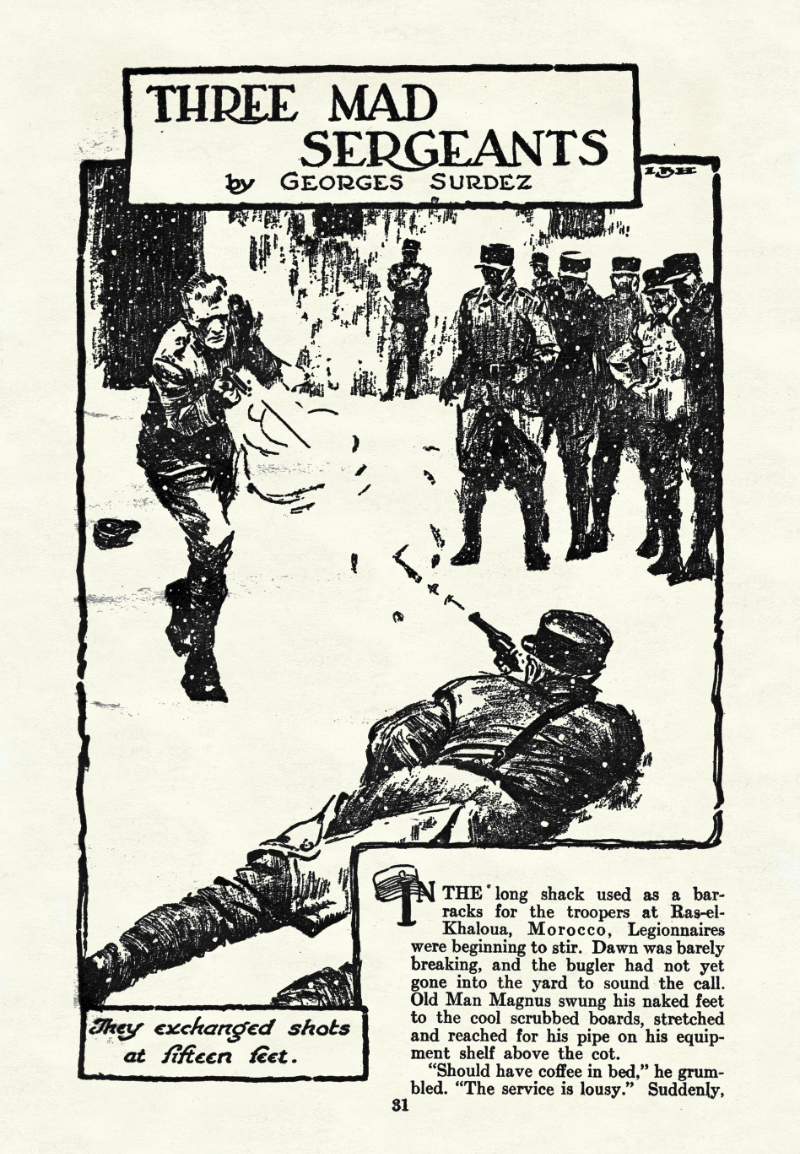
There's often a vicarious "can you take it?" quality to Foreign Legion stories. The readers is invited to imagine whether he, in the protagonist's boots, can take the discipline, the climate, the bullying by superior officers. Such stories are often tests of character, the final exam taking place under fire when some (usually) Muslim insurgents attack the post or the patrol. Going against that grain, Georges Surdez's "Three Mad Sergeants" (Adventure, February 1939) is one of the master's most nihilistic works in his genre. It concerns a unit on punishment detail in the Atlas mountains as winter hits. They're put in charge of the titular non-coms, the worst of whom, and thus the leader, being a sadistic, possibly syphilitic Pole named Larkorska. While he torments the men, the other two, rivals for a woman, goad each other toward mutual destruction, egged on by Lakorska, the enemy of all. The hero of this tale is Magnus, a former German officer who apparently joined the Legion to forget his killing of a best friend for cowardice on a world-war battlefield. Normally he's the drunk of the regiment -- or else it's the Bulgarian, Nikirov, obsessed with finding a hidden stash of booze -- but as he sobers up, deprived of liquor (apart from the daily wine ration) by the cruel Lakorska, he regains enough of his old pride to find his situation intolerable.


Not to worry, though, since after Lakorska finally gets one of the other sergeants to kill the other, the maddest of the sergeants takes out the survivor and goes completely berserk, holing up in his well-stocked, well-fortified quarters to take potshots at anyone that moves. With his newfound clarity, Magnus realizes that the men have to take Lakorska alive in order not to be accused of fragging all three sergeants. He also comes up with a plan to smoke him out of his lair so he can be dogpiled, but doesn't anticipate the madman bursting out into the open stark naked, his apparently pasty pallor making excellent camouflage in the snow. It falls to Bulgarian brute Nikirov finally to subdue Lakorska, overcoming the Pole's proverbial strength of a madman (see Nikirov's comment in the header) in a desperate grapple. In the end, Nikirov finally finds the legendary stash and all the survivors get wasted except Magnus, who holds out until the captain who originally assigned everyone to this wintry hell offers him a promotion for his leadership. That brings back unbearable memories of the war, along with a sergeant's stripes, both of which he hopes to "soak off" by throwing himself off the wagon at the end. Most of the time you can find some sort of a moral in a Surdez story, but this one is bracing, and arguably one of his best, in its complete absence of such a thing.

Wednesday, September 5, 2018

ESQUIRE: The slick that wanted to be pulp?

For the past couple of weeks I've had a chance to look through midcentury issues of Esquire, the prestigious men's magazine founded in 1933 and still flourishing today. It's been a shapeshifter of a magazine, starting thick with prestige, with Ernest Hemingway and F. Scott Fitzgerald as regular contributors, and becoming a cutting edge magazine on both the fiction and nonfiction fronts from the mid-1950s forward. But from the end of World War II to about 1952 Esquire made a big commitment to genre fiction. Look at it during those years and you can see what Popular Publications was aiming for when it transformed Argosy from a pulp to a full-sized magazine. Stories are designated as "Mystery" or "Western" when appropriate, and where there had not been proper illustrations in earlier years now there are dramatic two-page spreads, even for stories that are only that long, like the example shown here from June 1949.


Esquire's major contribution to genre fiction was Henry Kane's private eye Peter Chambers, who made his debut in February 1947 and remained an Esquire exclusive through the end of the decade. 1947 - 52 are the peak years for pulp-esque genre ficton in Esquire, and while many of the authors who appeared there also placed stories in slicks like Collier's and The Saturday Evening Post, one suspects that Esquire's status as a men's magazine, and a reputation gained by its showcasing of Varga and Petty girls, encouraged those writers to be, shall we say, more manly in their work. My guess is that erstwhile servicemen, initially attracted to Esquire by the pin-ups during the war, were the target audience for postwar he-man fiction. Along with Kane and numerous top-hand westerners, Esquire also published a good deal of early Ray Bradbury, including "The Illustrated Man." In short, this magazine at midcentury was a cornucopia for pulp or all-around genre fans. But after 1952, once co-founder Arnold Gingrich resumed the reins as publisher, Esquire turned again toward more literary fiction, after a few years of transition that, for example, placed Hugh B. Cave and Norman Mailer in the same issue. Objectively speaking, Esquire's greatest years were yet to come, but its greatness consisted in combining highbrow content with a pop-culture sensibility, with little room for genre fiction in the mix. There was a different kind of greatness in the previous generation, before "men's magazine," Argosy notwithstanding, came to denote something much less classy.

Sunday, August 26, 2018

Caradosso meets Hitler?


The Renaissance rogue Luigi Caradosso was one of pulp's longer-lived characters, making his first Adventure appearance in 1924 and his last appoximately thirty years later, in 1953. F. R. Buckley usually made an effort to give his character's often amoral tales an appropriately archaic flavor -- they are narrated in the form of reminiscing letters a retired Caradosso writes to his aristocratic patron -- but on at least one occasion he clearly meant his tale to have contemporary relevance. "Of Penitence" (June 1941) is primarily a cautionary tale of a young lord who lets a guilty conscience over some slight mischief get in the way of the ruthlessness appropriate to princes, by Caradosso's standards, and thus loses his land. The young lord's worst mistake is to show clemency toward a rabble-rouser, described by one observer as "a damned plasterer [who] wants to be a leader of the people like what's-his-hame at Florence. Finds talking easier than daubing an honest wall, I'll be bound." The demagogue calls himself Adolfo Illeri, and as Adolf Hitler got his start in beer halls, so Illeri orates atop a giant wine barrel, and as Hitler, as an Austrian, was an outsider in Germany, so Illeri is a Brescian interloper. "I have oft wondered why those who'd tell folk how to live in one country should usually come from some other," Caradosso opines, and Buckley may have had in mind here not only Hitler but immigrants to America who espoused Marxism. Caradosso's instinct tells him to get rid of Illeri as soon as possible, but just as the Weimar Republican wouldn't put Hitler down after the Beer Hall Putsch, so the young lord proves dangerously merciful, too interested in proving that "I am no tyrant."  After his misadventure, which involves beating up and humiliating the local night watch, the lord orders Illeri released without even trying him, telling Caradosso, "Who am I to judge my fellow man?" Who is anyone, our hero answers, "But if none did it, what would become of the world?" Sent out of the country, Illeri promptly sets up shop next door and resumes his rabble-rousing. The young lord's fatal flaw is his belief that dealing ruthlessly with the likes of Illeri would automatically make him the sort of tyrant he abhors, but his unwillingness to get his hands dirty killing one deserving man only guarantees the deaths of many undeserving others once he finally goes to war with Illeri's protector. The lord himself dies in the attack, guaranteeing that his land will fall to another, while Caradosso decapitates Illeri "as one might a puppy by a garden-walk." Perhaps this makes Caradosso, and by extension Buckley, an authentic Machiavellian, but it no doubt was easy, with much of the world at war with Hitler and the U.S. soon to join, to say that someone should have whacked that bastard long before. Whether Buckley was advocating preemptive assassination as a tactic for the 20th century is another matter. The nearest he comes in his "Camp Fire" comments to addressing contemporary issues is to note that in Italian history, the less fearless people became about criticizing tyrants, the more dangerous it became to do so -- "Which is something we might think over nowadays."