Adventures in a Golden Age of Storytelling by SAMUEL WILSON, Author of "Mondo 70," "The Think 3 Institute," etc.
Wednesday, September 26, 2018
More bang for your buck, or more quotes for your quarter
I haven't read much worth writing about lately, but what I have read lately interested me in a different way. I've just made my way through a recently-scanned issue of Fifteen Western Tales from May 1947. There were a few good stories in the more introspective late-pulp style -- stories by T.C. McClary, William Heuman and Tom W. Blackburn are highlights -- and relatively few in the more corny, cliched style. What impressed me most about the issue was the sheer density of text it offered. Any pulp reader knows that type sizes varied throughout the era, depending on how many pages a magazine had and how much content an editor wanted to cram in. Sometimes sizes varied within a single issue, as in many a mid-1930s issue of Argosy. The "normal" pulp page usually had forty-something lines of text to a column, but you often saw it go over fifty. This Fifteen Western Tales had a daunting 63 lines of text to a column. The only other time I've seen type that small in a standard-sized pulp is in a 1944 Adventure in my own collection, but I attributed that to Popular Publications (also Fifteen Western's publisher) having just reduced Adventure's page count from 160 to 144 pages. I don't know how representative the May 1947 issue was, but in another recent scan from 1946, and another from 1949 (all with the same page count) the number of lines is much closer to "normal." Mind you, I'm not complaining about May 1947. Reading it on a 10" screen in a very good scan didn't strain the eye, and of course in real life it would be bigger still. To me there's something comforting about those walls of text. It looks like you're getting your money's worth, whether you paid a dime or a quarter once upon a time, a whole lot more in the 21st century, or absolutely nothing for a scan. Thinking about it, though, made me wonder whether anyone else noticed differences in type sizes or had an ideal number of lines per column for the optimal reading experience. One reader's feast of print easily could be another's eyestrain, especially as another grows older. The one sure thing is that when you look at something like that May 1947 issue you can believe that the editor and publisher tried their best to give you as much fiction as possible that month, and believing that is a good feeling.
Sunday, September 16, 2018
'Dirty! He is strong man, that fellow.'
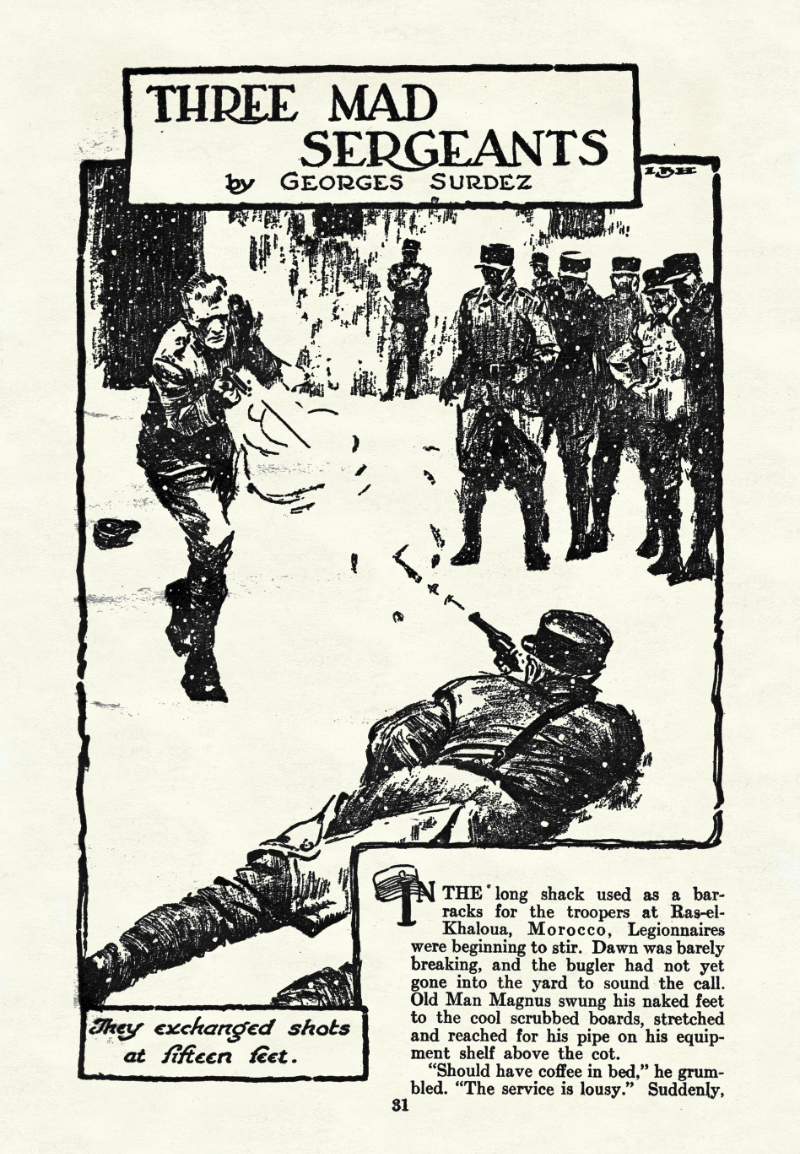
There's often a vicarious "can you take it?" quality to Foreign Legion stories. The readers is invited to imagine whether he, in the protagonist's boots, can take the discipline, the climate, the bullying by superior officers. Such stories are often tests of character, the final exam taking place under fire when some (usually) Muslim insurgents attack the post or the patrol. Going against that grain, Georges Surdez's "Three Mad Sergeants" (Adventure, February 1939) is one of the master's most nihilistic works in his genre. It concerns a unit on punishment detail in the Atlas mountains as winter hits. They're put in charge of the titular non-coms, the worst of whom, and thus the leader, being a sadistic, possibly syphilitic Pole named Larkorska. While he torments the men, the other two, rivals for a woman, goad each other toward mutual destruction, egged on by Lakorska, the enemy of all. The hero of this tale is Magnus, a former German officer who apparently joined the Legion to forget his killing of a best friend for cowardice on a world-war battlefield. Normally he's the drunk of the regiment -- or else it's the Bulgarian, Nikirov, obsessed with finding a hidden stash of booze -- but as he sobers up, deprived of liquor (apart from the daily wine ration) by the cruel Lakorska, he regains enough of his old pride to find his situation intolerable.
Not to worry, though, since after Lakorska finally gets one of the other sergeants to kill the other, the maddest of the sergeants takes out the survivor and goes completely berserk, holing up in his well-stocked, well-fortified quarters to take potshots at anyone that moves. With his newfound clarity, Magnus realizes that the men have to take Lakorska alive in order not to be accused of fragging all three sergeants. He also comes up with a plan to smoke him out of his lair so he can be dogpiled, but doesn't anticipate the madman bursting out into the open stark naked, his apparently pasty pallor making excellent camouflage in the snow. It falls to Bulgarian brute Nikirov finally to subdue Lakorska, overcoming the Pole's proverbial strength of a madman (see Nikirov's comment in the header) in a desperate grapple. In the end, Nikirov finally finds the legendary stash and all the survivors get wasted except Magnus, who holds out until the captain who originally assigned everyone to this wintry hell offers him a promotion for his leadership. That brings back unbearable memories of the war, along with a sergeant's stripes, both of which he hopes to "soak off" by throwing himself off the wagon at the end. Most of the time you can find some sort of a moral in a Surdez story, but this one is bracing, and arguably one of his best, in its complete absence of such a thing.
Wednesday, September 5, 2018
ESQUIRE: The slick that wanted to be pulp?
For the past couple of weeks I've had a chance to look through midcentury issues of Esquire, the prestigious men's magazine founded in 1933 and still flourishing today. It's been a shapeshifter of a magazine, starting thick with prestige, with Ernest Hemingway and F. Scott Fitzgerald as regular contributors, and becoming a cutting edge magazine on both the fiction and nonfiction fronts from the mid-1950s forward. But from the end of World War II to about 1952 Esquire made a big commitment to genre fiction. Look at it during those years and you can see what Popular Publications was aiming for when it transformed Argosy from a pulp to a full-sized magazine. Stories are designated as "Mystery" or "Western" when appropriate, and where there had not been proper illustrations in earlier years now there are dramatic two-page spreads, even for stories that are only that long, like the example shown here from June 1949.
Esquire's major contribution to genre fiction was Henry Kane's private eye Peter Chambers, who made his debut in February 1947 and remained an Esquire exclusive through the end of the decade. 1947 - 52 are the peak years for pulp-esque genre ficton in Esquire, and while many of the authors who appeared there also placed stories in slicks like Collier's and The Saturday Evening Post, one suspects that Esquire's status as a men's magazine, and a reputation gained by its showcasing of Varga and Petty girls, encouraged those writers to be, shall we say, more manly in their work. My guess is that erstwhile servicemen, initially attracted to Esquire by the pin-ups during the war, were the target audience for postwar he-man fiction. Along with Kane and numerous top-hand westerners, Esquire also published a good deal of early Ray Bradbury, including "The Illustrated Man." In short, this magazine at midcentury was a cornucopia for pulp or all-around genre fans. But after 1952, once co-founder Arnold Gingrich resumed the reins as publisher, Esquire turned again toward more literary fiction, after a few years of transition that, for example, placed Hugh B. Cave and Norman Mailer in the same issue. Objectively speaking, Esquire's greatest years were yet to come, but its greatness consisted in combining highbrow content with a pop-culture sensibility, with little room for genre fiction in the mix. There was a different kind of greatness in the previous generation, before "men's magazine," Argosy notwithstanding, came to denote something much less classy.
Sunday, August 26, 2018
Caradosso meets Hitler?
The Renaissance rogue Luigi Caradosso was one of pulp's longer-lived characters, making his first Adventure appearance in 1924 and his last appoximately thirty years later, in 1953. F. R. Buckley usually made an effort to give his character's often amoral tales an appropriately archaic flavor -- they are narrated in the form of reminiscing letters a retired Caradosso writes to his aristocratic patron -- but on at least one occasion he clearly meant his tale to have contemporary relevance. "Of Penitence" (June 1941) is primarily a cautionary tale of a young lord who lets a guilty conscience over some slight mischief get in the way of the ruthlessness appropriate to princes, by Caradosso's standards, and thus loses his land. The young lord's worst mistake is to show clemency toward a rabble-rouser, described by one observer as "a damned plasterer [who] wants to be a leader of the people like what's-his-hame at Florence. Finds talking easier than daubing an honest wall, I'll be bound." The demagogue calls himself Adolfo Illeri, and as Adolf Hitler got his start in beer halls, so Illeri orates atop a giant wine barrel, and as Hitler, as an Austrian, was an outsider in Germany, so Illeri is a Brescian interloper. "I have oft wondered why those who'd tell folk how to live in one country should usually come from some other," Caradosso opines, and Buckley may have had in mind here not only Hitler but immigrants to America who espoused Marxism. Caradosso's instinct tells him to get rid of Illeri as soon as possible, but just as the Weimar Republican wouldn't put Hitler down after the Beer Hall Putsch, so the young lord proves dangerously merciful, too interested in proving that "I am no tyrant." After his misadventure, which involves beating up and humiliating the local night watch, the lord orders Illeri released without even trying him, telling Caradosso, "Who am I to judge my fellow man?" Who is anyone, our hero answers, "But if none did it, what would become of the world?" Sent out of the country, Illeri promptly sets up shop next door and resumes his rabble-rousing. The young lord's fatal flaw is his belief that dealing ruthlessly with the likes of Illeri would automatically make him the sort of tyrant he abhors, but his unwillingness to get his hands dirty killing one deserving man only guarantees the deaths of many undeserving others once he finally goes to war with Illeri's protector. The lord himself dies in the attack, guaranteeing that his land will fall to another, while Caradosso decapitates Illeri "as one might a puppy by a garden-walk." Perhaps this makes Caradosso, and by extension Buckley, an authentic Machiavellian, but it no doubt was easy, with much of the world at war with Hitler and the U.S. soon to join, to say that someone should have whacked that bastard long before. Whether Buckley was advocating preemptive assassination as a tactic for the 20th century is another matter. The nearest he comes in his "Camp Fire" comments to addressing contemporary issues is to note that in Italian history, the less fearless people became about criticizing tyrants, the more dangerous it became to do so -- "Which is something we might think over nowadays."
Wednesday, August 22, 2018
'The Islands were not being tamed by prayers and good wishes.'
Albert Richard Wetjen wrote many a South Seas adventure story using different variations on the same basic character template, yet made a point of insisting that his heroes were all distinct personalities inhabiting what we'd now call the same "universe." His first such creation was Shark Gotch for Action Stories, starting in 1927, while the best known (in Wetjen's own time, at least) probably was Wallaby Jim, whose hardly toned-down adventures appeared in Collier's, one of the top slicks, and were made into a movie. In between came Typhoon Bradley, introduced in the September 1931 Action Stories after Shark Gotch was retired (for a time) earlier that year. Shark Gotch remains a point of reference in the Bradley stories."There are three men who can draw faster and shoot straighter than I can," a villain says in "Trial By Typhoon" (September 1932), "Those men are Larsen of Singapore, Shark Gotch and Typhoon Bradley." I'm not sure where Larsen appeared but I don't doubt that Wetjen had written stories about him. Wetjen would continue this self-referentiality in the Wallaby Jim series, in one episode of which Gotch, Bradley and others put in cameo appearances. "Trial" is the first Bradley series I read, and on that evidence he seems like a perfectly generic South Seas hero: big, strong, hard-boiled and fast on the draw. Noting Wetjen's emphasis on Bradley's gunmanship, I understood why Ralph R. Perry made a point of describing his South Seas hero, Bellow Bill Williams, as a lousy shot. It differentiated Bellow Bill from Wetjen's supermen -- which is not to say that Wetjen is the inferior writer, but that he and Perry really were writing two different kinds of story. Perry's are closer to thrillers in their emphasis on the obstacles to Bellow Bill's success, while Wetjen's are, well, action stories understandably focused on the hero's fighting prowess.
In this one, Typhoon Bradley makes an enemy by stopping a nasty captain from flogging a native crewman accused of petty theft. He "broke one of the unwritten laws of the Islands when he interfered," Wetjen opens, "A man had a right to punish his own natives. The Islands were not being tamed by prayers and good wishes. The South was raw and a man's crew might at any time turn and rip him to shreds if they thought him soft enough." Despite that, Bradley's humanitarian impulses compel him to beat the crap out of the captain, and as it turns out, if anyone has the right to interfere it's the temporary magistrate of this particular island, Typhoon Bradley. Concerned to maintain law and order, he boards the captain's ship after hearing rumors that his arch-enemy, Gentleman Harry, is on board. I assume Harry was introduced in an earlier story, but for those, like me, who missed it, Wetjen explains that the Gentleman was once a suave character whose nickname has been a parody ever since Bradley broke his face in a fight. He's a slick one, too; he planted the rumor of his presence to get Bradley off the island while his men, the captain's crooked crew, cleaned out the island's pearl dealers in a mass mugging. Gentleman Harry's triumph over Bradley is nearly complete, but he suffers from recurring-villain syndrome, whether he's actually recurring or not. That is, despite the captain's urging to kill Bradley and be done with it, Harry wants to humiliate and torture Typhoon to avenge his ruined face. Neither he nor the captain reckon on that poor native crewman remembering Bradley's kindness and freeing him so he can wreak characteristic havoc on the bad men. When it comes to action Wetjen delivers the goods, though not quite with the gusto of Action Stories regular Robert E. Howard. Conscious of writing a series rather than a stand-alone story, the author contrives to keep Gentleman Harry alive to fight another day, but that day was long in coming if it came at all. Action Stories soon went on a nearly yearlong hiatus and Wetjen moved on to other projects. The FictionMags Index doesn't report another Typhoon Bradley story, apart from his cameo in Collier's, until July 1939. From then, Bradley alternated with Wetjen's more recent and more interesting creation, Stinger Seave, until Wetjen tired of him again.
Wednesday, August 15, 2018
'Won't have to listen to the woman killer yelpin' while his neck is stretchin'.'
Action Stories was Fiction House's answer to the general-interest adventure pulps like Argosy, Blue Book, Short Stories and, of course, Adventure. The title, which is self-explanatory, may be best known today as one of Robert E. Howard's more reliable markets. It came out monthly until the end of 1932, when the Depression forced an almost-year long hiatus, after which it returned as a bimonthly. In later years it was almost entirely western in content, but in 1932 there was a greater mix of subject matter, with Albert Richard Wetjen's violent tales of South Seas sailors among the most popular stories. Compared to Wetjen, Art Lawson was a rookie when "Hanging Bee" (September 1932) became his Action Stories debut. It's a grim little tale of a sheriff, the man accused of murdering his girl, and a lynch mob. Sheriff Matt Babcock is introduced brooding over a photo of his dead beloved; he can't look at the picture without envisioning her strangled and in her grave. He has every reason to hate the accused killer, Steve Jackson, and does hate him, but he also believes in the rule of law. In other words, we have the classic setup for the lawman facing down a lynch mob ... except that a crucial clue that would cinch the case has yet to turn up, and Jackson's brothers are waiting outside to shoot the sheriff, while other citizens are filling up with liquid courage before setting out on the lynch. Under these pressures, Babcock sells Jackson on the idea of sneaking him out of prison by disguising him as the sheriff, on the condition that Jackson return in two weeks to stand trial. It's unclear at this point whether Babcock wants Jackson to escape or expects him to be killed by his own brothers. He tells Jackson to make it look convincing by slugging him, tying him up, and leaving him in a cell. The uncertain Jackson notices that Babcock, trussed up, "looked almost happy." He manages to dodge his brothers' bullets, not knowing the source, while the mob takes advantage of the confusion to storm the jail. The one unconvincing part of the story is how readily the mob accepts the tied-up and gagged Babcock as Jackson. A character actually wonders aloud why the prisoner would be tied up, but another likes the idea of keeping him gagged as he hangs. Of course, we learn at the end that it was Babcock, not Jackson, who killed the girl, the incriminating ring finally falling out of a pocket when his corpse is thrown across a saddle. So did he want to die, or did a plan to get Jackson killed trying to escape backfire on him. That "almost happy" bit makes you wonder. But if he wanted to die, why not confess -- and if he wanted to get away with murder, why not get rid of the ring instead of carrying it around? It's all kind of confusing, but it's actually a good kind of confusing with a touch of morbid ambiguity, perhaps more subtle than what you'd expect from something called Action Stories or from an author less than a year in the business. Lawson had a long career ahead of him. Ironically enough, in light of this tale, he ended up a specialist in western romance stories.
Saturday, August 11, 2018
'A decent-hearted straight-spoken white man reduced to that! And liking it! It's rotten!'
Arthur O. Friel includes a history lesson in his novelette "Killer's Gold" (Adventure, August 1, 1935) and editor Howard V.L. Bloomfield makes a point of informing readers that the backstory to the tale's treasure hunt is "actual Alto Orinoco history." The killer of the title is Tomas Funes, a "petty trader" who seized control of Venezuela's Amazonas territory in 1913 and held it for approximately eight years of "terror and murder." He's long gone by the time of Friel's story and only comes into it relatively late. At first it's the story of Pierce, sole survivor of a doomed expedition who encounters the vicious river trader/pirate Jacobo Dominguez. Predictably, Friel makes a big deal of Jacobo's black skin, though he makes a point later of saying while Funes was white, "inwardly he was even blacker" than the present-day villain. What gets Pierce's goat is that a fellow white man, calling himself "John Doe," is one of Jacobo's minions, though he also helps Pierce escape from Jacobo's clutches at a crucial point. Doe's complacency offends Pierce's sense of race prestige, but it turns out that Doe (short for Dolan) has an ulterior, selfish motive for sticking with Jacobo. He's after a long-rumored buried treasure of Funes' -- in the Camp Fire section Friel notes that no such had been found as of 1935 -- and when his path crosses again with Pierce's he figures a fellow American will help him so they can both get out of the benighted country. With one local guide of dubious loyalty, the Americans find the treasure and fight their way through Jacobo's effort to hijack it, predictably losing their token Venezuelan along the way. The poor superstitious chap believes that the dead hand of Tomas Funes claimed him, and Friel may mean to suggest that he's right in a way. In Camp Fire, he virtually apologizes for writing such a sordid portrait of Venezuela and feels obliged to remind readers that not everyone down there is a savage like the historical Funes or the fictional Jacobo. His story may well be a history lesson for anyone who hears about Venezuela in the 21st century and has the idea that everything was hunky dory down there before Hugo Chavez and his idiot understudy Maduro came along. As for Pierce and Dolan, there's a hint that they might become another of Friel's adventure teams, but as far as I know "Killer's Gold" was their one and only appearance. It's an interesting story regardless as an example of how Friel's own experiences in Venezuela -- he visited Funes' capital shortly after the tyrant fell -- shaped and darkened his once more romantic view of the region and its people.
Subscribe to:
Posts (Atom)


